Admin
Admin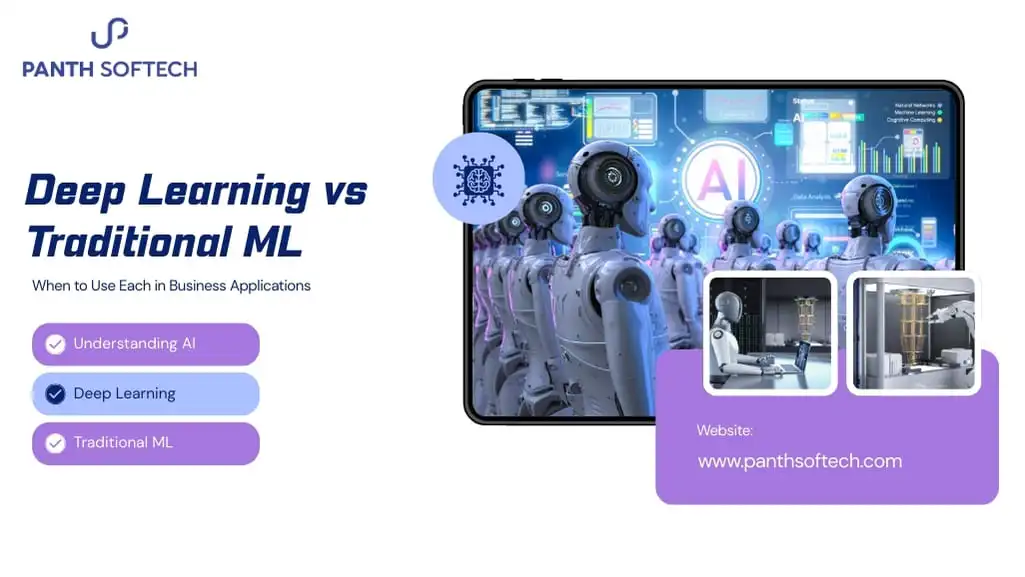
Artificial Intelligence (AI) is transforming the way businesses operate today. From customer support chatbots to sales forecasting tools, AI is helping companies make smarter, faster, and more data-driven decisions. Companies across industries are now using AI to automate processes, improve customer experience, reduce costs, and increase profits.
But when it comes to choosing the right AI approach, many businesses feel confused between Deep Learning and Traditional Machine Learning. Both are powerful, both are part of AI, and both can deliver strong results. However, they are not the same, and choosing the wrong one can lead to wasted time, money, and effort.
So, what is the real difference between Deep Learning vs Traditional Machine Learning?
And more importantly, which one should your business use?
At Panth Softech, we help businesses choose the most cost-effective and practical AI solutions based on their goals, data, and budget. Our focus is not just on using advanced technology, but on delivering real business value.
In this blog, we will explain everything in simple and human language so you can make the right decision for your business.
Understanding AI, Machine Learning, and Deep Learning
Before we compare them, let’s understand the basics. Many people use the terms AI, Machine Learning, and Deep Learning interchangeably, but they actually mean different things.
What is Artificial Intelligence (AI)?
Artificial Intelligence is a broad term for machines that can think, learn, and make decisions like humans. AI systems are designed to perform tasks that usually require human intelligence.
Examples of AI include:
- Chatbots that answer customer questions
- Recommendation systems on shopping websites
- Fraud detection in banking
- Image recognition in healthcare
- Voice assistants like Siri or Alexa
Artificial intelligence in business helps companies improve efficiency, accuracy, and customer experience. It reduces manual work, improves decision-making, and helps businesses stay competitive in the digital world.
What is Machine Learning (ML)?
Machine Learning is a part of AI where systems learn from data instead of being programmed manually. Instead of writing rules, we give data to the system, and it finds patterns on its own.
Examples of Machine Learning for Business Applications include:
- Sales prediction
- Customer segmentation
- Demand forecasting
- Email spam filtering
- Credit score analysis
ML uses machine learning algorithms like:
- Linear Regression
- Decision Trees
- Random Forest
- Support Vector Machines (SVM)
- K-Nearest Neighbors
These algorithms work well with structured data such as:
- Numbers
- Tables
- Excel sheets
- Databases
Traditional ML is easy to understand, cost-effective, and suitable for most business needs.
What is Deep Learning?
Deep Learning is a more advanced type of Machine Learning that uses neural networks with many layers, known as deep learning models. These models are inspired by the human brain.
Deep Learning is best for:
- Image recognition
- Speech recognition
- Natural language processing
- Video analysis
- Facial recognition
It can handle unstructured data like:
- Images
- Videos
- Audio
- Text
This makes Deep Learning for Business useful for industries like healthcare, retail, manufacturing, finance, and e-commerce.
Deep Learning vs Traditional Machine Learning: Key Differences
Let’s compare both approaches clearly so businesses can understand which one fits their needs.
| Feature | Traditional Machine Learning | Deep Learning |
| Data Type | Structured data | Structured + Unstructured data |
| Data Size | Small to medium | Large datasets |
| Human Effort | Requires feature engineering | Learns features automatically |
| Hardware | Normal computers | Needs GPUs/TPUs |
| Cost | Lower | Higher |
| Accuracy | Good | Very high for complex tasks |
| Use Cases | Predictions, classification | Images, voice, text |
Traditional Machine Learning is simpler, cheaper, and faster to implement.
Deep Learning is more powerful but needs more data, money, and time.
When to Use Traditional Machine Learning in Business
Traditional ML is still powerful, affordable, and practical for many business needs. It is often the best choice for small and medium-sized businesses.
1. When Your Data is Structured
If your data looks like this:
- Excel sheets
- CRM records
- Sales reports
- Financial data
- Customer databases
Then machine learning algorithms work perfectly.
Example:
A retail company wants to predict monthly sales using past sales data. Traditional ML can easily analyze this structured data and give accurate predictions.
2. When You Have Limited Data
Deep learning needs large amounts of data to perform well. If your dataset is small or medium-sized, traditional ML gives better and more stable results.
Many businesses do not have millions of data points. For them, ML is more practical and reliable.
3. When You Need Cost-Effective Solutions
Deep learning requires:
- Powerful hardware
- Expert data scientists
- Long training time
If your budget is limited, cost-effective machine learning solutions are the smarter choice.
Traditional ML gives excellent results without high investment.
4. When You Need Quick Results
Traditional ML models are faster to build, train, and deploy. Businesses can start seeing results in weeks instead of months.
This is ideal for:
- Startups
- Small businesses
- Marketing teams
- Sales teams
5. For Predictive Analytics
Predictive analytics using ML helps businesses forecast:
- Customer churn
- Product demand
- Market trends
- Revenue growth
- Inventory needs
These models are simple, reliable, and easy to maintain.
When to Use Deep Learning in Business
Deep Learning is powerful, but it should be used only when needed. It is best for complex problems that traditional ML cannot handle well.
1. When You Work with Images, Audio, or Video
Deep learning models are excellent for:
- Face recognition
- Product image analysis
- Security surveillance
- Voice assistants
- Video monitoring
Example:
A hospital using AI to detect diseases from X-ray images should use deep learning.
2. For Natural Language Processing (NLP)
If your business handles:
- Chatbots
- Email analysis
- Customer feedback
- Document processing
- Social media monitoring
Deep learning can understand human language better and provide more accurate results.
3. When Accuracy is Critical
In areas like:
- Medical diagnosis
- Fraud detection
- Autonomous systems
- Financial risk analysis
Deep learning gives more accurate results than traditional ML.
4. When You Have Large Datasets
Big companies with huge data volumes can fully benefit from deep learning. More data means better learning and better predictions.
AI vs Machine Learning: Business Perspective
Many people confuse AI vs Machine Learning.
- AI is the goal (making machines intelligent)
- Machine Learning is a method to achieve AI
- Deep Learning is a more advanced ML technique
In business, the focus is not on the technology name, but on results.
At Panth Softech, we recommend the solution that gives:
- Better ROI
- Faster implementation
- Real business value
Real Business Use Cases
1. Retail Industry
Traditional ML:
- Sales forecasting
- Inventory management
- Customer segmentation
- Price optimization
Deep Learning:
- Visual product search
- Demand prediction from images
- Smart recommendations
- Virtual try-on features
2. Finance & Banking
Traditional ML:
- Credit scoring
- Risk assessment
- Fraud detection
- Loan approval
Deep Learning:
- Voice authentication
- Document verification
- Pattern recognition in transactions
- Anti-money laundering systems
3. Healthcare
Traditional ML:
- Patient risk prediction
- Appointment scheduling
- Hospital resource planning
Deep Learning:
- Medical image analysis
- Disease detection
- AI-powered diagnosis
- Patient monitoring systems
4. Manufacturing
Traditional ML:
- Predictive maintenance
- Quality control
- Production forecasting
Deep Learning:
- Defect detection using cameras
- Smart automation
- Robotic vision systems
AI in Business Decision-Making
AI helps leaders make better decisions by:
- Reducing human errors
- Analyzing large data quickly
- Finding hidden patterns
- Predicting future outcomes
Both ML and Deep Learning support data-driven decision-making, but the choice depends on:
- Business goals
- Data type
- Budget
- Timeline
With the right AI strategy, businesses can:
- Improve efficiency
- Reduce risks
- Increase profits
- Gain competitive advantage
Cost Comparison: Deep Learning vs Traditional ML
| Factor | Traditional ML | Deep Learning |
| Setup Cost | Low | High |
| Hardware | Basic | Advanced GPUs |
| Training Time | Fast | Slow |
| Maintenance | Easy | Complex |
| ROI | High for small projects | High for large projects |
If you need cost-effective machine learning solutions, traditional ML is usually the better option.
Challenges of Deep Learning
While powerful, deep learning also has limitations:
- Needs large data
- High computing cost
- Longer development time
- Harder to explain results
- Requires expert teams
That’s why not every business needs deep learning.
How Panth Softech Helps Businesses Choose the Right Approach
At Panth Softech, we don’t believe in “one-size-fits-all” AI solutions.
We analyze:
- Your business goals
- Available data
- Budget
- Industry requirements
Then we recommend:
- Traditional Machine Learning
- Deep Learning
- Or a hybrid approach
Our focus is on:
- Practical implementation
- Business growth
- Scalable solutions
- Measurable results
Which One Should Your Business Choose?
Choose Traditional Machine Learning if:
- You have structured data
- Your budget is limited
- You need fast results
- You want predictive analytics
Choose Deep Learning if:
- You use images, videos, or voice
- You need very high accuracy
- You have large datasets
- You can invest in advanced infrastructure
Future of AI in Business
The future is not just about choosing ML or Deep Learning. It’s about using the right tool for the right problem.
Businesses that succeed will:
- Use AI strategically
- Focus on ROI
- Build scalable systems
- Embrace data-driven decision-making
AI will continue to evolve, but smart planning will always be more important than advanced technology alone.
Conclusion
The debate of Deep Learning vs Traditional Machine Learning is not about which is better.
It’s about which is better for your business.
- Traditional ML is affordable, fast, and perfect for most business applications.
- Deep Learning is powerful, accurate, and ideal for complex data problems.
At Panth Softech, we help you make smart AI choices that drive real business value. Whether you need Machine Learning for Business Applications, Deep Learning for Business, or a customized AI strategy, our team is here to support your growth.
Need AI Solutions for Your Business?
Let Panth Softech help you build intelligent, scalable, and cost-effective AI solutions.
Contact us today to start your AI journey!