Panth Softech Team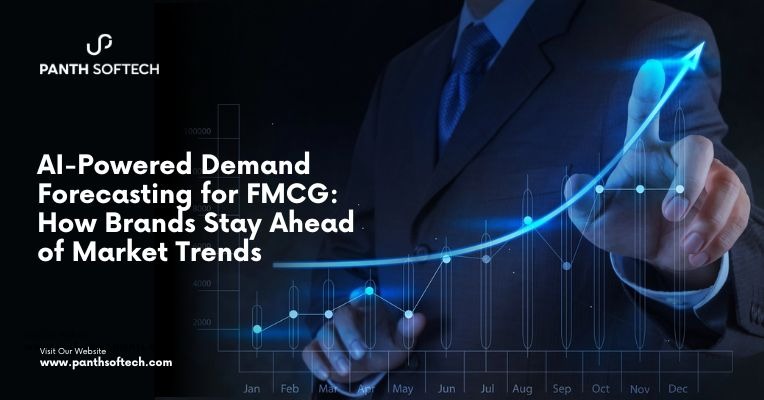
In the fast-moving world of FMCG, things change quickly. Customer demand can rise overnight. A product can go viral on social media. A festival, weather shift, or price change can suddenly increase or reduce sales. For FMCG brands, guessing demand is no longer enough.
This is where AI demand forecasting is making a big difference.
Today, many brands are using AI-powered demand forecasting for FMCG to predict sales more accurately, reduce waste, and stay ahead of market trends. With the right tools and data, companies can make smarter decisions and respond faster to customer needs.
At Panth Softech, we help FMCG businesses use AI to improve demand planning, manage inventory better, and increase profitability.
Let’s understand how AI is changing demand forecasting in FMCG and why it matters so much today.
What is Demand Forecasting in FMCG?
Demand Forecasting in FMCG means predicting how much of a product customers will buy in the future. This helps companies decide:
- How much to produce
- When to restock
- Where to distribute products
- How to manage promotions
In the past, companies used historical sales data and manual methods to forecast demand. They looked at last year’s numbers and made small adjustments. While this worked to some extent, it often failed during sudden market changes.
Traditional forecasting methods struggle with:
- Sudden demand spikes
- Seasonal changes
- New product launches
- Changing customer behavior
- Market competition
This is why many brands are now turning to AI in the FMCG industry for better and faster insights.
Why Traditional Forecasting Is Not Enough
FMCG markets are complex. There are thousands of products, multiple sales channels, and millions of customers.
Traditional forecasting often depends on:
- Spreadsheets
- Manual calculations
- Basic statistical models
These methods cannot handle:
- Large volumes of data
- Real-time updates
- Multiple influencing factors like weather, social trends, or competitor pricing
As a result, companies face:
- Stockouts
- Overstocking
- Wasted inventory
- Lost sales
- Higher operational costs
This is where machine learning demand forecasting brings real value.
What is AI-Powered Demand Forecasting for FMCG?
AI-powered demand forecasting for FMCG uses artificial intelligence and machine learning to analyze large amounts of data and predict future demand.
Instead of relying only on past sales data, AI systems analyze:
- Historical sales
- Market trends
- Customer buying behavior
- Seasonal patterns
- Promotions and discounts
- Weather data
- Economic indicators
- Social media signals
AI models learn from patterns and improve over time. The more data they process, the more accurate they become.
This is the core of predictive analytics for FMCG.
How AI Improves Demand Forecasting in FMCG
Let’s break down how AI improves demand forecasting in FMCG in simple terms.
1. Better Accuracy
AI models study thousands of data points at once. They can detect hidden patterns that humans might miss. This leads to:
- Improved forecast accuracy with machine learning
- Fewer forecasting errors
- Better production planning
Accurate forecasts mean fewer surprises.
2. Real-Time Insights
AI systems can process real-time data from:
- Retail stores
- E-commerce platforms
- Distributors
- Social media
This allows companies to react quickly. For example, if a product starts selling faster in a region, the system can alert managers immediately.
3. Smarter Inventory Planning
One of the biggest benefits of AI-powered demand forecasting is reducing inventory costs using AI forecasting.
AI helps companies:
- Avoid overstocking
- Reduce warehouse costs
- Minimize expired goods
- Prevent stockouts
This leads to better working capital management.
4. Faster Decision-Making
With AI-powered FMCG dashboards, managers can see:
- Sales trends
- Forecast accuracy
- Inventory levels
- Demand predictions
All in one place.
These dashboards make data-driven demand planning simple and clear.
Key Benefits of AI-Powered Demand Forecasting
Let’s look at the main benefits of AI-powered demand forecasting for FMCG companies.
1. Higher Sales
Accurate FMCG sales prediction ensures products are available when customers need them. No stockouts means no lost sales.
2. Reduced Waste
Perishable goods are common in FMCG. AI helps match supply with demand, reducing product expiry and waste.
3. Improved Supply Chain Efficiency
AI supports better coordination between:
- Manufacturers
- Distributors
- Retailers
This creates a smooth supply chain.
4. Better Promotion Planning
AI can analyze past promotion results and predict which offers will work best. This improves marketing ROI.
5. Competitive Advantage
Brands using AI solutions for FMCG demand planning can respond faster to trends than competitors.
Real-World Use Cases of AI Demand Forecasting for Consumer Goods
Many consumer goods brands are already using AI demand forecasting for consumer goods to stay ahead.
Here are some practical examples:
Seasonal Product Planning
AI predicts higher demand for cold drinks in summer or festive sweets during festivals. Production increases automatically based on forecast insights.
New Product Launch Forecasting
AI analyzes similar product launches and market data to predict how a new product may perform.
Regional Demand Optimization
Different cities have different buying patterns. AI identifies location-specific trends for better distribution planning.
Role of Machine Learning in Demand Forecasting
Machine learning demand forecasting works by:
- Collecting historical data
- Identifying patterns
- Building predictive models
- Continuously learning from new data
Over time, the system becomes smarter. It adapts to:
- Changing customer habits
- Economic shifts
- Unexpected events
This continuous improvement is what makes AI powerful.
AI-Powered FMCG Dashboards: Turning Data into Action
Data alone is not useful unless it is easy to understand.
AI-powered FMCG dashboards present data in simple charts and graphs. They show:
- Forecast vs actual sales
- Demand trends
- Inventory alerts
- Risk predictions
At Panth Softech, we design dashboards that are simple, clear, and easy to use. Managers do not need technical knowledge to understand the insights.
This helps companies move towards fully data-driven demand planning.
Reducing Inventory Costs Using AI Forecasting
Inventory costs can eat into profits. Warehousing, storage, insurance, and wastage add up quickly.
AI helps reduce costs by:
- Maintaining optimal stock levels
- Predicting slow-moving products
- Suggesting stock transfers between warehouses
- Avoiding emergency shipments
This leads to significant cost savings over time.
AI Solutions for FMCG Demand Planning
Modern AI forecasting tools for FMCG companies include:
- Automated demand forecasting engines
- Real-time data integration systems
- Smart dashboards
- Advanced analytics tools
- Scenario planning models
These tools allow brands to test different scenarios, like:
- What if prices increase?
- What if a competitor launches a new product?
- What if raw material costs rise?
AI simulations help businesses prepare in advance.
How Panth Softech Supports AI Demand Forecasting
At Panth Softech, we provide customized AI solutions for FMCG demand planning. Our approach focuses on:
- Understanding business goals
- Integrating existing data systems
- Building machine learning models
- Creating user-friendly dashboards
- Offering ongoing support
We help FMCG brands move from guesswork to intelligent forecasting.
Our solutions are built to:
- Improve forecast accuracy
- Increase operational efficiency
- Reduce costs
- Boost profitability
Challenges in AI Demand Forecasting
While AI offers many benefits, companies must also address certain challenges:
Data Quality Issues
Poor data leads to poor predictions. Clean and structured data is essential.
Integration Problems
Legacy systems may not connect easily with modern AI tools.
Change Management
Employees may need training to trust and use AI-based systems.
At Panth Softech, we guide companies through these challenges step by step.
Future of AI in FMCG Industry
The future of AI in the FMCG industry looks promising.
In the coming years, we will see:
- More automated supply chains
- Smarter retail forecasting
- Hyper-personalized demand prediction
- AI-driven promotion optimization
- Real-time market adaptation
AI will not replace human decision-makers. Instead, it will support them with better data and insights.
Why FMCG Brands Must Act Now
Markets are becoming more competitive. Customers expect products to be available instantly. E-commerce has made demand even more unpredictable.
Brands that still rely only on traditional forecasting risk:
- Losing customers
- Facing high inventory costs
- Falling behind competitors
By adopting AI-powered demand forecasting for FMCG, companies can stay prepared for market changes.
Final Thoughts
AI demand forecasting is not just a technology upgrade. It is a smarter way of running an FMCG business.
From improving forecast accuracy with machine learning to reducing inventory costs using AI forecasting, the benefits are clear. AI enables:
- Better planning
- Faster response
- Lower risk
- Higher profitability
At Panth Softech, we believe that data should guide every major decision. With the right AI forecasting tools for FMCG companies, brands can stay ahead of market trends and build a strong future.
If your FMCG business wants to improve demand forecasting, boost sales prediction accuracy, and create a data-driven demand planning system, now is the time to explore AI solutions.
The future of FMCG belongs to brands that can predict demand before it happens — and AI makes that possible.