Panth Softech Team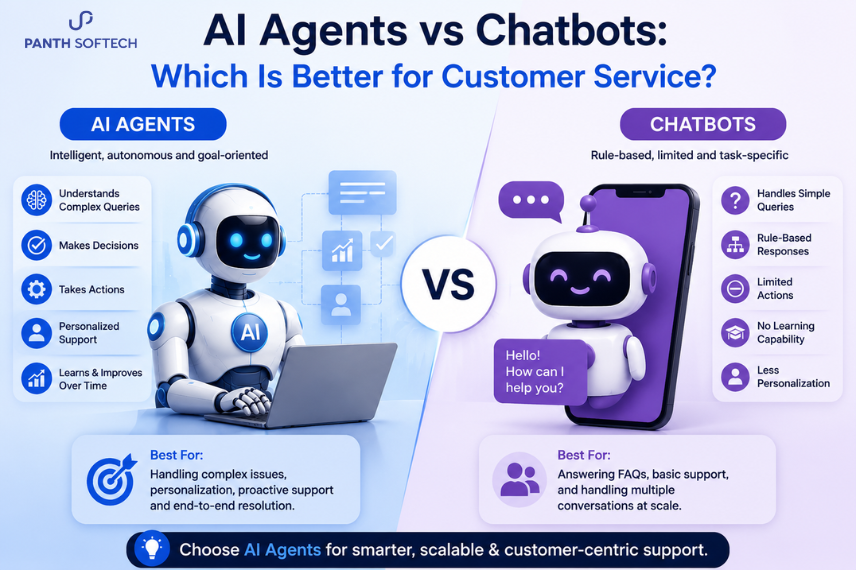
If you’ve been researching ways to improve customer support, you’ve probably come across two terms being used almost interchangeably: AI agents and chatbots. But here’s the thing: they’re not the same, and picking the wrong one for your business can mean the difference between customers feeling truly helped and customers hanging up in frustration.
The debate around AI Agents vs Chatbots has picked up a lot of steam lately, and for good reason. Customer expectations have changed. People don’t just want quick replies anymore — they want their problems actually solved, without repeating themselves five times or waiting for a human to “look into it.”
In this blog, we’ll break down what separates AI agents from traditional chatbots, look at where each one shines, and help you figure out which is the better fit for your customer service needs in 2026. We’ll also share how Panth Softech helps businesses build the right kind of AI-powered support system for their specific goals.
What Are Chatbots, Really?
Let’s start with the basics. A chatbot is a program designed to have conversations with users, usually following pre-set rules or scripted flows. Think of the classic “Hi, how can I help you today?” pop-up on a website that gives you a few button options to click.
Most traditional chatbots work like a decision tree. If a customer asks about order status, the bot follows a fixed path to answer that specific question. If the question falls outside its scripted flow, it either gives a generic response or passes the conversation to a human agent.
This makes an AI chatbot for customer support great for handling repetitive, predictable questions — things like:
- Checking order status
- Answering FAQs
- Resetting passwords
- Providing store hours or basic policy information
Chatbots are relatively simple to build, quick to deploy, and cost-effective for straightforward use cases. But their biggest limitation is flexibility. The moment a conversation goes off-script, most chatbots struggle.
What Are AI Agents?
Now let’s talk about intelligent AI agents, and why they’re a completely different breed of technology.
Unlike chatbots that follow rigid scripts, AI agents are built on advanced AI models that can understand context, reason through problems, and take actions on their own. Instead of just answering a question, an AI agent can actually complete a task, such as processing a refund, updating account details, or escalating a complex issue with the right context attached.
AI agents use generative AI for customer service to understand natural language the way a human would, not just matching keywords to scripted responses. They can hold a genuine conversation and adapt based on what the customer actually needs, not just what they typed.
Here’s a simple way to think about it: a chatbot answers questions, while an AI agent gets things done. Let’s break down exactly what that means in practice.
Difference Between AI Agents and Chatbots: The Real Breakdown
The difference between AI agents and chatbots comes down to a few core things: how they think, how they act, and how much they can actually handle without human help.
| Aspect | Chatbots | AI Agents |
| Understanding | Match input to pre-written responses or decision trees | Understand intent and context, even when phrased unusually |
| Approach | Follow a fixed, pre-designed conversation flow | Reason through problems step-by-step and adjust mid-conversation |
| Core function | Built to respond | Built to act and integrate with CRM, order, and ticketing systems to resolve issues |
| Conversation depth | Handle simple, single-turn questions well | Manage long, multi-step conversations and multi-part tasks |
| Improvement over time | Stay the same unless scripts are manually updated | Improve based on patterns and feedback, getting smarter with use |
| Best suited for | Repetitive, predictable queries | Complex, personalized, multi-step customer issues |
As the table shows, chatbots are great at answering, but AI agents are built to actually get things done. That’s the core of the difference between AI agents and chatbots in real-world use.
AI Agents for Customer Service: Where They Really Shine
So where do AI agents for customer service make the biggest difference? A few areas stand out:
Handling Complex, Multi-Step Requests Imagine a customer wants to change their subscription plan, apply a discount code, and update their billing address, all in one conversation. A chatbot would likely stumble through this. An AI agent can handle all three tasks in a single, connected conversation.
Reducing Human Agent Workload Because AI agents can genuinely resolve issues (not just answer basic questions), they take real work off your support team’s plate, not just the easy stuff, but a meaningful chunk of medium-complexity tickets too.
24/7 Consistent Support Both chatbots and AI agents can run around the clock, but AI agents provide a much more consistent quality of service since they’re not limited to scripted responses when things get slightly unusual.
Personalized Interactions AI agents can pull in customer history and account data to personalize responses in real time, creating a much better AI customer experience than a generic chatbot ever could.
Workflow Automation Beyond Chat This is where AI workflow automation comes in. AI agents aren’t limited to chat windows, they can trigger actions across your business systems, like updating a CRM record, generating a support ticket with full context, or notifying the right internal team automatically.
Are Chatbots Still Useful in 2026?
Absolutely. This is an important point. Chatbots aren’t obsolete; they’re just better suited for specific situations.
If your customer service needs are mostly simple and repetitive, such as checking delivery status or answering basic policy questions, a well-designed chatbot can still handle that efficiently and affordably. Not every business needs the complexity (or cost) of a full AI agent system for basic FAQ handling.
The smartest approach for many enterprises is actually a hybrid one: using chatbots for simple, high-volume queries, and routing more complex requests to AI agents or human agents when needed. This layered approach keeps costs manageable while still delivering strong AI-powered customer support where it matters most.
Benefits of AI Agents for Enterprises
If you’re considering a shift toward AI agents, here are some of the biggest benefits of AI agents worth knowing about:
- Higher resolution rates – AI agents can close out more tickets without human intervention, since they can actually complete tasks, not just describe next steps.
- Faster response times – Customers get instant, relevant answers instead of waiting in a queue for a human agent.
- Lower operational costs – Automating complex interactions reduces the need to scale up support teams as your customer base grows.
- Better customer satisfaction – Fewer repeated explanations, fewer transfers, and faster resolutions all add up to happier customers.
- Scalability – AI agents can handle sudden spikes in support volume (like during a sale or product launch) without a drop in service quality.
- Valuable data insights – AI agents can surface patterns in customer issues, helping you spot recurring problems before they escalate.
Future of AI in Customer Service
The future of AI in customer service is clearly moving toward more autonomous, capable systems. We’re already seeing AI agents take on tasks that used to require a human, from processing returns to handling billing disputes, and this trend is only going to grow.
Enterprises that adopt enterprise AI solutions early are positioning themselves to offer faster, more consistent support while reducing the operational burden on their teams. The businesses that get this right won’t just cut costs — they’ll build genuine trust with customers who feel like their problems are actually being solved, not just acknowledged.
That said, successful AI adoption isn’t just about picking the flashiest technology. It’s about matching the right tool to the right use case, integrating it properly with your existing systems, and making sure it actually improves the customer experience rather than frustrating people further.
How to Choose Between AI Agents and Chatbots for Your Business
Before deciding, ask yourself a few honest questions:
- How complex are your typical customer queries? Mostly simple and repetitive → chatbot may be enough. Frequently multi-step or account-specific AI agents are a better fit.
- Do you need actions taken, or just information given? If customers need things actually done (refunds, updates, changes), an AI agent will serve you far better than a bot that can only respond.
- What’s your current tech stack? AI agents work best when properly integrated with your CRM, helpdesk, and internal systems, so factor in integration effort.
- What’s your budget and timeline? Chatbots are quicker and cheaper to launch. AI agents require more setup but pay off significantly in complex support environments.
- How much do you value long-term scalability? If you’re planning to grow fast, investing in AI agents now can save you from major support bottlenecks later.
Real-World Use Cases: AI Agents in Action
Theory is one thing, but seeing how this plays out in real customer service scenarios makes the difference much clearer.
- E-commerce and Retail A customer wants to return a damaged product, get a replacement shipped, and apply a loyalty discount, all in one chat. An AI agent can verify the order, initiate the return, check discount eligibility, and confirm the replacement shipment, without looping in a human agent.
- Banking and Financial Services Instead of just telling a customer their card was declined, an AI agent can check the account status, identify the actual reason (expired card, insufficient funds, flagged transaction), and guide the customer through resolving it, or trigger the right internal workflow if human review is needed.
- Telecom and Subscription Services Plan upgrades, billing disputes, and service outages often involve multiple systems talking to each other. An AI agent can pull data from billing, network status, and account management systems simultaneously to give a single, accurate answer instead of a generic “please hold.”
- SaaS and Tech Support When a customer reports a bug or a login issue, an AI agent can check account logs, identify likely causes, and either resolve it directly or create a detailed, well-documented ticket for a human engineer — saving significant back-and-forth.
These examples show why the conversation has shifted from “should we use AI in support?” to “how far can we let AI actually handle on its own?”
Common Challenges When Implementing AI Agents
AI agents offer a lot of value, but rolling them out isn’t always plug-and-play. Here are a few challenges enterprises should plan for:
- Integration complexity – AI agents need proper access to your CRM, ticketing, and order systems to actually take action. Poor integration limits what they can do, no matter how smart the underlying model is.
- Data quality issues – An AI agent is only as good as the data it can access. Messy, outdated, or siloed customer data can lead to incorrect or incomplete responses.
- Trust and handoff design – Customers should always have a clear, easy path to a human agent when needed. A good AI agent knows when to escalate, rather than trying to force a resolution it can’t deliver.
- Governance and compliance – Especially in regulated industries like finance and healthcare, AI agents need clear guardrails around what actions they’re allowed to take without human approval.
- Change management internally – Support teams need to understand how AI agents fit into their workflow, not feel replaced by them. The best results come when AI handles routine and repetitive work, freeing up humans for judgment-heavy conversations.
Planning for these challenges upfront, rather than after a rushed rollout, is usually what separates a successful AI agent deployment from a frustrating one.
Choosing between AI agents and chatbots isn’t a one-size-fits-all decision, and honestly, most businesses benefit from a thoughtful mix of both.
At Panth Softech, we help businesses design and build AI customer service solutions that actually fit their operations, not just trendy tech for the sake of it. Our AI integration services cover everything from mapping out your customer service workflows to building and deploying AI agents that connect seamlessly with your existing systems.
Whether you’re looking to add a simple chatbot for common queries or build a full AI agent capable of resolving complex customer issues end-to-end, our team works closely with you to figure out what will genuinely improve your customer experience — not just what sounds impressive on paper.
We focus on practical, scalable customer service automation that reduces your team’s workload while keeping your customers happy, informed, and heard.
Final Thoughts
So, AI Agents vs Chatbots, which one is actually better for customer service? The honest answer is: it depends on what your customers need and how complex their problems typically are.
Chatbots remain a solid, affordable choice for simple, repetitive interactions. But if you need truly helpful, personal, and fast customer service at scale, AI agents offer the most value.
Ready to Modernize Your Data Infrastructure?
Turn your business data into a competitive advantage with a scalable cloud data engineering solution. Whether you’re planning a cloud migration, building automated data pipelines, or modernizing your analytics platform, Panth Softech can help.
Book a free consultation with our data engineering experts today and discover how the right cloud data platform can improve performance, reduce costs, and accelerate business growth.
FAQs About AI Agents vs Chatbots for Customer Service
1. What is the difference between AI agents and chatbots?
Chatbots are designed to answer predefined questions using scripted responses or simple AI. AI agents can understand context, make decisions, complete tasks, and learn from interactions, making them more suitable for complex customer service scenarios.
2. Are AI agents better than chatbots for customer service?
It depends on your business needs. Chatbots are ideal for handling FAQs and simple queries, while AI agents are better for resolving complex customer issues, providing personalized support, and automating multi-step workflows.
3. When should a business choose a chatbot instead of an AI agent?
A chatbot is a good choice if your business primarily needs to answer common questions, provide basic support, or operate with a limited budget. They are quick to deploy and easy to maintain.
4. Can AI agents and chatbots work together?
Yes. Many businesses use chatbots as the first point of contact to handle routine inquiries. When a request becomes more complex, the conversation is seamlessly transferred to an AI agent or a human support representative.
5. How do AI agents improve customer experience?
AI agents provide personalized responses, understand customer intent, remember previous interactions, automate repetitive tasks, and resolve issues faster, resulting in a better overall customer experience.
6. Are AI agents more expensive than chatbots?
AI agents generally require a higher initial investment because they offer advanced capabilities such as reasoning, automation, and integrations. However, they often deliver a better return on investment by improving efficiency and reducing manual support costs.
7. Can AI agents integrate with CRM and business applications?
Yes. Modern AI agents can integrate with CRM platforms, ERP systems, helpdesk software, payment gateways, and other business applications to provide real-time assistance and automate workflows.
8. How can Panth Softech help businesses implement AI-powered customer service?
Panth Softech develops custom AI agents and intelligent chatbot solutions tailored to your business needs. Whether you need automated customer support, workflow automation, or AI-powered virtual assistants, our team can help you build a scalable and secure solution that enhances customer satisfaction and operational efficiency.