Panth Softech Team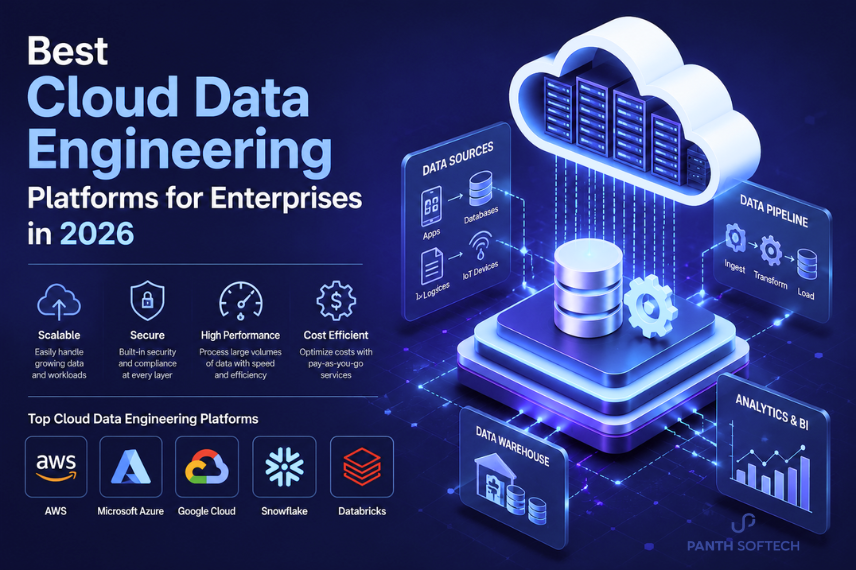
Every enterprise today runs on data. But having data is not enough, you need the right systems to collect it, clean it, move it, and make sense of it, all in real time. That’s exactly where a strong cloud data engineering platform comes in.
If you’ve been searching for the best cloud data engineering platforms for your business, you’ve probably noticed the market is crowded. Snowflake, Databricks, Google BigQuery, AWS Glue, Azure Data Factory, the list keeps growing, and each one claims to be “the best.” So how do you actually choose the right one for your enterprise in 2026?
In this blog, we’ll break down what a cloud data engineering platform really is, why it matters for enterprises, and which platforms are leading the pack this year. We’ll also look at how Panth Softech helps businesses build reliable, scalable data systems without the usual headaches.
What Is Cloud Data Engineering?
If you’ve ever wondered about cloud data engineering, the answer is simple.
Cloud data engineering is the process of designing, building, and managing data pipelines in cloud environments. Instead of relying on traditional on-premises infrastructure, businesses use cloud services to collect, clean, transform, and organize data for analytics, reporting, artificial intelligence (AI), and machine learning. If you’re evaluating cloud providers, read our guide to understand how leading cloud platforms support enterprise applications.
A modern cloud data engineering platform allows organizations to:
- Collect data from multiple sources
- Clean and transform raw data
- Automate workflows
- Store structured and unstructured data
- Enable real-time analytics
- Support AI and machine learning initiatives
Cloud-based platforms also reduce infrastructure management while offering flexibility and high availability.
Why Enterprises Need a Cloud Data Engineering Platform
Before we jump into the platforms, let’s talk about why this matters so much right now.
Enterprises today deal with data coming from dozens of sources: sales tools, marketing platforms, IoT devices, mobile apps, and legacy databases. Without a proper enterprise data engineering platform, this data sits in silos, gets duplicated, or simply goes unused.
A good platform helps you:
- Bring all your data together in one place
- Automate repetitive data tasks instead of doing them manually
- Process data faster, sometimes in real time
- Keep data secure and compliant with regulations
- Scale up as your data grows, without breaking anything
This is why more companies are investing in cloud data engineering services rather than trying to build everything in-house from scratch.
Best Cloud Data Engineering Platforms for Enterprises in 2026
Now let’s get to the part you’re really here for. Based on scalability, ease of use, integration options, and enterprise readiness, here are some of the best cloud data engineering platforms enterprises are relying on in 2026.
1. Snowflake
Snowflake continues to be a favorite for enterprises that need a flexible data warehouse with strong compute-storage separation. It handles massive datasets well and integrates smoothly with most BI and analytics tools. Its ability to support both structured and semi-structured data makes it a solid choice for teams managing diverse data sources.
- Key features: Compute-storage separation for independent scaling, native Apache Iceberg support, Snowpark for Python-based data engineering, secure data sharing across teams and partners, near-zero maintenance since it’s fully managed.
- Best for: Enterprises with SQL-first teams that need fast, governed analytics and heavy BI integrations (Tableau, Power BI, Looker).
- Pricing model: Usage-based, billed in credits for compute plus separate storage costs, costs scale with query volume and how efficiently workloads are tuned.
2. Databricks
Built on the lakehouse concept, Databricks blends the best of data lakes and data warehouses. It’s particularly strong for enterprises running AI and machine learning workloads alongside traditional analytics. If your team works heavily with big data and needs a unified platform for engineering and data science, Databricks is worth serious consideration.
- Key features: Unified lakehouse architecture on the open Delta Lake format, MLflow for managing the full machine learning lifecycle, Unity Catalog for centralized governance, native support for both real-time streaming and batch processing.
- Best for: Teams running AI/ML pipelines alongside analytics, and organizations that want data engineers, data scientists, and analysts working off the same platform.
- Pricing model: Usage-based, billed per Databricks Unit (DBU) depending on compute type and cloud provider, plus underlying cloud infrastructure costs.
3. Google BigQuery
BigQuery remains a top pick for companies already using the Google Cloud ecosystem. It’s serverless, so there’s less infrastructure to manage, and it handles large-scale queries impressively fast. It also pairs well with Google’s AI and analytics tools.
- Key features: Fully serverless (no clusters to manage), automatic scaling for large or unpredictable workloads, built-in ML capabilities through BigQuery ML, strong support for geospatial and semi-structured data.
- Best for: Enterprises already on Google Cloud, or teams that want minimal infrastructure management with fast, ad-hoc analytical queries.
- Pricing model: Pay-as-you-go based on data processed per query, with flat-rate/capacity-based pricing available for predictable, high-volume workloads.
4. AWS Glue and Amazon Redshift
For businesses already on AWS, Glue (for ETL) paired with Redshift (for warehousing) creates a strong combination. AWS’s wide range of services also makes it easier to build custom pipelines tailored to specific enterprise needs.
- Key features: Glue offers serverless ETL with auto-generated data catalogs; Redshift provides high-performance columnar storage with tight AWS-native integrations (S3, Lambda, SageMaker).
- Best for: Enterprises deeply invested in the AWS ecosystem that want tighter control over infrastructure and custom pipeline logic.
- Pricing model: Glue is billed per DPU-hour for ETL jobs; Redshift is billed by node-hours (provisioned) or by compute usage (serverless option).
- Worth knowing: Redshift can need more manual tuning (sort keys, distribution styles) than newer cloud-native warehouses, so factor in some ongoing optimization effort.
5. Microsoft Azure Data Factory
Azure Data Factory is a natural pick for enterprises running on Microsoft’s ecosystem. It offers strong cloud data integration platform capabilities and works well alongside Power BI, Synapse Analytics, and other Microsoft tools.
- Key features: 90+ built-in connectors, visual drag-and-drop pipeline design with low-code options, native integration with Synapse Analytics for unified analytics, and support for hybrid (cloud + on-prem) data movement.
- Best for: Microsoft-centric enterprises already using Power BI, SQL Server, or Dynamics 365, who want tight integration without a lot of custom glue code.
- Pricing model: Pay-as-you-go based on pipeline orchestration runs, data movement volume, and compute used for data flows.
6. Fivetran
Fivetran focuses purely on making data ingestion painless. If your biggest challenge is pulling data reliably from dozens of sources without writing custom connectors, Fivetran’s pre-built integrations save a lot of engineering time.
- Key features: 700+ pre-built connectors for SaaS apps, databases, and event streams, automatic schema drift handling, built-in support for change data capture (CDC).
- Best for: Teams that want to eliminate custom ingestion scripts entirely and get data flowing into their warehouse within hours, not weeks.
- Pricing model: Usage-based, typically tied to monthly active rows (MAR) synced across connectors.
7. Apache Airflow (Managed Orchestration)
For enterprises that want more control over pipeline orchestration, managed Airflow services (like those offered on AWS, Google Cloud, or Astronomer) remain a popular choice for enterprise data pipeline solutions, especially for complex, custom workflows. Dagster has also picked up serious momentum in 2026 with its asset-based approach to orchestration, and it’s now a genuine alternative for teams that don’t already have a heavy Airflow investment.
- Key features: Airflow offers mature DAG-based scheduling with a huge plugin ecosystem; Dagster brings asset-based orchestration with built-in data quality checks and better observability out of the box.
- Best for: Enterprises with complex, multi-step pipelines that need fine-grained control over dependencies, retries, and scheduling logic.
- Pricing model: Open-source cores are free; managed/hosted versions (Astronomer, Cloud Composer, Dagster Cloud) charge based on compute usage and features like alerting or role-based access.
8. Domo
Domo has grown into a strong end-to-end option, combining data ingestion, transformation, governance, and analytics in one interface. It’s particularly appealing to enterprises that want business teams and data engineers collaborating on the same platform, without constant hand-offs between IT and the rest of the company.
- Key features: Hundreds of pre-built connectors, drag-and-drop pipeline building, built-in governed dashboards and visualizations, low-code app development on top of your data.
- Best for: Enterprises that want business users and technical teams working off one shared platform, reducing dependency on IT for everyday reporting needs.
- Pricing model: Subscription-based, typically tiered by user count and data/connector volume.
Comparison Table: Best Cloud Data Engineering Platforms for Enterprises in 2026
Selecting the right cloud data engineering platform requires evaluating more than just features. Enterprises should consider scalability, deployment flexibility, AI and machine learning capabilities, pricing models, integration options, and overall business fit. The comparison table below provides a side-by-side overview of the leading cloud data engineering platforms to help you identify the solution that best supports your organization’s data strategy and digital transformation goals.
| Platform | Best For | Key Features | Advantages | Considerations | Deployment |
|---|---|---|---|---|---|
| Databricks | AI, machine learning, big data analytics, and enterprise data engineering | Apache Spark, Delta Lake, Lakehouse architecture, collaborative notebooks, MLflow integration | Excellent for large-scale data processing, real-time analytics, and AI-driven workloads | Requires Spark expertise for advanced implementations and may have higher compute costs for large workloads | AWS, Microsoft Azure, Google Cloud |
| Snowflake | Cloud data warehousing and business intelligence | Multi-cluster architecture, automatic scaling, secure data sharing, SQL-based analytics | Easy to use, highly scalable, minimal infrastructure management, excellent analytical performance | Primarily optimized for analytics rather than complex data engineering pipelines | AWS, Microsoft Azure, Google Cloud |
| Google BigQuery | Serverless analytics and large-scale reporting | Fully managed data warehouse, BigQuery ML, built-in AI capabilities, real-time analytics | No infrastructure management, high-speed SQL queries, seamless integration with Google Cloud services | Query-based pricing can become expensive with poorly optimized workloads | Google Cloud Platform |
| Microsoft Azure Synapse Analytics | Microsoft-centric enterprises | Unified analytics, SQL pools, Apache Spark, Power BI integration, Azure Data Factory connectivity | Strong integration with Microsoft ecosystem and enterprise security features | Initial setup and optimization can be complex for new users | Microsoft Azure |
| Amazon Redshift | Enterprise data warehousing within AWS | Massively Parallel Processing (MPP), Redshift Spectrum, workload management, AWS service integration | High-performance analytics with deep integration across AWS services | Better suited for warehousing than advanced data engineering workflows | Amazon Web Services |
| AWS Glue | Serverless ETL and data integration | Managed ETL, Data Catalog, schema discovery, workflow automation | Eliminates infrastructure management and integrates seamlessly with S3, Redshift, and Athena | Less flexible for highly customized data transformation requirements | Amazon Web Services |
| Apache Spark | Custom distributed data processing and streaming | Batch processing, stream processing, machine learning libraries, GraphX, Spark SQL | Open-source, highly scalable, supports both batch and real-time workloads | Requires cluster management and experienced engineers for deployment | Self-managed or Cloud Platforms |
| Cloudera Data Platform (CDP) | Hybrid and multi-cloud enterprises | Data governance, security, machine learning, data warehousing, hybrid cloud support | Ideal for regulated industries requiring strong governance and hybrid deployments | Higher licensing costs and greater operational complexity compared to managed cloud services | Hybrid Cloud, Multi-cloud, On-premises |
Which Platform Should Your Business Choose?
Every enterprise has unique requirements. The table below can help you quickly identify the platform that best matches your business objectives.
| Business Requirement | Recommended Platform |
|---|---|
| Artificial Intelligence & Machine Learning | Databricks |
| Enterprise Cloud Data Warehouse | Snowflake |
| Serverless Analytics | Google BigQuery |
| Microsoft Technology Stack | Azure Data Factory |
| AWS Cloud Infrastructure | AWS Glue + Amazon Redshift |
| Automated Data Ingestion | Fivetran |
| Workflow Orchestration | Apache Airflow |
| Business Dashboards & Self-Service Analytics | Domo |
Key Features to Look for in a Modern Data Engineering Platform
Not all platforms are built the same. Here’s what a truly modern data engineering platform should offer:
1. Strong Data Ingestion and Transformation Capabilities The platform should make data ingestion and transformation simple, whether you’re pulling data from a database, an API, or a flat file. It should handle messy, unstructured data just as well as clean, structured data.
2. Support for ETL and ELT Workflows Depending on your use case, you’ll need solid cloud ETL and ELT tools to extract data, transform it, and load it into your warehouse or lake, without writing endless custom scripts.
3. Real-Time Processing Batch processing was fine a few years ago. Now, businesses need real-time data processing for things like fraud detection, live dashboards, and instant customer insights.
4. Easy Integration A good cloud data integration platform should connect easily with your existing tools, CRMs, ERPs, marketing platforms, and third-party APIs, without a ton of custom coding.
5. Automation Data pipeline automation reduces manual work, cuts down errors, and lets your data team focus on analysis instead of babysitting pipelines.
6. Scalable Architecture Your cloud data engineering architecture should be flexible enough to scale as your data volume grows, without needing a complete rebuild every year.
How to Choose the Right Platform for Your Enterprise
Here’s a quick checklist before you commit to any platform:
- Check your data volume and variety – Are you dealing with structured data only, or a mix of formats?
- Look at your existing cloud provider – Sticking with AWS, Google Cloud, or Azure often reduces integration headaches.
- Think about your team’s skill set – Some platforms need heavy coding; others are more low-code friendly.
- Consider cost over time, not just setup price – Storage, compute, and data transfer costs can add up quickly.
- Prioritize security and compliance – Especially important for industries like finance, healthcare, and retail.
- Test scalability – Make sure the platform can handle 3x or 5x your current data volume without major rework.
A Quick Note on 2026 Trends
A couple of shifts are shaping platform decisions this year that are worth knowing about:
- Open table formats are now mainstream. Apache Iceberg is supported across Snowflake, Databricks, and BigQuery, so enterprises have more freedom to avoid getting locked into one engine’s storage format.
- Multi-cloud is the norm, not the exception. Most organizations now run across two or more cloud providers to stay flexible and reduce risk, which is pushing demand for platform-agnostic tools like Airflow, dbt, and open formats.
- Observability and FinOps are being built in from day one. Enterprises are pairing their pipelines with cost dashboards and data quality checks rather than bolting them on later.
There’s no single “best” platform for everyone. The right choice depends on your existing tech stack, data volume, team skills, and budget. This is exactly where working with an experienced partner like Panth Softech makes a difference; we help you evaluate your specific needs and recommend (or build) the right architecture instead of pushing a one-size-fits-all solution.
Why Partner with Panth Softech for Cloud Data Engineering
Choosing a platform is only half the battle. The real value comes from how well it’s implemented, integrated, and maintained.
At Panth Softech, we help enterprises design and build data systems that actually work for their business, not just in theory, but in day-to-day operations. Our cloud data engineering services cover everything from initial architecture planning to pipeline automation, data integration, and ongoing support.
Whether you’re just starting to move away from spreadsheets and manual reports, or you’re scaling an existing data infrastructure to handle real-time processing, our team works closely with you to build a solution that fits your goals, budget, and timeline.
We don’t believe in forcing a fixed platform on every client. Instead, we assess your data sources, business goals, and existing tools to recommend (or build) an architecture that genuinely makes your life easier.
Final Thoughts
2026 has made one thing clear: enterprises that treat data engineering as an afterthought fall behind fast. The best cloud data engineering platforms aren’t just about storing data, they’re about making that data usable, accessible, and reliable across your entire organization.
Whether you go with Snowflake, Databricks, BigQuery, or a custom-built solution, what matters most is choosing a platform (and a partner) that understands your specific business needs.
Build a Data Platform That Grows with Your Business
The right data platform isn’t just about managing data. It’s about creating a foundation for faster decisions, AI adoption, and long-term innovation.
Talk to the cloud data engineering experts at Panth Softech and get a tailored roadmap for building a scalable, secure, and future-ready data ecosystem that aligns with your business objectives.
FAQs About Best Cloud Data Engineering Platforms for Enterprises in 2026
1. What is a cloud data engineering platform?
A cloud data engineering platform is a cloud-based environment that enables businesses to collect, process, transform, and manage large volumes of data from multiple sources. It helps organizations create reliable data pipelines, improve data quality, and support analytics, reporting, and AI initiatives while reducing infrastructure management.
2. Which cloud data engineering platform is best for enterprises in 2026?
The best cloud data engineering platform depends on your organization’s business goals, existing technology stack, scalability needs, and budget. Popular enterprise platforms in 2026 include AWS Glue, Azure Data Factory, Google Cloud Dataflow, Databricks, and Snowflake, each offering unique capabilities for data integration, processing, and analytics.
3. Why should enterprises invest in cloud data engineering platforms?
Cloud data engineering platforms help enterprises streamline data management, automate data workflows, improve operational efficiency, and enable faster decision-making. They also provide scalability, stronger security, and seamless integration with modern analytics and AI applications.
4. What features should I look for in a cloud data engineering platform?
A reliable cloud data engineering platform should offer scalable data pipelines, real-time and batch data processing, seamless integration with multiple data sources, automated workflow management, robust security, data governance, monitoring capabilities, and compatibility with analytics and machine learning tools.
5. Can cloud data engineering platforms support AI and machine learning projects?
Yes. Cloud data engineering platforms prepare, organize, and deliver high-quality data that AI and machine learning models require. They automate data ingestion, transformation, and storage, making it easier for organizations to build accurate and efficient AI applications.
6. Which industries benefit the most from cloud data engineering platforms?
Cloud data engineering platforms are valuable across industries such as healthcare, banking, retail, manufacturing, logistics, telecommunications, and eCommerce. Any organization that relies on large volumes of data can benefit from improved data management, analytics, and business intelligence.
7. Are cloud data engineering platforms secure for enterprise data?
Most leading cloud data engineering platforms provide enterprise-grade security features, including encryption, identity and access management, compliance certifications, automated backups, and continuous monitoring. When implemented correctly, they help organizations protect sensitive business data while meeting regulatory requirements.
8. How can Panth Softech help with cloud data engineering?
Panth Softech helps enterprises design and implement scalable cloud data engineering platforms that align with their business objectives. From building efficient data pipelines and integrating cloud services to enabling advanced analytics and AI-ready architectures, Panth Softech delivers customized solutions that help organizations maximize the value of their data.