Panth Softech Team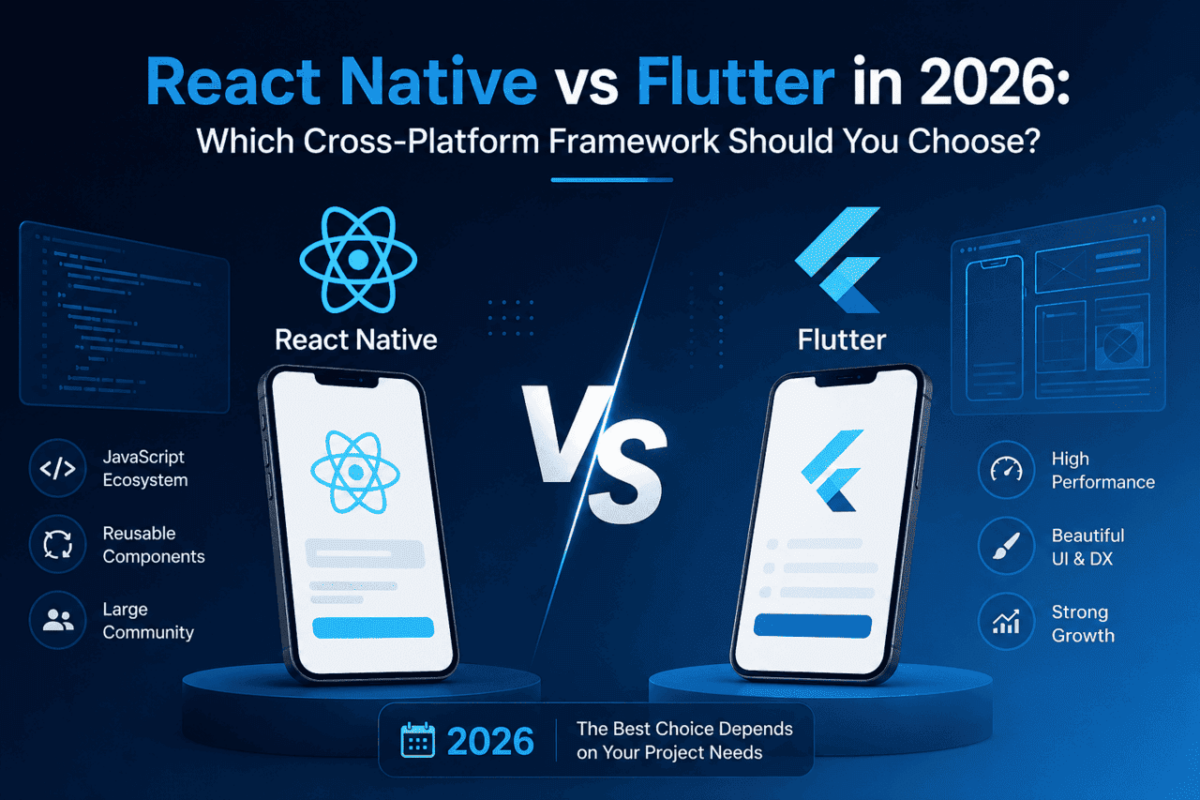
If you’re planning to build a mobile app in 2026, one of the biggest decisions you’ll face is choosing the right technology. The debate around React Native vs Flutter 2026 is still going strong—and for good reason. Both frameworks dominate the cross-platform app development space, helping businesses build apps for iOS and Android using a single codebase.
At Panth Softech, we’ve worked with multiple clients across industries, and one thing is clear: there is no one-size-fits-all answer. The right choice depends on your business goals, budget, performance needs, and team expertise.
In this detailed guide, we’ll break down everything you need to know about flutter vs react native comparison, including performance, cost, scalability, and future scope—so you can make a smart, strategic decision.
What is React Native?
React Native is a free, open-source framework created by Meta (previously known as Facebook). It enables developers to create mobile applications using JavaScript and React.
Instead of building separate apps for iOS and Android, React Native lets you reuse most of your code, saving time and cost. It uses native components, which means apps look and feel like traditional native apps.
What is Flutter?
Flutter is a free, open-source UI toolkit created by Google. It uses the Dart programming language and allows developers to create visually rich, high-performance apps for mobile, web, and desktop—all from a single codebase.
Flutter renders its own UI using a powerful graphics engine, which gives it more control over design and performance.
React Native vs Flutter 2026: Quick Comparison
Here’s a quick snapshot of the difference between Flutter and React Native:
| Feature | React Native | Flutter |
| Language | JavaScript | Dart |
| Performance | Good | Excellent |
| UI Rendering | Native components | Custom rendering engine |
| Learning Curve | Easier (JS-based) | Moderate (Dart learning required) |
| Development Speed | Fast | Very fast |
| Community | Large | Rapidly growing |
| Best Use Case | Apps needing a native feel | High-performance UI apps |
Flutter vs React Native Comparison: Detailed Breakdown
1. Performance
When it comes to react native vs flutter performance, Flutter has a slight edge.
Flutter compiles directly into native ARM code, which results in faster execution and smoother animations. React Native, on the other hand, relies on a bridge between JavaScript and native modules, which can sometimes cause delays.
👉 Verdict:
For high-performance apps (like gaming, animations, or heavy UI), Flutter is better.
2. Development Speed
Both frameworks are built for speed—but in different ways.
React Native allows developers to reuse existing JavaScript code, making it faster for teams already familiar with React. Flutter, however, offers “Hot Reload,” which makes UI changes instantly visible during development.
👉 Flutter vs React Native speed comparison:
Flutter is slightly faster in UI development, while React Native is faster if your team already knows JavaScript.
3. UI and Design Flexibility
Flutter shines in UI design.
Since Flutter uses its own rendering engine, it provides pixel-perfect control over UI elements. This makes it ideal for apps with custom designs and animations.
React Native depends on native components, which means design flexibility is slightly limited.
👉 Verdict:
If design is your priority → Flutter wins.
4. Programming Language: JavaScript vs Dart Performance
One major factor in JavaScript vs Dart performance is how each language interacts with the system.
- JavaScript (React Native) runs through a bridge → slight latency
- Dart (Flutter) compiles directly → faster execution
👉 Verdict:
Dart performs better for complex applications, but JavaScript is easier to adopt.
5. Community and Ecosystem
React Native has been around longer, so it has a larger community and more third-party libraries.
Flutter, however, is growing rapidly and has strong backing from Google.
👉 Verdict:
- React Native = Mature ecosystem
- Flutter = Fast-growing ecosystem
6. App Development Cost: Flutter vs React Native
If you’re comparing app development cost flutter vs react native, both are cost-effective compared to native development.
However:
- React Native may cost less initially (due to JS developers’ availability)
- Flutter may reduce long-term costs (due to better performance and fewer bugs)
👉 Verdict:
- Short-term → React Native
- Long-term → Flutter
React Native vs Flutter Pros and Cons
React Native Pros
- Easy to learn (JavaScript-based)
- Large developer community
- Strong third-party support
- Faster onboarding for web developers
React Native Cons
- Performance limitations
- UI inconsistencies across platforms
- Dependency on native modules
Flutter Pros
- High performance
- Beautiful, customizable UI
- Single codebase for multiple platforms
- Strong support from Google
Flutter Cons
- Smaller talent pool
- Dart is less popular than JavaScript
- Larger app size
Best Framework for Mobile App Development 2026
Choosing the best framework for mobile app development 2026 depends on your use case:
Choose React Native if: You have a JavaScript team
- You need faster development for MVP
- Your app doesn’t require heavy animations
Choose Flutter if: You want high performance
- You need custom UI/UX
- You’re building a scalable long-term product
Flutter vs React Native for Startups
Startups often ask: flutter vs react native which is better?
Here’s a practical breakdown:
- React Native for startups:
-
- Best for quick MVP launches and cost-saving.
- Flutter for startups:
-
- Better for building a strong, scalable product from day one.
👉 At Panth Softech, we usually recommend:
- MVP → React Native
- Scalable product → Flutter
Best Cross Platform Framework for iOS and Android
Both frameworks qualify as the best cross-platform framework for iOS and Android, but your choice depends on priorities:
- Speed + Familiarity → React Native
- Performance + Design → Flutter
Mobile App Frameworks Comparison: Real-World Use Cases
React Native Apps
- Airbnb (initially)
Flutter Apps
- Google Ads
- Alibaba
- BMW
This shows both frameworks are production-ready and trusted by global brands.
Flutter vs React Native Future Scope 2026
Looking at trends, the flutter vs react native future scope in 2026 is interesting:
- Flutter is gaining traction due to performance and multi-platform capabilities (mobile, web, desktop)
- React Native remains strong due to JavaScript dominance
👉 Prediction:
- Flutter will grow faster
- React Native will remain stable
Which One Should You Choose?
Let’s simplify the decision:
| Your Need | Choose |
| Fast MVP | React Native |
| High-performance app | Flutter |
| Custom UI | Flutter |
| JavaScript team | React Native |
| Long-term scalability | Flutter |
Why Choose Panth Softech for Cross-Platform App Development?
At Panth Softech, we help businesses choose the right technology based on real business goals—not just trends.
Whether you’re confused between react native vs flutter 2026 or planning to build a scalable mobile app, our team focuses on performance, user experience, and long-term growth. We carefully analyze your requirements, target audience, and budget to recommend the most suitable framework.
From MVP development to enterprise-level applications, we ensure faster delivery, cost efficiency, and future-ready solutions using the best cross-platform framework for iOS and Android.
Conclusion
The debate around react native vs flutter 2026 ultimately comes down to your needs.
- React Native = Fast development + JavaScript ecosystem
- Flutter = High performance + Custom UI flexibility
Both are powerful, reliable, and widely used frameworks. Understanding the difference between flutter and react native will help you make a smarter decision for your business.
If you’re planning your next app, choosing the right framework today will define your success tomorrow. Looking to build your app with the right framework? Connect with Panth Softech for a tailored consultation.
FAQs About Flutter vs React Native
1. Which cross-platform framework delivers a lower total cost of ownership (TCO)?
The total cost depends on your app’s complexity, future updates, and maintenance needs. Flutter often reduces UI development effort with its rich widget library, while React Native may lower onboarding costs for JavaScript teams. Evaluating long-term maintenance and scalability is more important than comparing initial development costs alone.
2. How does the choice of framework affect future app maintenance and updates?
Both Flutter and React Native support long-term maintenance, but each follows a different development ecosystem. Businesses should consider framework updates, plugin compatibility, community support, and developer availability to ensure the application remains secure, stable, and easy to enhance over time.
3. Which framework is better for building apps that require high performance and complex animations?
Flutter is often preferred for applications with custom interfaces, rich animations, and consistent performance across platforms because it renders its own UI. React Native performs well for many business applications but may rely more on native components for advanced graphical experiences.
4. Can Flutter or React Native support enterprise-grade mobile applications?
Yes. Both frameworks are widely used for enterprise applications with features such as secure authentication, API integrations, cloud connectivity, payment gateways, and real-time notifications. The right choice depends on your technical requirements, performance goals, and long-term product roadmap.
5. How does Panth Softech help businesses select the right cross-platform framework?
Panth Softech analyzes your business objectives, user expectations, existing technology stack, budget, and scalability requirements before recommending Flutter or React Native. This consultative approach ensures the selected framework aligns with your product strategy and supports future business growth.
6. What should businesses evaluate before hiring a Flutter or React Native development company?
Look for expertise in cross-platform development, UI/UX design, API integration, performance optimization, security, testing, and post-launch support. Reviewing previous projects, development methodology, and communication processes helps ensure a successful partnership and high-quality application delivery.
7. Why do businesses choose Panth Softech for Flutter and React Native app development?
Businesses choose Panth Softech for its expertise in building scalable, secure, and user-friendly cross-platform applications. The team follows agile development, maintains transparent communication, and provides ongoing support, enabling organizations to launch high-performance mobile apps that adapt to evolving business needs.