Panth Softech Team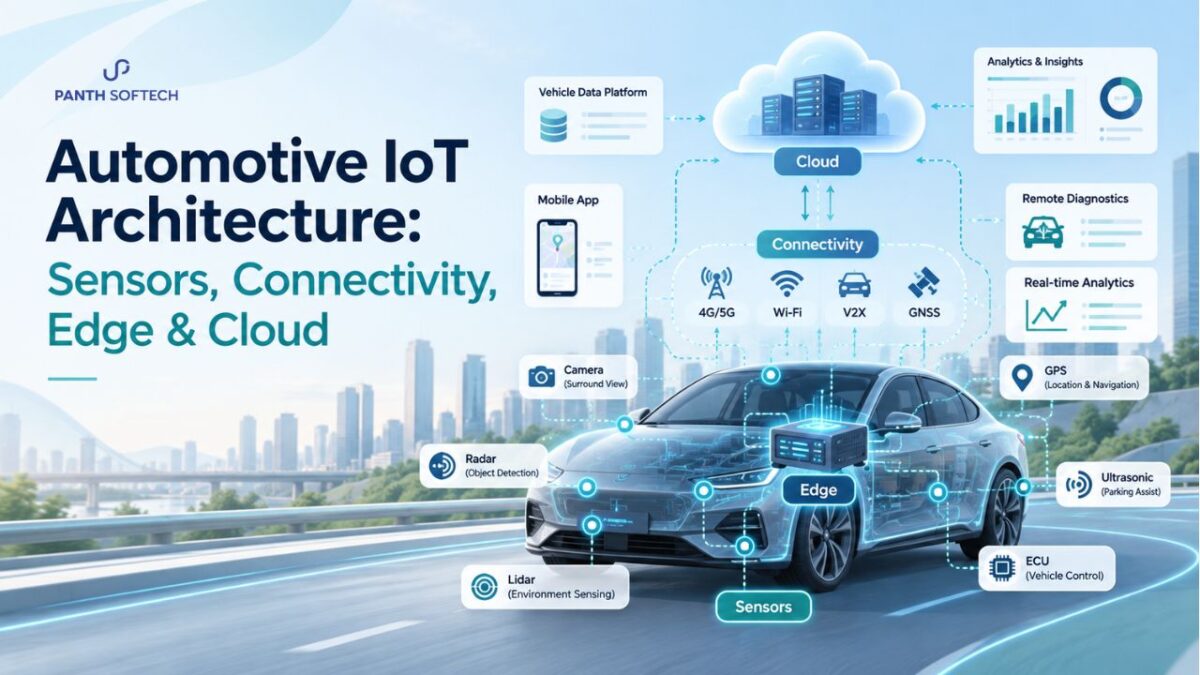
Modern vehicles generate more data in a single drive than early cars generated over their entire lifespan. Behind every connected car, fleet-tracking dashboard, or predictive maintenance alert sits a layered system called automotive IoT architecture — the structured pipeline that moves data from a vehicle’s sensors all the way to cloud platforms and back again as real-time decisions.
For OEMs, fleet operators, and mobility startups, understanding this architecture isn’t optional anymore. It’s the foundation for safety systems, connected services, predictive maintenance, and the software-defined vehicles now shaping the automotive industry.
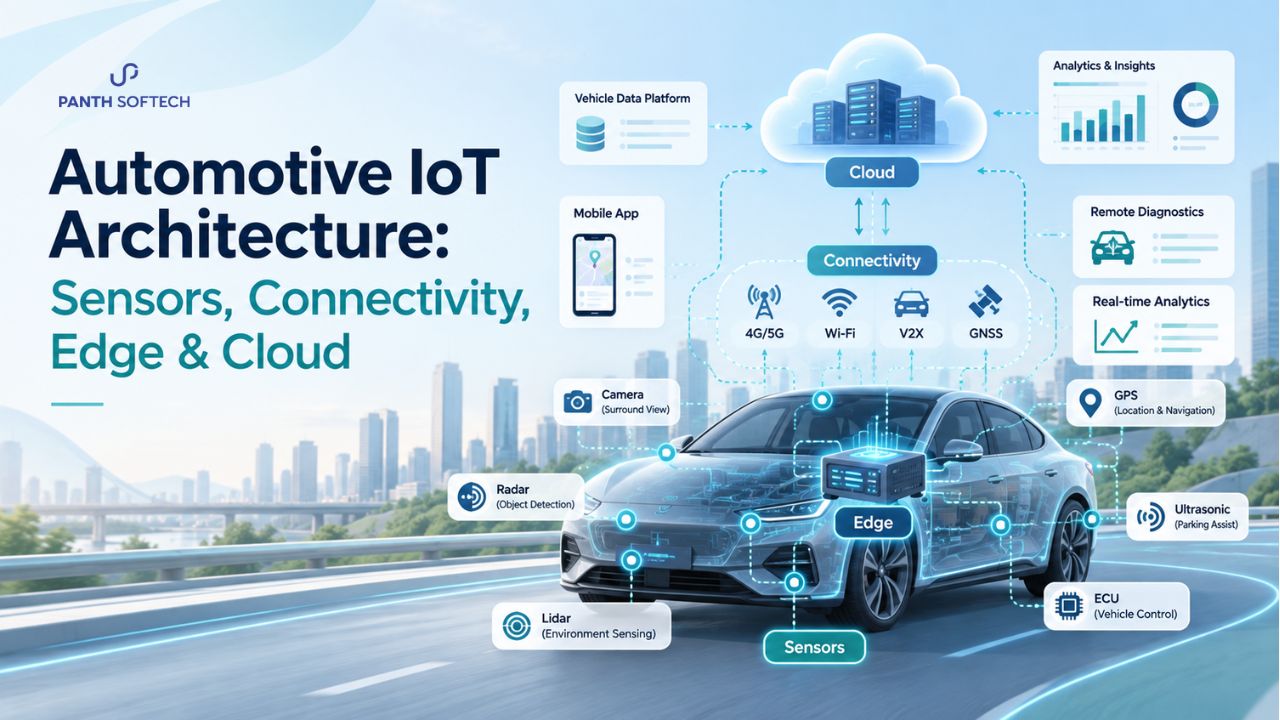
This guide breaks down exactly how automotive IoT architecture works — sensor layer, connectivity layer, edge computing layer, and cloud layer — along with real use cases, challenges, and where the technology is headed.
1. What Is Automotive IoT Architecture?
Automotive IoT architecture is the layered technical framework — sensors, connectivity, edge computing, and cloud platforms — that lets a vehicle collect real-time data, process it, transmit it securely, and turn it into usable insights for drivers, fleet managers, insurers, and OEMs.
In simple terms, it works in four steps:
- Sensors collect raw data from the vehicle and its environment
- Edge systems process time-sensitive data locally, inside the vehicle
- Connectivity carries that data to and from the cloud
- Cloud platforms analyze data at scale and send commands or updates back
Why it matters: A car without this architecture only reacts to what a driver does. A car built on strong IoT architecture can sense a hazard, process it in milliseconds, warn nearby vehicles, and log the event for a fleet manager or insurer — all before the driver has finished reacting.
2. The Four Core Layers of Automotive IoT Architecture
| Layer | Function | Examples |
| Sensors | Collect raw physical data from the vehicle and environment | LiDAR, radar, cameras, tire pressure sensors, GPS |
| Connectivity | Transmit data between the vehicle, other vehicles, infrastructure, and the cloud | 4G/5G, Wi-Fi, Bluetooth, C-V2X, DSRC |
| Edge Computing | Process time-sensitive data locally, near the source | Telematics Control Units (TCUs), onboard AI chips |
| Cloud | Store, analyze, and scale data across fleets; power dashboards and apps | AWS IoT, Azure IoT Hub, custom cloud platforms |
Each layer depends on the one before it. Weak sensor data leads to poor decisions downstream; weak connectivity creates latency that edge computing can’t always compensate for; and a cloud layer without solid edge pre-processing gets flooded with raw, unfiltered noise. Getting automotive IoT right means engineering all four layers to work as a single, coordinated system — not four disconnected components.
3. Sensors: The Data Collection Layer
Sensors are the eyes, ears, and nerves of a connected vehicle. They convert physical conditions — speed, temperature, proximity, pressure — into digital signals the rest of the architecture can use.
Common automotive sensor types:
- Cameras — lane detection, traffic sign recognition, driver fatigue monitoring
- Radar — object detection in low visibility, adaptive cruise control
- LiDAR — 3D environment mapping for autonomous and semi-autonomous driving
- Ultrasonic sensors — parking assistance, blind-spot detection
- Inertial Measurement Units (IMUs) — motion, orientation, stability control
- Tire Pressure Monitoring Sensors (TPMS) — safety and maintenance alerts
- OBD-II and CAN bus sensors — engine performance, diagnostic trouble codes
- GPS modules — real-time location tracking
All of this data travels through the vehicle’s internal network — typically a CAN bus for core systems, a LIN bus for lower-priority functions like window controls, and increasingly automotive Ethernet for high-bandwidth data like camera and radar feeds.
4. Connectivity: How Vehicles Talk to the World
Once sensor data is collected, it needs somewhere to go. Connectivity is the layer that carries that data — from inside the vehicle to the cloud, and increasingly, from vehicle to vehicle.
| Connectivity Type | Best For | Typical Range |
| Cellular (4G/5G) | Cloud communication, OTA updates, remote diagnostics | Long-range |
| Wi-Fi | Bulk data transfer at depots, infotainment | Short-range |
| Bluetooth | Keyless entry, phone pairing, nearby device sync | Very short-range |
| C-V2X / DSRC | Vehicle-to-vehicle and vehicle-to-infrastructure safety messages | Short-range, low latency |
| LPWAN (LoRa, NB-IoT) | Fleet tracking in low-bandwidth, wide-area scenarios | Long-range, low power |
V2X connectivity deserves special attention here, since it’s what turns individual connected cars into a coordinated transport network:
- V2V (Vehicle-to-Vehicle): Cars warn each other about sudden braking or hazards before a driver could react
- V2I (Vehicle-to-Infrastructure): Vehicles communicate with traffic lights and toll systems for smoother traffic flow
- V2P (Vehicle-to-Pedestrian): Alerts drivers to pedestrians or cyclists in blind spots
- V2N (Vehicle-to-Network): Connects vehicles to cloud systems for routing, weather, and dispatch data
V2X messages typically need to move in under 20 milliseconds — which is exactly why this layer often bypasses the cloud entirely and talks directly, vehicle to vehicle or vehicle to roadside unit.
5. Edge Computing: Processing Data Where It’s Generated
Sending every byte of raw sensor data straight to the cloud is slow, expensive, and — for safety-critical functions — genuinely dangerous. That’s where edge computing in automotive comes in.
Edge computing processes data locally, inside the vehicle or at a nearby edge node, instead of routing everything to a distant data center first. A Telematics Control Unit (TCU) typically handles this job, filtering and converting raw CAN bus signals into structured, usable data before deciding what’s urgent enough to act on immediately and what can wait for the cloud.
Why edge computing matters in automotive IoT architecture:
- Speed: Collision avoidance and lane-departure warnings need sub-millisecond reaction times — no round trip to the cloud can deliver that
- Bandwidth savings: Filtering data locally means only meaningful data gets transmitted, not a constant firehose of raw signals
- Reliability: Vehicles pass through tunnels, garages, and dead zones — edge systems keep working even when connectivity drops
- Cost control: Less raw data sent to the cloud means lower data transmission and cloud storage costs at fleet scale
Increasingly, edge nodes also run lightweight AI models directly — detecting driver fatigue from a cabin camera, for instance, without ever sending the video feed to the cloud.
6. Cloud: Where Intelligence Happens at Scale
If edge computing handles the “right now,” the cloud handles the “big picture.” This is where data from thousands — or millions — of vehicles gets aggregated, analyzed, and turned into fleet-wide insights.
What the cloud layer typically powers:
- Fleet management dashboards and driver scoring
- Predictive maintenance models trained across entire vehicle fleets
- Over-the-air (OTA) software and firmware updates
- Usage-based insurance calculations
- EV battery health analytics and smart charging coordination
- API integrations feeding data into third-party apps and business systems
Cloud platforms like AWS IoT Core, Microsoft Azure IoT Hub, and Google Cloud IoT provide the scaffolding, but the real value comes from how well a company’s custom data pipelines, analytics models, and dashboards are engineered on top of that scaffolding — which is usually where custom development makes the biggest difference over off-the-shelf telematics tools.
7. Edge vs. Cloud — Which Handles What
One of the most common architecture questions automotive teams face isn’t “edge or cloud” — it’s which service categories belong in each.
| Function | Better Suited To | Why |
| Collision avoidance | Edge | Requires sub-millisecond response time |
| Lane departure warnings | Edge | Safety-critical, needs instant local processing |
| Predictive maintenance modeling | Cloud | Requires large historical datasets across fleets |
| Fleet-wide analytics | Cloud | Needs to aggregate data from many vehicles |
| OTA software updates | Cloud | Delivered on-demand, not time-critical |
| Driver fatigue detection | Edge | Real-time, privacy-friendly (no raw video upload) |
| Usage-based insurance scoring | Cloud | Aggregates driving history over time |
| V2X hazard warnings | Edge (device-to-device) | Millisecond latency requirement |
The right architecture doesn’t force a choice between edge and cloud — it uses both, assigning each function to whichever layer fits its latency, cost, and scale requirements.
8. Key Use Cases Powered by This Architecture
Predictive Maintenance & Remote Diagnostics
Sensors track vibration, temperature, and pressure; when readings drift outside expected ranges, the system flags a service need before a breakdown occurs — reducing unscheduled downtime significantly for fleet operators.
Fleet Management & Telematics
Real-time GPS and diagnostic data feed a central dashboard, enabling geofencing, driver behavior scoring, fuel optimization, and automated compliance logging.
ADAS & Driver Safety
Camera, radar, and LiDAR data combine with edge processing to power adaptive cruise control, automatic emergency braking, and lane-keeping assistance.
Usage-Based Insurance
Telemetry on braking, speed, and driving times lets insurers price policies on actual behavior instead of demographic assumptions.
EV Battery Monitoring & Smart Charging
Battery management systems track cell temperature and voltage, coordinating with charging infrastructure to extend battery life and improve range accuracy.
V2X-Enabled Smart Mobility
Vehicles exchange hazard warnings, traffic signal data, and positioning information directly with infrastructure and other vehicles — laying the groundwork for autonomous and cooperative driving.
9. Security and Compliance Challenges
Connecting a physical, safety-critical machine to public networks raises the stakes considerably. A handful of challenges come up in nearly every automotive IoT project:
- Cybersecurity risk: A breach that spoofs braking or steering commands is a physical safety issue, not just a data one. Standards like ISO/SAE 21434 and UNECE WP.29 now govern automotive cybersecurity engineering.
- OTA update security: Firmware must be digitally signed and verified before installation, with automatic rollback if an update fails.
- Interoperability: Fleets running mixed vehicle makes and models often use different proprietary CAN configurations, requiring a translation layer for unified telematics.
- Connectivity gaps: Systems need to be offline-first, buffering data locally and syncing once connectivity returns.
- Scalability costs: Moving from thousands to millions of connected vehicles changes the cost equation — edge filtering and autoscaling cloud pipelines are essential to keep it under control.
10. Future of Automotive IoT Architecture
- Software-Defined Vehicles (SDVs): Consolidating dozens of single-purpose ECUs into fewer, more powerful zonal computing units
- Edge AI: More machine learning inference moving directly onto vehicle hardware, reducing reliance on constant cloud connectivity
- 5G and C-V2X expansion: Enabling genuinely cooperative, low-latency vehicle-to-infrastructure communication at scale
- Digital twins: Live virtual models of physical vehicles, continuously updated from real telemetry to simulate wear and predict maintenance needs
11. Why Work With a Custom IoT Development Partner
Off-the-shelf telematics devices can handle basic tracking, but most automotive companies eventually hit a ceiling — non-standard hardware, real-time edge AI requirements, strict compliance needs, or the need for one team that can own the full stack from sensor firmware to cloud dashboards.
At Panth Softech, we help automotive businesses, fleet operators, and mobility startups design and build automotive IoT architecture end-to-end — sensor integration, edge processing, secure connectivity, and scalable cloud platforms — as one coordinated system rather than disconnected pieces.
If your team is scoping a connected vehicle, fleet telematics, or predictive maintenance project, contact us for a free consultation.
FAQ
- How does data flow through an automotive IoT system?
Data flows in five steps: sensors collect raw signals, the CAN bus carries them to a Telematics Control Unit, the TCU filters and processes time-sensitive data at the edge, cellular or V2X connectivity transmits the clean data, and the cloud runs analytics and sends back commands or alerts. - What sensors are used in automotive IoT?
Common sensors include cameras, radar, LiDAR, ultrasonic sensors, inertial measurement units (IMUs), tire pressure monitors, and GPS modules — each feeding a different function like object detection, stability control, or location tracking. - What’s the difference between edge computing and cloud computing in vehicles?
Edge computing processes data locally inside the vehicle for instant, safety-critical decisions like collision avoidance, while cloud computing aggregates data from many vehicles for large-scale analytics like predictive maintenance and fleet dashboards. - How does IoT enable predictive maintenance in vehicles?
Sensors continuously track vibration, temperature, and pressure; when readings drift outside expected patterns, the system flags a service need before the part actually fails, letting operators schedule repairs instead of dealing with breakdowns. - What connectivity options are used in connected vehicles?
Connected vehicles typically use cellular (4G/5G) for cloud communication, Wi-Fi and Bluetooth for short-range tasks like keyless entry, and C-V2X or DSRC for low-latency vehicle-to-vehicle and vehicle-to-infrastructure safety messages. - Why do vehicles need both edge and cloud computing?
Vehicles need edge computing for split-second, safety-critical decisions and cloud computing for large-scale analytics, storage, and fleet-wide insights — neither layer alone can handle both jobs efficiently. - How is automotive IoT architecture different from a standard IoT system?
Automotive IoT architecture has stricter latency requirements, safety-critical failure tolerances, and regulatory standards like ISO/SAE 21434 that most consumer IoT systems don’t need to meet, since a delay or failure can directly affect road safety.