Panth Softech Team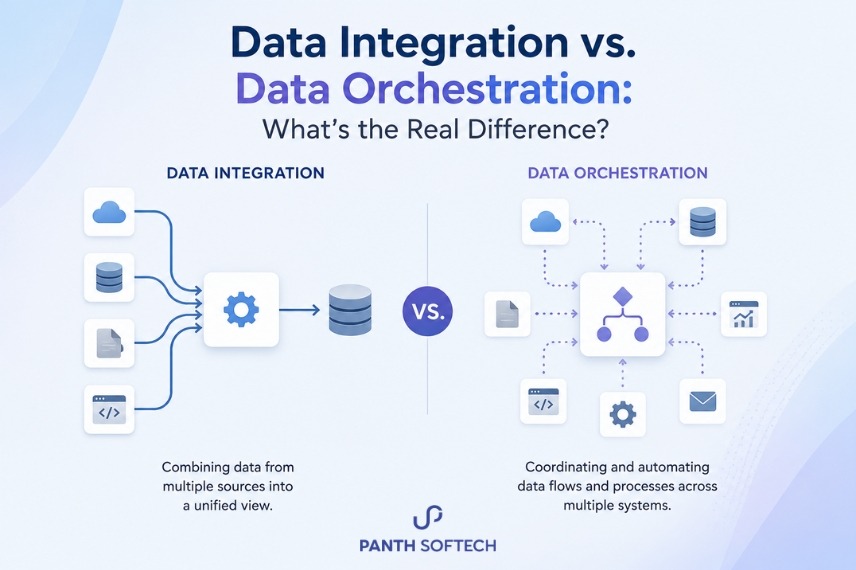
Modern enterprises rely on data to improve operational efficiency, drive innovation, and make informed business decisions. However, as organizations adopt cloud applications, IoT devices, ERP systems, CRM platforms, and third-party software, managing data becomes increasingly complex. Simply moving data between systems is no longer enough—businesses also need to automate how that data flows across applications, analytics platforms, and business processes.
This is where Data Integration and Data Orchestration come into play. Although these terms are often used interchangeably, they solve different problems within a modern data ecosystem. Data Integration focuses on connecting and consolidating information from multiple sources, while Data Orchestration manages and automates the workflows that move, transform, and deliver that data to the right systems at the right time.
Understanding the difference between Data Integration vs. Data Orchestration is essential for organizations building scalable data platforms, enabling real-time analytics, or preparing for AI-driven decision-making. Together, these capabilities form the backbone of modern Data Engineering Services, helping businesses eliminate data silos, improve operational visibility, and create trusted enterprise data platforms.
In this guide, we’ll explore how Data Integration and Data Orchestration differ, when to use each approach, and why combining both creates a more intelligent, scalable, and future-ready data ecosystem.
Key Takeaways
- Data Integration connects enterprise data from multiple sources into a unified platform.
- Data Orchestration automates and coordinates the workflows that process and deliver that data.
- Both technologies work together to build scalable, cloud-ready, and intelligent data ecosystems.
- Organizations that combine integration with orchestration improve operational efficiency, support real-time analytics, and accelerate digital transformation.
- Partnering with an experienced provider like Panth Softech helps ensure your enterprise data platform is secure, scalable, and ready for future AI and analytics initiatives.
What is Data Integration?
Data Integration is the process of collecting, connecting, and consolidating data from multiple sources into a unified and consistent format. It enables organizations to eliminate data silos by bringing information from different applications, databases, cloud platforms, APIs, and enterprise systems into a centralized environment for reporting, analytics, and business operations.
Modern enterprises generate data across numerous business applications. Without proper integration, valuable information remains isolated, making it difficult to gain a complete view of customers, operations, inventory, or financial performance.
Data integration creates a single source of truth, ensuring business users can access reliable and consistent data across the organization.
How Does Data Integration Work?
A typical data integration process includes:
- Extracting data from multiple enterprise systems
- Transforming and standardizing data formats using ETL and ELT processes
- Validating and cleansing data for consistency
- Loading information into centralized repositories such as data warehouses or data lakes
- Synchronizing data continuously through automated Data Pipelines
This structured process enables organizations to improve reporting accuracy while reducing manual data management.
Common Data Integration Sources
Organizations typically integrate data from:
- ERP Systems
- CRM Platforms
- HR Management Systems
- Financial Applications
- IoT Devices
- Cloud Applications
- APIs
- SQL & NoSQL Databases
- Third-Party SaaS Platforms
By implementing Enterprise Data Integration, businesses gain a unified view of operations that supports business intelligence, regulatory compliance, and digital transformation initiatives.
Real-World Example of Data Integration
Imagine a retail company using Salesforce for customer management, SAP for ERP, Shopify for eCommerce, and Google Analytics for website insights. Each platform stores valuable but separate datasets.
Through Data Integration, these systems are connected into a centralized data platform where sales, inventory, customer behavior, and financial information are consolidated. Business leaders can then generate unified reports, improve forecasting, and make faster, data-driven decisions without manually combining information from multiple systems.
What is Data Orchestration?
While Data Integration focuses on connecting data, Data Orchestration focuses on coordinating everything that happens after the data is connected.
Data Orchestration is the process of automating, managing, and monitoring the complete lifecycle of data workflows across multiple systems, applications, and cloud environments. It ensures that every task—from data ingestion and transformation to validation, storage, analytics, and reporting—runs in the correct sequence with minimal manual intervention.
Rather than simply moving data between systems, orchestration coordinates complex workflows, dependencies, and automated processes that keep enterprise data platforms running efficiently.
How Does Data Orchestration Work?
A modern orchestration workflow typically includes:
- Triggering automated data ingestion
- Scheduling ETL and ELT jobs
- Managing workflow dependencies
- Coordinating cloud-based Data Pipelines
- Monitoring workflow execution
- Handling failures and retries
- Supporting Real-Time Data Processing
- Delivering analytics-ready data to downstream systems
This automation significantly improves reliability, scalability, and operational efficiency across enterprise data environments.
Where is Data Orchestration Used?
Data Orchestration is commonly implemented in:
- Cloud Data Platforms
- Business Intelligence Systems
- Machine Learning Pipelines
- Real-Time Analytics Platforms
- Enterprise Reporting Systems
- Multi-Cloud Environments
- Workflow Automation Platforms
- IoT Data Processing
By automating complex workflows, organizations reduce manual effort while ensuring data is always available when business users need it.
Real-World Example of Data Orchestration
Consider a manufacturing company that collects machine sensor data every few seconds.
Instead of manually processing this information, an orchestration platform automatically:
- Collects sensor data in real time.
- Validates and cleans the incoming data.
- Executes transformation workflows.
- Stores processed data in a cloud data warehouse.
- Updates operational dashboards.
- Triggers predictive maintenance alerts if abnormal machine behavior is detected.
This entire workflow occurs automatically through Workflow Automation, ensuring reliable and timely data delivery across the organization.
Data Integration vs. Data Orchestration: Key Differences
Although Data Integration and Data Orchestration work together, they serve different purposes within a modern enterprise data architecture. Data Integration is responsible for connecting and consolidating data, while Data Orchestration manages the automated workflows that control how that data moves, transforms, and reaches downstream applications.
Understanding these differences helps organizations design scalable data ecosystems that support analytics, automation, and intelligent decision-making.
| Feature | Data Integration | Data Orchestration |
| Primary Purpose | Connects and consolidates data from multiple sources | Automates and coordinates end-to-end data workflows |
| Focus Area | Data movement and synchronization | Workflow execution and process automation |
| Core Function | Integrates enterprise data into a unified platform | Manages how integrated data flows across systems |
| ETL & ELT | Performs extraction, transformation, and loading | Schedules, triggers, and monitors ETL & ELT workflows |
| Automation Level | Automates data transfer between systems | Automates complete business and data workflows |
| Data Dependency | Works directly with data sources | Coordinates integrated data across multiple processes |
| Real-Time Processing | Supports real-time data synchronization | Manages real-time workflow execution and dependencies |
| Primary Outcome | Single source of truth | Intelligent, automated enterprise data operations |
| Best For | Data consolidation, reporting, analytics | Workflow Automation, cloud operations, AI pipelines |
Data Integration or Data Orchestration?
The answer is rarely one or the other.
Modern organizations typically use Data Integration to unify business information and Data Orchestration to automate how that information is processed, governed, and delivered across enterprise systems.
When implemented together, they create a scalable data foundation that supports business intelligence, cloud analytics, AI, and digital transformation initiatives—forming the backbone of every modern enterprise data platform.
Data Integration vs. Data Orchestration: Use Cases
Although Data Integration and Data Orchestration serve different purposes, they work together to build modern enterprise data ecosystems. Data Integration focuses on connecting and consolidating business data, while Data Orchestration automates how that integrated data moves through business workflows, analytics platforms, and operational systems.
Understanding where each approach fits helps organizations design scalable, intelligent, and cloud-ready data platforms.
Data Integration Use Cases:
Data Integration is best suited for organizations that need to combine information from multiple systems into a unified and reliable data platform.
-
Enterprise Data Warehousing
Organizations collect data from ERP systems, CRM platforms, finance applications, HR software, and operational databases. Data Integration consolidates this information into centralized Data Warehousing & Data Lakes, enabling consistent reporting, historical analysis, and enterprise-wide visibility.
-
Customer 360 Platforms
Businesses often maintain customer information across multiple departments. Data Integration combines sales, marketing, customer service, and support data into a unified customer profile, helping organizations improve personalization and customer experience.
-
ERP & CRM Integration
Integrating enterprise resource planning and customer relationship management systems ensures sales, finance, procurement, inventory, and operations teams work with synchronized, up-to-date information, reducing manual effort and improving business efficiency.
-
Cloud Migration Projects
During cloud modernization initiatives, Data Integration connects legacy databases, cloud applications, APIs, and enterprise systems, ensuring business continuity while migrating data securely and efficiently.
-
Business Intelligence & Reporting
Reliable reporting depends on consistent enterprise data. Data Integration prepares clean, standardized datasets that enable executives to build dashboards, monitor KPIs, and make informed strategic decisions.
Data Orchestration Use Cases:
While integration connects enterprise data, Data Orchestration automates the complex workflows required to process, transform, and deliver that data efficiently.
-
Automated ETL & ELT Workflows
Modern enterprises automate ETL and ELT jobs to extract, transform, validate, and load data without manual intervention. Data Orchestration schedules and manages these workflows, ensuring reliable execution and reducing operational complexity.
-
Cloud Data Platforms
Organizations operating across cloud environments rely on orchestration to coordinate data ingestion, processing, storage, and analytics while maintaining workflow dependencies across distributed systems.
This approach plays a critical role in modern Cloud Data Engineering Services, where automated workflows ensure scalable and reliable cloud-based data operations.
-
Real-Time Analytics
Businesses requiring immediate insights—such as manufacturing, logistics, and financial services—use Data Orchestration to automate streaming data pipelines, enabling dashboards and analytics platforms to process information in near real time.
-
AI & Machine Learning Workflows
Artificial Intelligence projects require multiple automated steps, including data preparation, feature engineering, model training, deployment, and monitoring. Data Orchestration coordinates these interconnected processes to ensure AI workflows run efficiently and consistently.
-
Multi-System Business Automation
Organizations often automate workflows involving ERP systems, CRM platforms, cloud applications, APIs, and reporting tools. Data Orchestration manages task sequencing, dependencies, approvals, and notifications, creating seamless end-to-end business automation.
When Should You Use Both?
For most enterprises, the question isn’t Data Integration vs. Data Orchestration—it’s how to use both together.
Data Integration ensures business information is connected and standardized, while Data Orchestration automates how that information flows through enterprise applications, cloud platforms, analytics systems, and operational processes.
Together, they create intelligent, scalable data ecosystems capable of supporting digital transformation, advanced analytics, and enterprise automation.
Benefits of Data Integration and Data Orchestration
Organizations that combine Data Integration with Data Orchestration gain more than connected systems—they create a modern data foundation that improves operational efficiency, business intelligence, and enterprise agility.
Unified Enterprise Data
Data Integration eliminates information silos by connecting business applications, cloud platforms, databases, and APIs into a centralized ecosystem. This provides a consistent view of enterprise data across departments and business functions.
Improved Data Quality & Consistency
Integrated and orchestrated workflows automatically validate, standardize, and synchronize data across systems. Combined with strong Data Quality Assurance & Management, organizations reduce duplicate records, inconsistencies, and reporting errors while improving trust in enterprise data.
Faster Decision-Making
Business leaders gain access to reliable, real-time information through automated data pipelines and centralized reporting, enabling faster operational decisions and more accurate strategic planning.
Intelligent Workflow Automation
Data Orchestration reduces manual intervention by automating data movement, transformation, approvals, notifications, and workflow execution across enterprise systems. This improves productivity while reducing operational bottlenecks.
Improved Scalability
As organizations grow, automated data pipelines and orchestration workflows efficiently manage increasing data volumes without compromising performance, reliability, or business continuity.
AI & Analytics Readiness
Modern analytics, machine learning, and AI initiatives depend on clean, integrated, and well-governed data. Together, Data Integration and Data Orchestration provide the reliable data foundation required for predictive analytics, automation, and intelligent decision-making.
Common Challenges in Data Integration and Data Orchestration
Despite their benefits, implementing enterprise data platforms comes with several technical and operational challenges. Understanding these obstacles helps organizations build more resilient and scalable solutions.
Integrating Legacy Systems
Many organizations continue to rely on legacy applications that lack modern APIs and cloud connectivity. Integrating these systems with today’s enterprise platforms often requires specialized architectures and careful planning to avoid disrupting business operations.
Managing Data Silos
Business data is frequently distributed across multiple departments, cloud platforms, databases, and third-party applications. Without a well-defined integration strategy, organizations struggle to create a unified and consistent view of enterprise information.
Maintaining Data Quality
Poor-quality data remains one of the biggest obstacles to successful analytics. Duplicate records, inconsistent formats, missing values, and outdated information can negatively impact reporting, automation, and business decisions if quality controls are not continuously maintained.
Complex Workflow Dependencies
Modern enterprise workflows often involve multiple applications, cloud services, APIs, and automated processes. Managing task sequencing, error handling, retries, and dependencies becomes increasingly complex as organizations scale their digital operations.
Scaling Enterprise Data Platforms
As business data grows, organizations must ensure their integration pipelines and orchestration workflows continue performing efficiently. Poorly designed architectures can create bottlenecks that affect processing speed, reporting, and overall system reliability.
Security, Privacy & Compliance
Enterprise data frequently includes sensitive customer, financial, and operational information. Organizations must implement strong security controls, governance policies, encryption, and compliance frameworks to protect business-critical data throughout every stage of the data lifecycle.
Best Practices for Successful Data Integration and Data Orchestration
Implementing Data Integration and Data Orchestration successfully requires more than selecting the right technology. Organizations need a well-defined strategy, scalable architecture, and governance framework to ensure enterprise data remains accurate, secure, and accessible across business systems.
Define Clear Business Objectives
Begin with specific business goals rather than technology choices. Identify the systems to integrate, reporting requirements, automation opportunities, and expected business outcomes before designing your data architecture.
Build a Scalable Data Architecture
Design cloud-native architectures that can accommodate increasing data volumes, additional applications, and future business expansion without requiring major infrastructure changes.
Automate Repetitive Workflows
Use orchestration tools to automate data ingestion, ETL and ELT processes, scheduling, monitoring, and workflow execution. Automation minimizes manual effort, reduces errors, and improves operational efficiency.
Prioritize Data Quality
Reliable analytics starts with trusted data. Continuously validate, cleanse, standardize, and monitor enterprise data to maintain consistency across integrated systems.
Implement Strong Governance & Security
Establish governance policies, role-based access control, encryption, metadata management, and audit logging to protect sensitive enterprise data while ensuring regulatory compliance.
Monitor & Optimize Continuously
Monitor pipeline performance, workflow execution, infrastructure utilization, and system reliability regularly to identify bottlenecks, improve scalability, and maintain optimal performance.
Data Integration or Data Orchestration: Which One Does Your Business Need?
The answer depends on your business objectives—but for most enterprises, the real value comes from combining both.
If your organization primarily needs to connect data from multiple business systems into a centralized platform, Data Integration is the right starting point. It enables consistent reporting, improves visibility, and creates a trusted foundation for analytics.
However, if you’re managing complex enterprise workflows, cloud applications, real-time processing, or automated business operations, Data Orchestration becomes equally important. It coordinates how integrated data moves through multiple systems, ensuring every workflow executes efficiently and reliably.
Modern enterprises rarely choose one over the other. Instead, they use Data Integration to consolidate information and Data Orchestration to automate the complete data lifecycle—creating scalable, intelligent, and future-ready enterprise data platforms.
Partner with Panth Softech for Data Integration and Data Orchestration
Modern enterprises require more than connected systems—they need intelligent data ecosystems that deliver trusted insights, automate business processes, and support long-term digital transformation.
At Panth Softech, we provide enterprise-grade Data Integration Services and Data Orchestration Services that help organizations eliminate data silos, automate workflows, and build scalable cloud-native data platforms. From integrating enterprise applications and designing automated data pipelines to enabling real-time analytics and AI-ready architectures, we deliver solutions tailored to your business objectives.
Whether you’re modernizing legacy infrastructure, implementing cloud-based integration, or optimizing enterprise workflows, our experts combine deep technical knowledge with proven engineering practices to help you maximize the value of your enterprise data.
Why Choose Panth Softech?
- Enterprise-first data engineering approach
- Cloud-native and scalable architectures
- Secure, governed, and reliable data platforms
- Industry expertise across Manufacturing, FMCG, Logistics, Agriculture, and HR
- Agile implementation with continuous optimization
- End-to-end consulting, implementation, and support
Ready to Build a Connected Enterprise Data Ecosystem?
Transform fragmented business data into a unified, intelligent platform with Panth Softech’s Data Integration & Orchestration expertise.
Schedule a Free Data Integration Consultation
Frequently Asked Questions
1. What is the difference between Data Integration and Data Orchestration?
Data Integration connects and consolidates data from multiple systems into a unified platform, while Data Orchestration automates the workflows that move, transform, and manage that data across enterprise applications. Integration focuses on data connectivity, whereas orchestration focuses on process automation.
2. Can Data Integration work without Data Orchestration?
Yes. Data Integration can function independently by consolidating information from multiple systems. However, combining it with Data Orchestration automates data workflows, improves operational efficiency, and enables real-time data processing across enterprise environments.
3. Do I need both Data Integration and Data Orchestration?
Most modern enterprises benefit from both. Data Integration creates a centralized and reliable data foundation, while Data Orchestration automates workflows, coordinates data movement, and ensures information reaches the right systems at the right time.
4. Which industries benefit from Data Integration and Data Orchestration?
Manufacturing, logistics, healthcare, retail, finance, FMCG, agriculture, and enterprise businesses benefit from Data Integration and Data Orchestration by improving operational visibility, reporting accuracy, workflow automation, and data-driven decision-making.
5. How do Data Integration Services improve business efficiency?
Data Integration Services eliminate data silos by connecting enterprise applications, databases, and cloud platforms into a unified ecosystem. This improves data accessibility, reduces manual effort, enhances reporting accuracy, and enables faster, more informed business decisions.