Panth Softech Team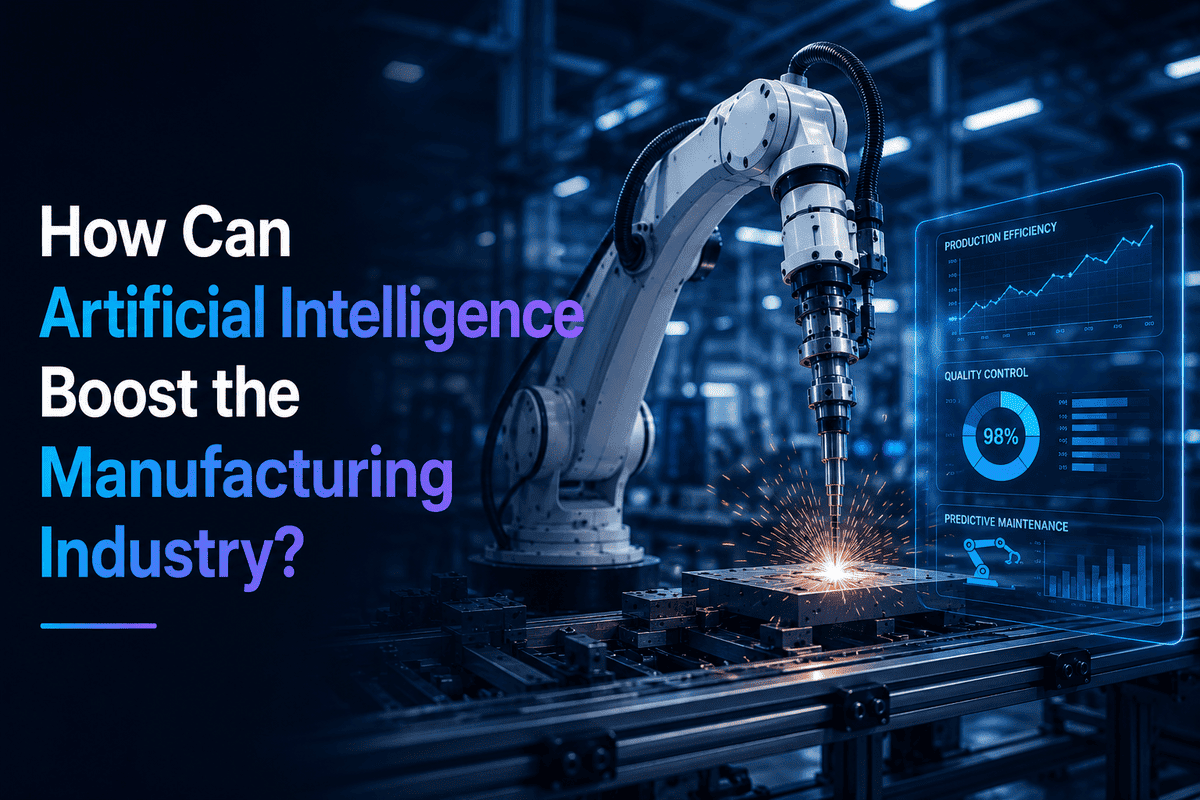
Artificial Intelligence (AI) is transforming the manufacturing industry by enabling businesses to automate operations, improve quality control, optimize production processes, and make smarter decisions using real-time data. From predictive maintenance and computer vision inspections to generative AI assistants and autonomous workflows, AI helps manufacturers. It boosts efficiency, agility, and profitability.
Today, AI in manufacturing is no longer a futuristic concept. Manufacturers across automotive, electronics, FMCG, industrial equipment, pharmaceuticals, food processing, and consumer goods sectors are actively investing in artificial intelligence to streamline operations, reduce costs, and gain a competitive advantage.
As Industry 4.0 continues to reshape global manufacturing, organizations are increasingly leveraging machine learning, industrial IoT (IIoT), data analytics, cloud technologies, and Generative AI to build smarter and more connected factories.
In this article, we explore how artificial intelligence in manufacturing is revolutionizing production environments, key use cases, benefits, challenges, emerging trends, and how businesses can successfully implement AI-powered manufacturing solutions.
What Is AI in Manufacturing?
AI in manufacturing refers to the application of artificial intelligence technologies such as machine learning, deep learning, computer vision, predictive analytics, natural language processing (NLP), and Generative AI to improve manufacturing processes and business outcomes.
These technologies help manufacturers analyze large volumes of operational data, identify patterns, predict future events, automate repetitive tasks, and support intelligent decision-making.
Benefits of Artificial Intelligence in Manufacturing
Adopting AI technology in manufacturing offers clear advantages for businesses of all sizes. Leaders in the AI manufacturing industry report significant improvements in operational efficiency and cost management.
- Higher Productivity: AI systems work 24/7 without fatigue, maintaining peak performance across every shift.
- Cost Reduction: Smart algorithms identify waste in energy, materials, and time, saving companies millions annually.
- Faster Innovation: Generative design allows engineers to test thousands of product variations in seconds.
- Better Scaling: Automated systems allow factories to increase output without a linear increase in overhead.
Top AI Use Cases in Manufacturing
Practical AI applications in manufacturing solve the most common “pain points” for plant managers. By using data analytics, companies turn raw information into a roadmap for better performance.
Predictive Maintenance
Instead of fixing machines when they break, AI predicts failures before they happen. Sensors collect data on vibration, heat, and noise. A machine learning development company can build models that flag unusual patterns, allowing for repairs during scheduled downtime.
Quality Control and Defect Detection
Human inspectors often miss tiny flaws due to fatigue or high-speed production lines. Computer vision solutions use high-resolution cameras to scan every item. These systems identify scratches, dents, or missing parts with nearly 100% accuracy in real-time.
Production Planning and Scheduling
Traditional production planning often struggles with sudden changes in demand or material shortages. AI handles complex production scheduling by analyzing thousands of variables instantly. It ensures optimal resource allocation to keep the factory running smoothly.
Supply Chain Optimization
A “connected” supply chain uses AI to track shipments and predict delays. Supply chain optimization tools analyze weather patterns, port congestion, and fuel costs. This helps manufacturers adjust their logistics strategies to ensure on-time delivery.
Inventory Management
Overstocking ties up cash, while understocking halts production. AI-driven inventory management systems monitor stock levels in real-time. These tools automatically trigger orders based on historical demand and current production speeds.
Workplace Safety Monitoring
AI monitors the factory floor for safety violations through existing cameras. If a worker enters a dangerous zone or forgets safety gear, the system alerts supervisors immediately. This proactive quality inspection of safety protocols reduces accidents and insurance costs.
Machine Learning in Manufacturing
Machine learning is the engine behind most factory innovations. It involves training software on historical data so it can recognize patterns and make predictions. A specialized machine learning development company helps manufacturers turn their “big data” into usable insights.
Algorithms analyze everything from machine performance to energy consumption. Over time, the software becomes more accurate, leading to better production optimization. This continuous learning helps factories adapt to new products or materials without manual reprogramming.
Computer Vision Applications in Manufacturing
Computer vision solutions act as the “eyes” of the modern factory. These systems process visual data faster and more accurately than any human. They are essential for high-speed assembly lines where precision is critical.
Beyond just finding defects, computer vision helps with:
- Robot Guidance: Helping robotic arms pick and place items with extreme precision.
- Assembly Verification: Ensuring every component is installed in the correct order.
- Safety Zones: Detecting if a person’s limb is too close to moving parts to trigger an emergency stop.
Generative AI in Manufacturing
The rise of the Generative AI Development Company has introduced a new way to design products. Instead of engineers drawing every line, they input requirements into a Generative AI tool. The software then creates thousands of design options that meet those goals.
This process often results in lighter, stronger, and more efficient parts that humans might never imagine. It also assists in creating synthetic data to train other AI models, which is vital when real-world data is scarce.
Industry 4.0 and AI-Powered Smart Factories
We are currently in the era of Industry 4.0. This phase focuses on connected manufacturing and the Industrial IoT (IIoT). In a smart factory, every machine, sensor, and worker is part of a single digital ecosystem.
|
Feature |
Traditional Factory |
AI-Powered Smart Factory |
|---|---|---|
|
Data Usage |
Manual logs and silos |
Real-time data analytics |
|
Maintenance |
Reactive (Fix when broken) |
Predictive (Fix before failure) |
|
Communication |
Isolated machines |
Connected manufacturing |
|
Decision Making |
Human-led experience |
Data-driven AI models |
|
Automation |
Basic industrial automation |
Intelligent cyber physical systems |
Challenges of Implementing AI in Manufacturing
While the rewards are high, adopting AI in Manufacturing comes with hurdles. Many companies struggle with “data silos” where information stays trapped in old machines. Integrating modern AI with legacy equipment requires careful planning.
There is also a significant skill gap. Factories need workers who understand both mechanical engineering and data science. Finally, the initial cost of AI development services can be high, though the long-term ROI usually justifies the spend.
Future Trends of AI in Manufacturing
The next frontier involves AI agents in manufacturing. These are independent software units that can manage entire workflows without human intervention. We will also see more edge computing, where AI processing happens directly on the machine rather than in a distant cloud.
Warehouse automation will become even more sophisticated. Mobile robots will use AI to navigate complex environments, moving materials exactly where they are needed. This level of factory automation will make “lights-out” manufacturing (factories that run without humans present) a reality.
How Panth Softech Helps Manufacturers Adopt AI
Manufacturers often face challenges when adopting artificial intelligence due to complex operational environments, fragmented data systems, and evolving technology requirements.
Panth Softech helps manufacturing organizations successfully implement AI-driven solutions that deliver measurable business outcomes.
Our expertise includes:
AI Development Services
We design and develop custom artificial intelligence solutions that automate business processes, improve operational efficiency, and support data-driven decision-making.
Machine Learning Development
As a machine learning development company, we build intelligent models that help manufacturers forecast demand, optimize production, improve quality, and reduce downtime.
Generative AI Development
Our generative AI development company services help manufacturers build AI assistants, enterprise knowledge systems, intelligent copilots, and workflow automation solutions.
Computer Vision Services
We develop computer vision solutions that automate quality inspection, defect detection, worker safety monitoring, and visual analytics.
IoT Development Services
Our IoT development services enable manufacturers to connect machines, collect real-time data, and create intelligent industrial ecosystems.
Data Engineering Services
We build modern data platforms that integrate manufacturing data, improve data quality, and enable advanced analytics and AI initiatives.
Cloud Consulting Services
Our cloud consulting services help manufacturers modernize infrastructure, scale AI solutions, and support enterprise digital transformation initiatives.
By combining AI, machine learning, industrial IoT, cloud technologies, and data engineering expertise, we help manufacturers accelerate their Industry 4.0 journey and unlock new opportunities for growth.
Frequently Asked Questions About AI in Manufacturing
Q1. What are the benefits of AI in manufacturing?
The primary benefits include improved productivity, reduced downtime, better quality control, enhanced supply chain visibility, predictive maintenance, lower operating costs, and more accurate forecasting.
Q2. How is machine learning used in manufacturing?
Machine learning helps manufacturers analyze production data, predict equipment failures, optimize production schedules, improve demand forecasting, and identify operational inefficiencies.
Q3. How does computer vision improve manufacturing?
Computer vision systems automate visual inspection processes by identifying defects, monitoring product quality, verifying assembly operations, and improving workplace safety.
Q4. What is Generative AI in manufacturing?
Generative AI helps manufacturers create engineering documentation, automate knowledge management, support technical teams, optimize product designs, and improve decision-making through intelligent AI assistants.
Q5. What technologies support AI in manufacturing?
Successful AI implementation typically requires machine learning, industrial IoT, computer vision, cloud infrastructure, data engineering services, advanced analytics, and enterprise software integration.
Q6. What industries benefit most from AI-powered manufacturing?
Industries such as automotive, electronics, FMCG, pharmaceuticals, industrial equipment, food processing, consumer goods, and logistics can significantly benefit from AI-powered manufacturing solutions.
Q7. How does AI improve manufacturing efficiency?
Artificial intelligence improves manufacturing efficiency by automating repetitive tasks, optimizing production schedules, reducing equipment downtime, enhancing quality control, and enabling real-time decision-making through advanced analytics.
Q8. Why are manufacturers investing in AI?
Manufacturers invest in AI to reduce costs, improve productivity, enhance product quality, increase operational visibility, strengthen supply chains, and accelerate digital transformation initiatives.
Q9. What is the future of AI in manufacturing?
The future of AI in manufacturing includes Generative AI, AI agents, digital twins, autonomous manufacturing systems, smart factories, industrial IoT integration, and real-time manufacturing intelligence platforms.
Ready to modernize your operations? Connect with our experts at Panth Softech to build a smarter, more efficient future for your business.