Panth Softech Team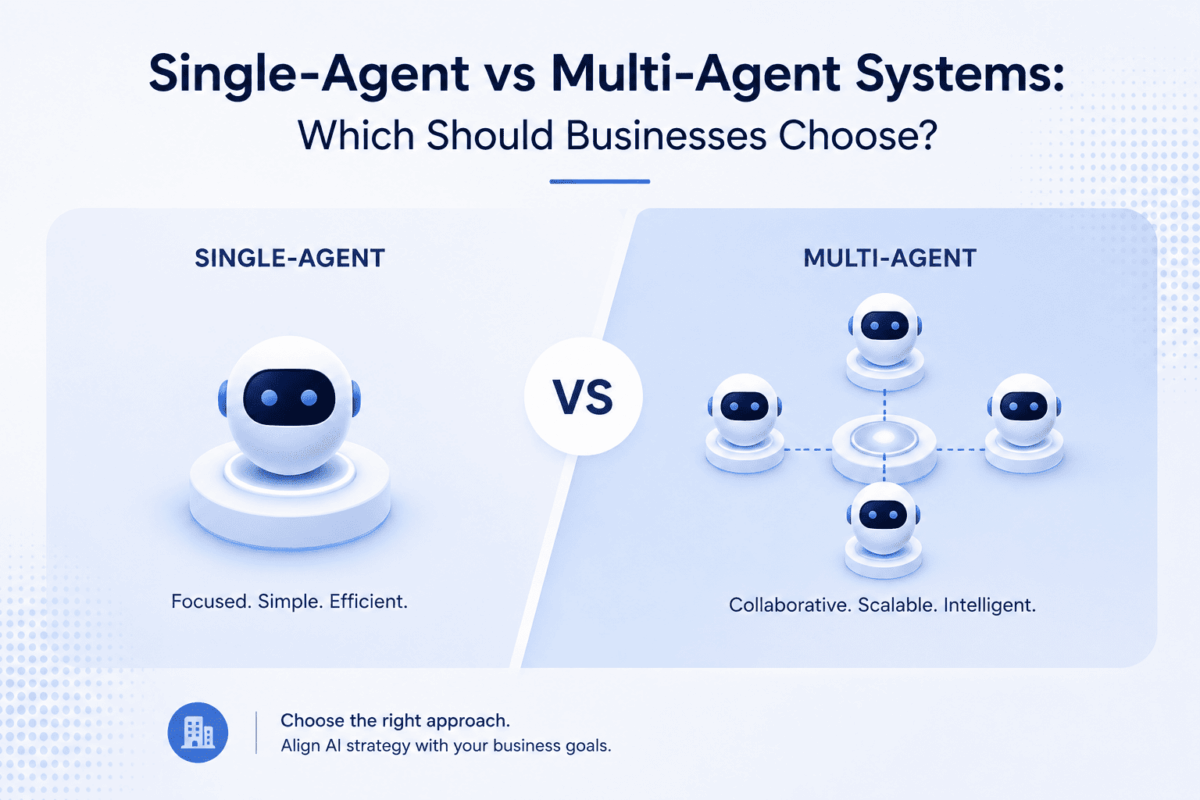
Businesses are moving beyond basic AI assistants toward AI Agents that can reason, use tools, retrieve information, and execute multi-step tasks. As these systems become more capable, an important architectural question emerges: should an organization use a single AI agent to manage a workflow, or deploy multiple specialized agents that collaborate to complete complex tasks?
The answer depends on the complexity of the business process, the number of specialized capabilities required, the level of automation, and the operational environment. A Single-Agent System can be highly effective for focused workflows, while Multi-Agent Systems can support more complex processes by dividing responsibilities among specialized agents.
In this guide, we’ll compare single-agent and multi-agent systems, explore their advantages and limitations, examine enterprise use cases, and provide a practical framework for deciding which approach is right for your organization.
What Are AI Agent Systems?
AI agent systems are software systems that use artificial intelligence to understand objectives, reason about tasks, interact with tools or data sources, and take actions with varying levels of autonomy.
Unlike a traditional chatbot that primarily responds to a user prompt, an AI agent can perform a sequence of actions to achieve an objective.
For example, an enterprise AI agent could:
- Understand a business request
- Retrieve information from internal systems
- Analyze available data
- Select appropriate tools
- Execute actions through APIs
- Evaluate results
- Continue working until the task is completed
This makes AI Agent Workflow automation particularly useful for business processes that involve multiple steps.
How AI Agents Work
A simplified agent workflow can be represented as:
Input → Reasoning → Tool Selection → Action → Feedback → Next Action
The agent receives an objective, determines what needs to be done, selects appropriate tools or information sources, performs an action, evaluates the result, and determines the next step.
Depending on the architecture, this process may be handled by one agent or distributed across multiple specialized agents.
What Is a Single-Agent System?
A Single-Agent System uses one primary AI agent to manage and execute a business workflow.
The agent may have access to multiple tools, APIs, databases, knowledge bases, or enterprise applications, but the overall reasoning and task coordination remain centered around one agent.
A simplified architecture looks like:
User Request → AI Agent → Tools / APIs / Data → Result
The agent can break a request into multiple steps internally without requiring a separate agent for each task.
How Single-Agent AI Works
Suppose a sales employee asks:
“Analyze this prospect, summarize their company, identify relevant opportunities, and prepare a personalized outreach message.”
A single agent could:
- Research the company.
- Retrieve relevant information.
- Analyze the prospect.
- Identify potential opportunities.
- Generate the outreach message.
- Return the final result.
The entire workflow is managed by one agent.
Common Single-Agent Use Cases
Single-agent systems can work particularly well for focused business workflows such as:
- Customer support
- Internal knowledge assistants
- Document analysis
- Research assistants
- Sales assistants
- IT helpdesk automation
- Content generation
- Basic workflow automation
When the workflow has a relatively clear objective and doesn’t require multiple specialized reasoning roles, a single agent can provide a simpler and more efficient architecture.
What Is a Multi-Agent System?
A Multi-Agent System uses multiple specialized AI agents that collaborate, communicate, or coordinate to accomplish a larger objective.
Instead of asking one agent to perform every task, organizations can assign specific responsibilities to different agents.
For example:
Customer Request
↓
Orchestrator Agent
↓
Research Agent | Data Agent | Analysis Agent | Action Agent
↓
Final Result
Each agent can have its own instructions, tools, responsibilities, and specialized capabilities.
How Multi-Agent AI Works
Consider an enterprise research workflow.
Instead of one agent performing everything, the system could include:
- Research Agent — gathers relevant information.
- Data Agent — retrieves and processes business data.
- Analysis Agent — evaluates findings.
- Compliance Agent — checks requirements.
- Reporting Agent — prepares the final output.
An orchestration layer can determine which agent should perform each task and how the results should be combined.
This approach introduces concepts such as:
- Agent collaboration
- Agent communication
- Task delegation
- Agent coordination
- AI Agent Orchestration
- Specialized reasoning
- Parallel task execution
Single-Agent vs Multi-Agent Systems: Key Differences
The right architecture depends on the business problem rather than the number of agents involved.
| Comparison Area | Single-Agent System | Multi-Agent System |
| Architecture | One primary AI agent manages the workflow and performs required tasks. | Multiple specialized agents collaborate to complete different parts of a workflow. |
| Complexity | Relatively simpler to design, deploy, monitor, and maintain. | More complex because communication, coordination, orchestration, and dependencies must be managed. |
| Best For | Focused workflows with a clear objective and limited task complexity. | Complex workflows requiring specialized capabilities, parallel tasks, or multiple decision-making roles. |
| Coordination | Minimal coordination is required because one agent manages the workflow. | Requires communication and coordination between agents or an orchestration layer. |
| Development Effort | Generally faster to prototype and implement. | Typically requires more architecture, testing, integration, and monitoring. |
| Scalability | Can become difficult to manage when one agent handles too many specialized responsibilities. | Specialized agents can be added or modified as workflows become more complex. |
| Operational Overhead | Lower monitoring and infrastructure overhead. | Higher overhead because of multiple agents, interactions, tool calls, and state management. |
| Typical Business Use | Customer assistants, research, document processing, and focused automation. | Complex enterprise workflows, cross-functional automation, research, operations, and specialized task execution. |
The key takeaway is that Single-Agent vs Multi-Agent Systems is not simply a comparison between basic and advanced AI. It is fundamentally an architectural decision based on workflow complexity and business requirements.
Advantages of Single-Agent Systems
Simpler Architecture
A single-agent architecture has fewer moving parts, making it easier for development teams to understand and maintain.
There are fewer agent-to-agent dependencies, communication channels, and orchestration requirements.
Faster Development
Businesses can generally prototype and validate focused use cases faster because there is no need to design multiple autonomous components.
This makes single-agent AI useful when an organization wants to test an AI workflow before investing in a more complex architecture.
Easier Monitoring
With one primary agent managing the workflow, it is generally easier to track:
- Inputs
- Reasoning steps
- Tool calls
- Outputs
- Errors
- Performance
This can simplify troubleshooting and operational monitoring.
Lower Operational Complexity
Single-agent systems typically require fewer infrastructure components, model interactions, and coordination mechanisms.
That can make them easier to deploy and operate, particularly for organizations beginning their enterprise AI journey.
Easier Governance
Organizations can establish access controls, tool permissions, data policies, and human approval processes around a single primary agent.
This can simplify governance for lower-risk workflows.
Limitations of Single-Agent Systems
Single-agent architectures can become less effective when the business workflow becomes highly complex.
Complex Task Overload
A single agent may be responsible for too many different tasks, tools, and decision-making requirements.
As responsibilities increase, the agent’s instructions and workflow logic can become increasingly difficult to manage.
Limited Specialization
A single agent may need to perform research, analysis, coding, customer communication, compliance checks, and data processing within the same workflow.
Specialized agents can sometimes handle these responsibilities more effectively.
Longer and More Complex Workflows
As the number of workflow steps increases, maintaining reliable execution within one agent can become challenging.
Context Management Challenges
Long workflows may require the agent to maintain significant amounts of information and state throughout execution.
This can make context management and reliability more difficult.
Advantages of Multi-Agent Systems
Task Specialization
Each agent can be designed around a specific responsibility.
For example:
Research Agent → Analysis Agent → Compliance Agent → Reporting Agent
This can create clearer boundaries between different capabilities.
Parallel Processing
Independent tasks can potentially be delegated to different agents and executed in parallel, reducing unnecessary sequential processing.
For example, a research agent and data-analysis agent may work on separate parts of a task before their findings are combined.
Complex Workflow Automation
Multi-agent architecture can support business processes involving multiple functions, systems, and decision points.
This makes it particularly relevant for complex enterprise automation.
Greater Modularity
Individual agents can be updated, replaced, or improved without necessarily redesigning the entire system.
This modularity can become valuable as enterprise AI workflows evolve.
Cross-Functional Intelligence
Multiple specialized agents can represent different functional capabilities within a broader workflow.
For example, an enterprise process could combine sales, finance, compliance, operations, and customer-service agents to complete a complex business process.
Challenges of Multi-Agent Systems
Multi-agent architecture provides additional capabilities, but it also introduces additional engineering and operational requirements.
Higher Architecture Complexity
More agents mean more components, dependencies, workflows, and failure points.
The architecture therefore requires careful design.
Agent Coordination
Agents need reliable mechanisms for sharing information, delegating tasks, and determining when a task has been completed.
Poor coordination can result in duplicated work, conflicting outputs, or incomplete workflows.
Debugging & Observability
When multiple agents interact, identifying why a workflow failed can be more difficult.
Teams may need to monitor:
- Agent decisions
- Agent messages
- Tool calls
- Workflow state
- Errors
- Latency
- Model usage
Increased Cost
A multi-agent workflow may generate more model calls, tool calls, and infrastructure activity than a comparable single-agent workflow.
Organizations should therefore measure cost against the business value generated by the additional specialization.
Security & Governance
Multiple autonomous agents may have access to different enterprise systems and tools.
Organizations need appropriate controls around:
- Agent permissions
- Data access
- API access
- Tool usage
- Sensitive information
- Human approval
- Auditability
Unexpected Agent Behavior
Autonomous interactions can create unpredictable outcomes if agents have poorly defined responsibilities or insufficient constraints.
Clear agent roles, controlled tool access, validation mechanisms, and human oversight are therefore important for high-impact workflows.
Single-Agent vs Multi-Agent: Which Is Better for Businesses?
There is no universally better architecture between single-agent and multi-agent AI. The right choice depends on the complexity of the workflow, the number of specialized capabilities required, the systems involved, and the level of autonomy the business needs.
For many focused workflows, a Single-Agent System can provide the required intelligence with less development and operational complexity. A Multi-Agent System becomes more appropriate when a process involves multiple specialized tasks, independent decision-making, or collaboration across different business functions.
Choose Single-Agent When:
A single-agent approach is generally appropriate when the workflow has a clear objective and can be managed effectively by one capable agent.
Consider a Single-Agent AI architecture when:
- The workflow has a relatively straightforward objective.
- One agent can access all required tools and information.
- Tasks do not require highly specialized reasoning roles.
- You need to build and validate a solution quickly.
- Operational simplicity is important.
- The workflow has a limited number of decision points.
- There is no strong requirement for independent parallel task execution.
Example:
An internal employee assistant could answer questions, search company documents, retrieve information from business systems, and generate summaries.
One capable agent may be sufficient for this workflow.
Choose Multi-Agent When:
A Multi-Agent AI System becomes more attractive when the workflow consists of several distinct responsibilities that can be delegated to specialized agents.
Consider a multi-agent architecture when:
- The workflow contains multiple specialized tasks.
- Different tasks require different tools or capabilities.
- Tasks can be performed independently or in parallel.
- Multiple business functions need to collaborate.
- The process requires specialized reasoning.
- The workflow is expected to grow in complexity.
- Individual capabilities need to be developed independently.
Example:
Consider an enterprise procurement workflow:
Request → Procurement Agent → Supplier Research Agent → Pricing Analysis Agent → Compliance Agent → Approval Agent
Instead of asking one agent to manage every responsibility, each specialized agent can focus on a clearly defined task.
Single-Agent vs Multi-Agent Decision Framework
Businesses can use a simple decision framework before selecting an architecture.
Step 1: Is the workflow relatively simple?
Yes → Start with a Single-Agent System
No → Continue evaluating
Step 2: Does the workflow require multiple specialized capabilities?
No → Single-Agent System may be sufficient
Yes → Evaluate Multi-Agent Architecture
Step 3: Can tasks be delegated or executed independently?
Yes → Multi-Agent System may provide an advantage
No → Consider whether a more capable single agent can handle the workflow
Step 4: Does the additional complexity provide measurable business value?
No → Prefer Single-Agent
Yes → Consider Multi-Agent
This prevents organizations from introducing unnecessary architectural complexity simply because multi-agent AI appears more advanced.
The Future of Single-Agent and Multi-Agent AI
The distinction between single-agent and multi-agent architectures will likely become less rigid as Agentic AI continues to evolve.
Future enterprise systems may combine both approaches. A primary agent could manage the overall user interaction while delegating specialized tasks to smaller agents when required.
For example:
Primary Enterprise Agent
↓
Research Agent | Data Agent | Compliance Agent | Action Agent
The primary agent can maintain the overall context while specialized agents perform individual tasks.
This hybrid architecture can provide the simplicity of a primary agent while allowing organizations to introduce specialized capabilities where they create measurable value.
The evolution of Large Language Models, tool use, agent orchestration, memory, enterprise data integration, and AI governance will continue to expand what AI agents can accomplish.
Not sure whether your business needs a single AI agent or a multi-agent architecture?
Panth Softech can evaluate your workflow, identify the right agent architecture, and build secure, scalable AI agent solutions aligned with your enterprise objectives.
Explore AI Agent Development Services
Frequently Asked Questions
Q1. What is the difference between a single-agent and multi-agent system?
A single-agent system uses one AI agent to manage and execute a workflow, while a multi-agent system uses multiple specialized agents that collaborate or coordinate to complete a broader objective.
Q2. Is a multi-agent system better than a single-agent system?
Not necessarily. A multi-agent system is useful when a workflow requires multiple specialized capabilities, independent tasks, or complex coordination. For simpler workflows, a single agent can provide the required functionality with less complexity.
Q3. When should a business use a single AI agent?
Businesses should consider a single AI agent when the workflow has a clear objective, limited complexity, and can be handled effectively by one agent with access to the necessary tools and information.
Q4. When should businesses use multi-agent AI?
Businesses can consider multi-agent AI when workflows involve multiple specialized tasks, different tools or capabilities, parallel processes, or collaboration across business functions.
Q5. Are multi-agent systems more expensive?
They can be. Multiple agents may require additional model calls, tool calls, infrastructure, orchestration, monitoring, and testing. Businesses should therefore evaluate whether the additional complexity produces enough business value to justify the cost.
Q6. What is AI agent orchestration?
AI agent orchestration is the process of coordinating multiple AI agents, assigning tasks, managing workflow state, controlling execution, combining results, and determining when a workflow should continue, stop, or require human intervention.
Q7. Can a single-agent system evolve into a multi-agent system?
Yes. Businesses can start with a single-agent implementation and introduce specialized agents as workflow complexity, automation requirements, or business needs increase.
This incremental approach can help organizations validate the business value of AI before introducing additional architectural complexity.
Q8. How do multi-agent systems communicate?
Multi-agent systems can use APIs, structured messages, shared state, task queues, orchestration frameworks, or other application-level communication mechanisms. The appropriate approach depends on the workflow and system architecture.
Q9. What are the main challenges of multi-agent AI?
Key challenges include agent coordination, workflow orchestration, observability, security, permissions, data access, model costs, latency, failure handling, and maintaining reliable behavior across multiple autonomous components.
Q10. Are AI agents suitable for enterprise applications?
Yes. AI agents can support enterprise workflows such as customer service, sales, IT operations, manufacturing, supply chain, document processing, research, analytics, and internal knowledge management. The appropriate level of autonomy and system architecture depends on the business process and risk level.