Panth Softech Team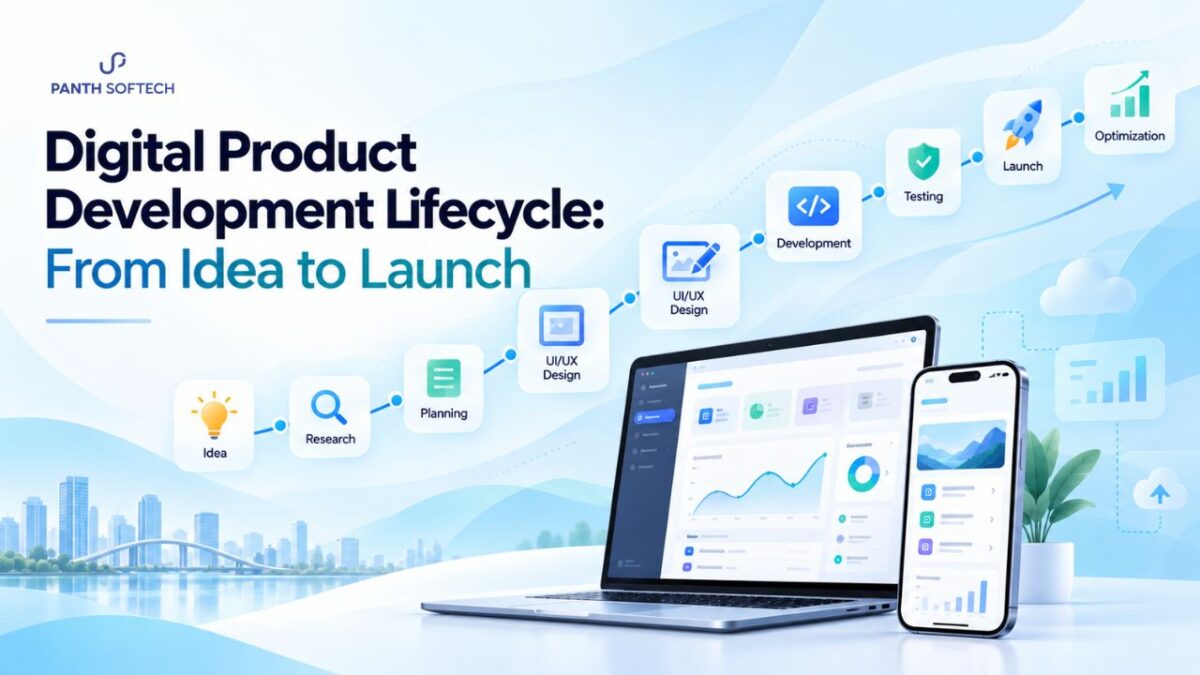
A strong digital product may begin with a simple idea, but turning that idea into something people actually want to use requires much more than development alone. Businesses need to understand the problem, research users, define requirements, design the experience, build the right features, test the product, and continue improving it after launch.
The digital product development lifecycle provides a structured way to manage this journey. Whether you are creating a mobile app, SaaS platform, web application, or another software solution, following clear product development stages can reduce uncertainty, improve collaboration, and help teams focus on building features that create real value for users and the business.
What Is the Digital Product Development Lifecycle?
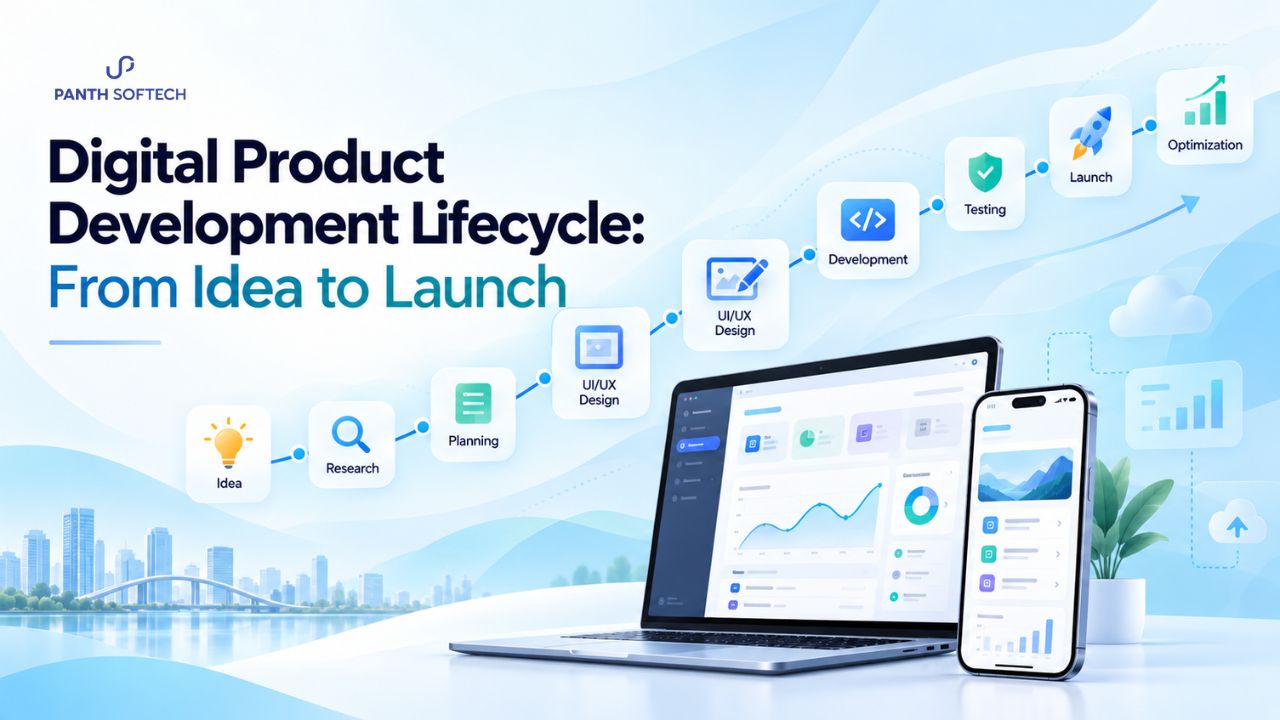
The digital product development lifecycle is the structured process of taking a digital product from an initial idea to launch and continuous improvement. It combines business planning, user research, product strategy, design, development, testing, deployment, and ongoing optimization.
Although every product is different, most digital products move through similar stages. A simple mobile application may require fewer resources, while a complex SaaS or enterprise platform may involve more detailed requirements, integrations, security considerations, and testing.
A typical digital product lifecycle includes:
- Idea validation
- Product discovery and research
- Product strategy
- Requirements planning
- UX and UI design
- MVP development
- Product development
- Testing and validation
- Product launch
- Continuous improvement
Following a structured lifecycle helps teams understand not only what needs to be built, but also why it should be built and how it will support user and business goals.
Digital Product Development Lifecycle at a Glance
| Stage | Main Purpose |
| Idea | Identify the problem or opportunity |
| Discovery | Understand users, competitors, and the market |
| Strategy | Define product goals and direction |
| Requirements | Decide what needs to be built |
| Design | Plan the user experience and interface |
| MVP | Build the essential first version |
| Development | Build the product functionality |
| Testing | Check quality, usability, and performance |
| Launch | Release the product to users |
| Improvement | Use feedback and data to improve the product |
These stages are connected rather than completely separate. Research may influence strategy, testing may reveal design changes, and post-launch feedback may create new product requirements. A flexible but structured approach allows teams to respond to new information without losing sight of the main product goals.
1. Start With a Clear Product Idea
Every digital product begins with a problem, opportunity, or business need. Before discussing technology or features, teams should clearly understand what problem they want to solve and who is experiencing it.
Useful questions include:
- Who is experiencing the problem?
- How are users solving it today?
- What limitations exist in current solutions?
- Can a digital product provide a better experience?
- What would make the product useful or different?
A clear problem statement provides direction for the entire project. It can also prevent teams from adding unnecessary features before understanding what users actually need.
2. Conduct Product Discovery and Market Research
The product discovery process turns an initial idea into a more informed product concept. This stage focuses on understanding users, competitors, market conditions, and existing solutions before significant development begins.
Research may include user interviews, surveys, competitor analysis, market research, keyword research, customer feedback, and analysis of similar products. The objective is to understand whether there is genuine demand and what users expect from the solution.
Good product discovery can reveal potential risks early. It may also show that certain features are less important than originally expected, helping businesses avoid unnecessary development costs.
For companies that are still validating a concept, working with an experienced digital product development team during discovery can help create a clearer direction before moving into design and development.
3. Define Your Digital Product Strategy
Once the problem and market opportunity are understood, the next step is creating a digital product strategy. The strategy connects the product idea with broader business objectives and defines how the product is expected to create value.
A product strategy should clarify areas such as:
- Target audience
- Main user problems
- Product goals
- Core features
- Business model
- Revenue opportunities
- Technology requirements
- Launch objectives
- Key performance indicators
For example, a SaaS platform may focus on reducing manual work for businesses, while a consumer mobile application may focus on improving convenience or engagement.
A clear strategy keeps product managers, designers, developers, marketers, and business stakeholders aligned throughout the project.
4. Plan Product Requirements
The next stage is converting the product strategy into specific requirements. This part of the product development process defines what the product should do and what functionality must be included.
Requirements may cover user roles, core features, integrations, security needs, platform requirements, data management, performance expectations, and technical specifications.
Feature prioritization is especially important at this stage. Trying to include every possible feature in the first release can increase cost, development time, and complexity.
A practical approach is to divide features into essential requirements, important additions, and future improvements. This helps the development team focus first on the functionality that delivers the most immediate value.
5. Design the User Experience and Interface
Product design is not only about making an interface visually attractive. It also determines how easily users can understand, navigate, and interact with the product.
The design process may include user flows, wireframes, prototypes, interface design, navigation planning, and usability considerations. These elements help teams visualize how the product will work before development begins.
For example, an e-commerce application needs a clear journey from searching for a product to viewing details, adding items to the cart, completing payment, and tracking an order.
Testing these flows during the design stage can identify usability problems early, when they are easier and less expensive to change.
6. Build an MVP
One of the most important concepts in modern digital product development is the Minimum Viable Product, commonly known as an MVP.
MVP development focuses on building the smallest useful version of a product that can solve the main user problem. The purpose is to validate important assumptions and collect feedback without spending unnecessary time and resources on secondary features.
For example, an MVP for a food delivery application may include restaurant listings, product selection, cart functionality, payment, and order tracking. Loyalty programs, advanced recommendations, and other additional features can be introduced later.
An MVP should not be considered an incomplete product. It should be a focused and usable first version that helps teams learn from real users before expanding the product further.
7. Develop the Digital Product
Once requirements and designs are ready, the development stage begins. Developers select an appropriate technology stack and build the front end, back end, databases, APIs, integrations, and other required systems.
The technologies used depend on the product. A mobile application may require native or cross-platform development, while a web platform may use a combination of front-end, back-end, database, and cloud technologies.
Development is often divided into smaller cycles. Features can be built, reviewed, tested, and improved instead of waiting until the entire product is complete.
Regular communication between developers, designers, product managers, and stakeholders is important during this stage to prevent misunderstandings and keep development aligned with the agreed requirements.
8. Test and Validate the Product
Testing should happen throughout development rather than only immediately before launch. Product testing and validation help teams identify technical problems, usability issues, security concerns, and performance limitations.
Common testing activities include:
- Functional testing
- Usability testing
- Performance testing
- Compatibility testing
- Security testing
- Integration testing
- User acceptance testing
Real users may also be involved during validation. Their feedback can reveal problems that internal teams may not notice.
Product validation should answer two important questions: does the software work correctly, and does it actually solve the problem it was designed to address?
9. Launch the Product
Once major issues have been resolved, the product can be prepared for launch. This stage involves more than simply making the application available to users.
Launch preparation may include final quality checks, deployment, app store submission, analytics configuration, documentation, customer support planning, marketing materials, and launch communication.
Some businesses may choose a controlled or phased launch rather than releasing the product to everyone immediately. This approach allows the team to observe real-world performance, identify unexpected problems, and make improvements before expanding to a larger audience.
The launch should therefore be viewed as the beginning of real product usage rather than the end of development.
10. Collect Feedback and Improve
After launch, real users begin generating valuable information about how the product performs. This data can help teams understand what is working well and what needs improvement.
Teams may monitor:
- User engagement
- Conversion rates
- Retention
- Feature usage
- Customer feedback
- Error reports
- Performance
- Support requests
These insights help determine which updates should be prioritized. Some improvements may focus on fixing issues, while others may introduce new features or simplify existing experiences.
The digital product lifecycle is continuous because user expectations, technologies, competitors, and business goals continue to change after launch.
Who Is Involved in Digital Product Development?
Successful product development usually requires collaboration between several roles. The exact team depends on the size and complexity of the project, but responsibilities generally extend beyond developers alone.
A product manager or product owner helps define priorities and business requirements. Business analysts may translate business needs into detailed requirements, while UI/UX designers focus on user journeys and interface design.
Front-end, back-end, and mobile developers build the technical solution. QA engineers test the product, while DevOps or cloud specialists may manage infrastructure, deployment, and application environments.
Marketing teams, customer support teams, and business stakeholders can also provide important input during launch and post-launch improvement.
Strong coordination between these roles helps keep the product aligned with both user expectations and business objectives.
How Long Does Digital Product Development Take?
There is no fixed timeline for developing a digital product because every project has different requirements.
The total duration can depend on product complexity, number of features, platforms, integrations, design requirements, security needs, existing systems, testing requirements, and available development resources.
An MVP with a focused feature set will generally require less effort than a full-scale platform with multiple user roles, advanced integrations, analytics, automation, and complex workflows.
Clear product discovery and requirement planning can make timeline estimates more realistic. They also reduce the risk of major changes appearing after development has already started.
Common Mistakes in Digital Product Development
Even a strong product idea can face difficulties when the development process is not properly managed.
Building Without Understanding Users
Starting development before researching users can result in a product that technically works but does not solve an important problem. Product decisions should be based on real user needs rather than assumptions alone.
Adding Too Many Features
Including too many features in the first release can increase development time, cost, and complexity. Starting with the most important functionality makes it easier to validate the product before expanding it.
Ignoring User Feedback
Customer feedback and product analytics provide valuable information after launch. Ignoring them can make it difficult to identify usability problems or understand which features users value most.
Leaving Testing Until the End
When testing happens only before launch, problems can become more difficult and expensive to fix. Testing throughout development allows issues to be identified much earlier.
Focusing Only on Technology
A successful digital product needs more than good code. Research, strategy, UX design, testing, analytics, marketing, and ongoing improvement all contribute to the final result.
Best Practices for Successful Digital Product Development
A strong digital product development process should remain focused on solving user problems instead of simply adding more features.
Teams should validate important assumptions before major development begins and prioritize functionality according to user and business value. Regular testing should be included throughout the project rather than treated as a final task.
Stakeholders should also remain aligned on priorities, requirements, and changes. Clear communication reduces unnecessary rework and helps teams make faster decisions.
After launch, analytics and customer feedback should guide future updates. A structured lifecycle provides direction, while flexibility allows the product to evolve when research or real user behavior reveals new opportunities.
Why Choose Panth Softech for Digital Product Development?
Developing a digital product requires coordination between business strategy, design, technology, testing, and long-term improvement. Panth Softech helps businesses manage these different stages through a structured development approach.
The team can support product discovery and planning to help define requirements before development starts. UI/UX design can then translate these requirements into practical user flows, wireframes, and interfaces.
Panth Softech also supports MVP development and custom software development for businesses that need mobile apps, SaaS platforms, web applications, or other digital solutions. API integrations, testing, deployment, and ongoing improvements can also be included according to project requirements.
Whether you are starting with an early product idea or modernizing an existing digital solution, Panth Softech can help create a development approach aligned with your users, technical requirements, and long-term business goals.
Conclusion
The digital product development lifecycle provides a practical framework for turning an idea into a useful and market-ready product. From product discovery and strategy to UX design, MVP development, testing, launch, and continuous improvement, each stage helps reduce uncertainty and keep the product aligned with real user needs.
Successful software product development requires more than writing code. It combines business planning, user research, design, technology, testing, and continuous learning.
If you are planning a mobile application, SaaS platform, web solution, or custom digital product, Panth Softech can support your project from product discovery and MVP planning through development, testing, deployment, and post-launch improvement.
Talk to Panth Softech about your digital product idea and create a clear development path from concept to launch.
FAQs About Digital Product Development
1. What are the main stages of the digital product development lifecycle?
The main stages usually include idea validation, product discovery, strategy, requirements planning, UX/UI design, MVP development, software development, testing, launch, and continuous improvement. The exact process may vary depending on the product and business requirements.
2. What is product discovery in digital product development?
Product discovery is the process of researching users, competitors, market conditions, and business requirements before major development begins. It helps teams understand whether the idea solves a real problem and what features should be prioritized.
3. What is an MVP in digital product development?
An MVP is a focused first version of a product that contains the essential functionality required to solve the main user problem. It allows businesses to collect real feedback before investing in more advanced features.
4. What is the difference between product development and software development?
Software development mainly focuses on building and maintaining the technical solution. Product development has a wider scope that also includes research, strategy, UX design, validation, launch planning, analytics, and ongoing product improvement.
5. Does digital product development end after launch?
No. Launch is only one stage of the lifecycle. Businesses should continue monitoring performance, user behavior, feedback, technical issues, and market changes so the product can be improved over time.