Panth Softech Team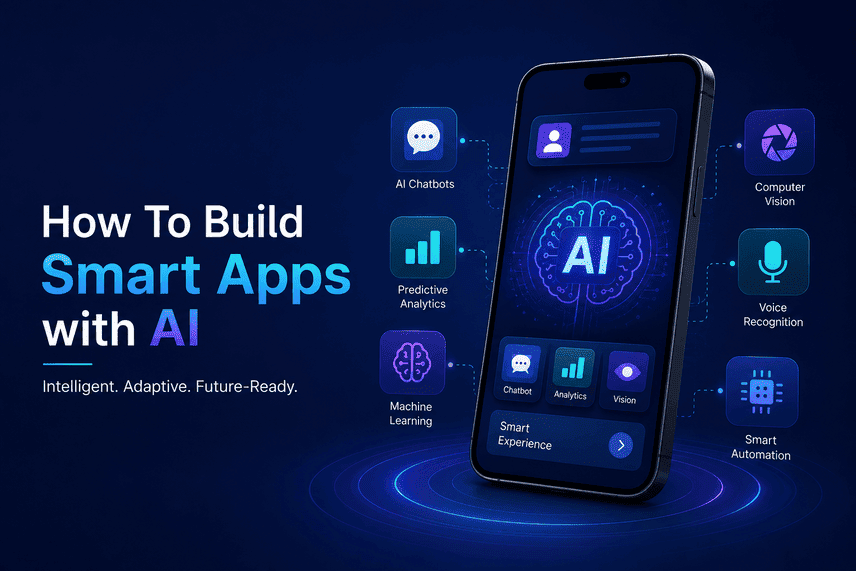
How can businesses build smarter mobile apps using artificial intelligence? The answer lies in integrating AI capabilities that enable applications to learn, adapt, and make intelligent decisions in real time. Today’s users expect mobile apps to offer personalized recommendations, voice interactions, predictive insights, and seamless experiences rather than simply performing predefined tasks. As customer expectations continue to evolve, AI in Mobile Applications has become a key technology for delivering more engaging, efficient, and user-centric digital experiences.
Modern AI Mobile Application Development combines technologies such as machine learning, natural language processing (NLP), computer vision, and predictive analytics to create applications that continuously improve through user interactions and data analysis. From intelligent chatbots and recommendation engines to fraud detection and image recognition, AI helps businesses automate processes, enhance decision-making, and deliver greater value to users across industries such as healthcare, retail, finance, manufacturing, and logistics.
In this guide, we’ll explore how AI is transforming mobile app development, the technologies behind intelligent mobile applications, the key benefits and challenges of AI adoption, and the future of building smarter, AI-powered mobile experiences. Whether you’re planning a new mobile application or enhancing an existing one, understanding the role of AI can help you create innovative solutions that drive user engagement and long-term business growth.
Key Takeaways
- AI in Mobile Applications enables personalized, intelligent, and context-aware user experiences.
- AI Mobile Application Development combines machine learning, computer vision, and natural language processing to build smarter applications.
- AI improves mobile apps through automation, predictive analytics, intelligent recommendations, and enhanced security.
- Businesses across healthcare, retail, finance, logistics, and manufacturing are using AI to increase engagement and operational efficiency.
- Organizations investing in AI-powered mobile applications gain a competitive advantage through innovation, automation, and better customer experiences.
What is AI Mobile App Development?
AI Mobile Application Development is the process of integrating artificial intelligence technologies into mobile applications to enable intelligent decision-making, personalized user experiences, automation, and real-time data analysis.
Today’s AI-enabled mobile applications leverage multiple technologies, including:
- Machine Learning (ML)
- Natural Language Processing (NLP)
- Computer Vision
- Voice Recognition
- Predictive Analytics
- Recommendation Engines
- Intelligent Automation
- On-device AI
These capabilities enable businesses to deliver applications that are faster, smarter, and more responsive to user needs.
From virtual assistants and personalized shopping experiences to fraud detection and healthcare diagnostics, AI has become an essential component of modern mobile application development.
Why AI in Mobile Applications Matters
Mobile applications have become the primary digital touchpoint between businesses and their customers. As user expectations continue to evolve, businesses need applications that not only perform tasks but also understand user intent, anticipate needs, and deliver meaningful experiences.
This is where AI in Mobile Applications creates significant business value.
Rather than simply responding to user inputs, AI-powered applications continuously analyze behavior, identify patterns, and make intelligent decisions that improve engagement, efficiency, and customer satisfaction.
Deliver Personalized User Experiences
Every user interacts with mobile applications differently. Artificial intelligence analyzes browsing behavior, purchase history, location, preferences, and engagement patterns to provide personalized recommendations and experiences tailored to each individual.
Whether suggesting products, recommending content, or customizing dashboards, AI helps businesses create experiences that keep users engaged.
Improve Customer Engagement
AI-powered notifications, personalized offers, intelligent recommendations, and contextual messaging significantly improve user engagement.
Instead of sending generic updates, mobile applications can communicate with users based on their preferences, activities, and behavioral patterns, increasing interaction and retention.
Automate Routine Tasks
Artificial intelligence automates repetitive processes that would otherwise require manual effort.
Examples include:
- Smart form completion
- Customer support automation
- Intelligent scheduling
- Automated content categorization
- Expense tracking
- Image tagging
Automation improves productivity while allowing users to focus on higher-value activities.
Enable Smarter Business Decisions
Modern mobile applications generate enormous amounts of operational and customer data.
By applying AI algorithms, businesses gain actionable insights into user behavior, product usage, engagement trends, and customer preferences, enabling faster and more informed decision-making.
Organizations investing in intelligent mobile platforms often complement them with Artificial Intelligence Services to build scalable AI strategies that support long-term innovation and business growth.
Increase Operational Efficiency
AI streamlines business operations by reducing manual intervention, optimizing workflows, and improving resource utilization.
From intelligent scheduling and predictive maintenance to automated approvals and fraud detection, AI enables organizations to operate more efficiently while delivering superior user experiences.
Strengthen Security
Artificial intelligence continuously monitors user activity, detects unusual behavior, identifies potential security threats, and strengthens authentication mechanisms.
AI-powered security significantly improves fraud prevention while protecting sensitive customer and enterprise data.
How AI Makes Mobile Applications Smarter
Artificial intelligence transforms mobile applications from static software into intelligent digital assistants capable of learning, adapting, and making decisions.
Instead of relying solely on predefined programming logic, AI continuously improves application performance by analyzing user interactions, contextual information, and business data.
Personalized User Experiences
AI analyzes user preferences, browsing history, purchase behavior, and engagement patterns to deliver personalized content, recommendations, and application experiences.
This increases user satisfaction while improving retention and conversion rates.
Intelligent Search & Recommendations
Recommendation engines use AI algorithms to suggest products, services, videos, music, articles, or content based on user interests and historical behavior.
These intelligent recommendations improve discovery while increasing customer engagement.
Predictive Analytics
Using Predictive Analytics, mobile applications anticipate future user behavior based on historical trends and real-time interactions.
Businesses use predictive models to:
- Forecast customer demand
- Recommend products
- Predict user churn
- Improve marketing campaigns
- Optimize business operations
AI Chatbots & Virtual Assistants
Modern mobile applications increasingly incorporate AI-powered virtual assistants capable of answering questions, resolving issues, scheduling appointments, and assisting users through conversational interfaces.
These intelligent assistants improve customer support while reducing operational costs.
Fraud Detection & Risk Analysis
Financial institutions, eCommerce platforms, and enterprise applications use AI to detect unusual transaction patterns, identify fraudulent activities, and minimize security risks in real time.
Real-Time Decision Making
AI enables mobile applications to analyze incoming information instantly and respond with intelligent recommendations or automated actions.
Whether adjusting pricing, recommending services, or detecting anomalies, AI supports Real-Time Decision Making that enhances both user experience and business performance.
How Machine Learning Powers Intelligent Mobile Applications
Artificial intelligence is powered by several underlying technologies, with Machine Learning (ML) serving as one of the most important. Machine learning enables mobile applications to continuously learn from user interactions, recognize patterns, and improve performance without requiring explicit programming for every scenario.
Unlike traditional mobile applications that rely on predefined business rules, Machine Learning Mobile Apps analyze large volumes of data to make intelligent predictions, automate decisions, and deliver personalized user experiences.
As businesses continue investing in AI Mobile Application Development, machine learning has become a core capability for building adaptive, scalable, and intelligent applications.
- Learning from User Behavior
- Personalized Recommendations
- Predictive User Insights
- Intelligent Automation
- Continuous Application Improvement
AI Technologies Transforming Mobile Applications
Modern AI in Mobile Applications combines multiple artificial intelligence technologies to deliver intelligent, context-aware, and highly personalized experiences.
Rather than relying on a single AI model, today’s applications integrate several specialized technologies that work together to improve user engagement, security, and operational efficiency.
Computer Vision
Computer Vision enables mobile applications to understand and interpret visual information captured through a smartphone camera.
Common use cases include:
- Face Recognition
- Object Detection
- Image Classification
- OCR (Optical Character Recognition)
- Barcode & QR Code Scanning
- Identity Verification
- Medical Image Analysis
- Visual Search
Computer vision is widely used across healthcare, retail, manufacturing, logistics, and financial services.
Organizations building advanced image recognition solutions often complement mobile AI initiatives with Computer Vision Solutions to create intelligent applications capable of understanding and processing visual data in real time.
Voice Recognition & Natural Language Processing
Voice interfaces are becoming an essential feature of modern mobile applications.
Using Natural Language Processing (NLP) and speech recognition, applications can understand spoken language, interpret user intent, and respond naturally.
Popular capabilities include:
- Speech-to-Text
- Voice Commands
- Voice Search
- Conversational AI
- AI Voice Assistants
- Language Translation
- Sentiment Analysis
- Smart Replies
Voice technologies create hands-free experiences that improve accessibility and customer engagement.
Intelligent Chatbots & AI Assistants
AI-powered assistants help users perform tasks more efficiently through natural conversations.
Mobile applications use intelligent assistants for:
- Customer support
- Appointment scheduling
- Order tracking
- FAQ automation
- Product recommendations
- Travel assistance
- Healthcare guidance
- Banking support
Unlike traditional chatbots, modern AI assistants understand context and provide more accurate, personalized responses.
Predictive Analytics
Predictive Analytics allows mobile applications to anticipate future events using historical and real-time data.
Businesses use predictive models to:
- Forecast demand
- Detect fraud
- Predict equipment failures
- Recommend products
- Improve inventory planning
- Identify customer churn
- Optimize pricing
These insights enable organizations to make proactive decisions rather than reacting to problems after they occur.
Edge AI
Cloud-based AI isn’t always the best solution.
Edge AI processes artificial intelligence models directly on mobile devices without sending sensitive information to external servers.
Benefits include:
- Faster processing
- Improved privacy
- Reduced latency
- Offline AI capabilities
- Lower cloud costs
- Better user experience
Edge AI is becoming increasingly important for healthcare, financial services, manufacturing, and enterprise mobility applications.
Benefits of AI Mobile Application Development
Businesses across industries are investing in AI Mobile Application Development because it delivers measurable improvements in customer experience, operational efficiency, and business performance.
Here are some of the most significant benefits.
Personalized Customer Experiences
Artificial intelligence analyzes user preferences, behaviors, and interactions to deliver highly personalized recommendations, content, and services that improve customer satisfaction and engagement.
Higher User Engagement
AI-powered recommendations, intelligent notifications, and contextual experiences encourage users to interact with mobile applications more frequently, increasing retention and long-term engagement.
Smarter Business Automation
Artificial intelligence automates repetitive workflows, customer support, data processing, approvals, and administrative tasks, enabling businesses to operate more efficiently while reducing manual effort.
Better Decision-Making
AI continuously analyzes customer behavior, operational metrics, and business performance, helping organizations make faster, more informed decisions supported by reliable insights.
Improved Security
Artificial intelligence enhances fraud detection, anomaly detection, biometric authentication, and threat monitoring, strengthening application security while protecting sensitive customer information.
Operational Efficiency
By automating routine tasks and optimizing workflows, AI helps organizations reduce operational costs while improving productivity and service quality.
Competitive Advantage
Businesses that integrate AI into mobile applications can deliver innovative customer experiences, launch intelligent products faster, and differentiate themselves in increasingly competitive digital markets.
How AI Is Transforming Mobile App Development
Artificial intelligence is no longer limited to technology companies. Organizations across industries are integrating AI into mobile applications to improve customer experiences, streamline operations, and accelerate innovation.
Here are some of the most impactful industry applications.
- Healthcare
- Financial Services
- Retail & eCommerce
- Logistics & Supply Chain
- Manufacturing
- Enterprise Mobility
Challenges of AI Mobile Application Development
While artificial intelligence unlocks significant opportunities for innovation, building intelligent mobile applications also introduces technical, operational, and business challenges. Organizations must address these challenges early to ensure successful implementation and long-term scalability.
Data Quality & Availability
Artificial intelligence models rely heavily on high-quality data. Incomplete, inconsistent, or biased datasets can lead to inaccurate predictions, poor recommendations, and unreliable application performance.
To maximize AI effectiveness, businesses should establish robust data collection, validation, and governance practices before deploying AI-powered features.
Data Privacy & Security
AI-powered mobile applications often process sensitive user information, including personal data, behavioral insights, financial transactions, and location data.
Organizations must implement:
- Secure authentication
- Data encryption
- Privacy controls
- Consent management
- Secure APIs
- Compliance with regulations such as GDPR and HIPAA (where applicable)
Protecting user trust should remain a top priority throughout the AI development lifecycle.
Model Accuracy & AI Bias
Artificial intelligence is only as reliable as the data used to train it.
Poorly trained models may:
- Produce inaccurate recommendations
- Misinterpret user intent
- Introduce algorithmic bias
- Generate inconsistent results
Continuous testing, monitoring, and model refinement are essential to improve accuracy while minimizing unintended bias.
Performance & Device Limitations
Mobile devices have limited processing power, battery life, and storage compared to cloud infrastructure.
Developers must carefully balance:
- AI model complexity
- Application speed
- Memory consumption
- Battery optimization
- Offline functionality
Modern approaches such as Edge AI help address many of these challenges by enabling efficient on-device processing.
Integration with Existing Systems
Many organizations need AI-powered mobile applications to integrate with ERP platforms, CRM systems, payment gateways, cloud services, and third-party APIs.
Without a well-planned integration strategy, disconnected systems can create data silos and reduce the effectiveness of AI-driven insights.
Continuous Maintenance & Model Improvement
Unlike traditional software, AI applications require continuous optimization.
Businesses must regularly:
- Retrain AI models
- Update datasets
- Improve prompts
- Monitor AI performance
- Introduce new capabilities
- Adapt to changing user behavior
AI should be treated as an evolving business capability rather than a one-time implementation.
The Future of AI in Mobile Application Development
Artificial intelligence is rapidly becoming a standard component of modern mobile applications. As AI technologies mature, mobile experiences will become increasingly autonomous, context-aware, and personalized.
Several emerging trends are expected to shape the future of AI Mobile Application Development.
AI Agents Inside Mobile Applications
The next generation of mobile apps will move beyond simple chatbots toward autonomous AI agents capable of reasoning, planning, and executing complex tasks on behalf of users.
Examples include:
- Personal productivity assistants
- Intelligent shopping assistants
- Healthcare companions
- Financial advisors
- Enterprise workflow assistants
These agents will significantly reduce manual effort while improving user productivity.
Hyper-Personalized User Experiences
Future AI applications will analyze contextual information such as user preferences, location, behavior, device usage, and historical interactions to deliver highly personalized experiences in real time.
Personalization will extend beyond recommendations to entire application workflows.
Edge AI & On-Device Intelligence
More AI processing will move directly onto mobile devices.
Edge AI enables:
- Faster responses
- Offline functionality
- Improved privacy
- Reduced cloud dependency
- Lower latency
- Better battery optimization
This trend is expected to accelerate as mobile hardware continues to evolve.
Generative AI Integration
Generative AI is transforming how users interact with mobile applications.
Future mobile apps will increasingly generate:
- Personalized content
- Intelligent summaries
- Marketing copy
- Reports
- Emails
- Images
- Code suggestions
- Dynamic user interfaces
These capabilities will improve productivity while creating more engaging user experiences.
Responsible & Explainable AI
As AI adoption increases, businesses will place greater emphasis on transparency, governance, fairness, and explainability.
Organizations will need AI systems that are:
- Ethical
- Secure
- Transparent
- Auditable
- Compliant
- Human-supervised
Responsible AI practices will become an important competitive differentiator.
How Panth Softech Helps Build Intelligent AI-Powered Mobile Applications
Building successful AI-powered mobile applications requires more than integrating machine learning models. It requires a deep understanding of business objectives, user behavior, cloud infrastructure, enterprise systems, and modern AI technologies.
At Panth Softech, we help organizations design, develop, and scale intelligent mobile applications that combine artificial intelligence, automation, analytics, and cloud-native architecture to deliver exceptional digital experiences.
Businesses looking to create intelligent mobile experiences can also leverage our AI Agent Development Services to build autonomous AI assistants capable of automating workflows, supporting users, and enhancing productivity across enterprise applications.
Additionally, our expertise in Cloud Application Development Services enables organizations to deploy scalable, secure, and high-performance AI-powered mobile applications that seamlessly integrate with modern cloud ecosystems.
Ready to Build an AI-Powered Mobile Application?
Whether you’re developing a customer-facing app, modernizing an enterprise mobility platform, or integrating artificial intelligence into an existing mobile solution, Panth Softech can help you transform your vision into a scalable, intelligent application.
Our team combines AI expertise, mobile engineering, cloud technologies, and enterprise integration capabilities to build secure, high-performance applications that deliver measurable business outcomes.
Talk to Our AI & Mobile Application Experts Today
Frequently Asked Questions
What is AI in Mobile Applications?
AI in Mobile Applications refers to integrating artificial intelligence technologies such as machine learning, natural language processing, computer vision, and predictive analytics into mobile apps to automate tasks, personalize user experiences, and improve decision-making.
How does AI improve mobile applications?
AI improves mobile applications by delivering personalized recommendations, intelligent search, predictive insights, voice interactions, fraud detection, automation, and real-time decision-making, resulting in better user engagement and operational efficiency.
What industries benefit from AI Mobile Application Development?
Healthcare, Financial Services, Retail, eCommerce, Manufacturing, Logistics, Education, Travel, Hospitality, and Enterprise businesses use AI Mobile Application Development to improve customer experiences, automate workflows, and increase operational efficiency.
What technologies are commonly used in AI-powered mobile apps?
Modern AI-powered mobile applications commonly use Machine Learning, Natural Language Processing (NLP), Computer Vision, Voice Recognition, Predictive Analytics, Edge AI, Recommendation Engines, and Generative AI technologies.
Is AI Mobile Application Development suitable for startups?
Yes. Startups can integrate AI into mobile applications to automate operations, personalize customer experiences, improve user engagement, and accelerate innovation. Starting with focused AI features and expanding over time is often the most practical approach.
What are the biggest challenges of AI Mobile Application Development?
Common challenges include data quality, privacy, model accuracy, integration complexity, device performance, ongoing AI model maintenance, and ensuring responsible AI implementation.