Panth Softech Team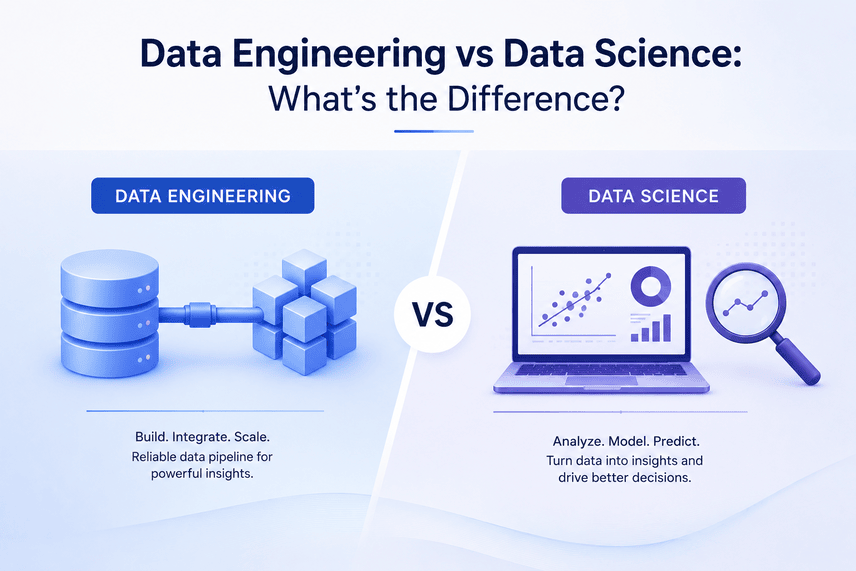
Businesses generate massive amounts of data from websites, mobile apps, transactions, customer interactions, social media, IoT devices, and internal systems. But collecting data is only the beginning. Businesses also need reliable systems to organize, process, analyze, and turn that data into useful insights.
This is where data engineering and data science play important roles. While the two disciplines work closely together, they solve different problems. Data engineers build the infrastructure and pipelines that make data reliable and accessible, while data scientists analyze that data to discover patterns, build predictive models, and support business decisions.
In this guide, we’ll explore Data Engineering vs Data Science, their responsibilities, skills, tools, differences, use cases, and how they work together.
What Is Data Engineering?
Data engineering is the process of building and managing the systems that collect, process, store, and deliver reliable data. Data engineers create pipelines that move information from multiple sources into databases, data warehouses, or data lakes. They also transform data into usable formats and focus on data quality, scalability, security, and performance.
For example, an e-commerce company may collect information from its website, mobile application, payment system, customer support platform, and marketing tools. A data engineer can build pipelines that bring this information together into a reliable data environment.
Common Data Engineering Responsibilities
- Collecting data from different sources
- Building and maintaining data pipelines
- Developing ETL and ELT processes
- Cleaning and transforming data
- Managing databases and data warehouses
- Integrating different systems
- Monitoring data quality
- Managing cloud-based data infrastructure
- Improving data processing performance
- Supporting data security and governance
The primary goal of data engineering is to create a reliable data foundation that analysts, data scientists, and business teams can use.
What Is Data Science?
Data science focuses on analyzing data to discover patterns, answer business questions, make predictions, and support decision-making. Data scientists use statistics, programming, mathematics, machine learning, and analytical techniques to understand existing data and predict potential outcomes.
For example, a retail company may want to identify customers who are likely to stop purchasing. A data scientist can analyze customer behavior and develop a predictive model to identify customers who may be at risk of leaving.
Common Data Science Responsibilities
- Exploring and analyzing data
- Identifying patterns and trends
- Performing statistical analysis
- Building predictive models
- Developing machine learning models
- Testing and evaluating models
- Creating forecasts
- Visualizing data
- Communicating findings to business teams
The goal is to turn available data into insights, predictions, and business value.
Data Engineering vs Data Science: Key Difference
The easiest way to understand the difference is to look at how each discipline works with data. Data engineering builds the foundation. Data science uses that foundation to generate insights and predictions.
For example:
- Data Engineer: Collects customer data from multiple systems, cleans it, transforms it, and stores it in a data warehouse.
- Data Scientist: Uses prepared data to identify customer behavior patterns and predict future purchasing behavior.
Both roles are important, but their objectives are different.
Data Engineering vs Data Science Comparison
| Factor | Data Engineering | Data Science |
| Primary goal | Build reliable data infrastructure | Generate insights and predictions |
| Main focus | Data collection, processing, and storage | Data analysis, modeling, and prediction |
| Key activities | Pipelines, integration, ETL/ELT, data management | Statistics, machine learning, predictive modeling |
| Common languages | SQL, Python | Python, R, SQL |
| Mathematics | Moderate | Higher emphasis |
| Machine learning | Supports data and ML infrastructure | Develops and evaluates ML models |
| Main output | Reliable and accessible data | Insights, models, and predictions |
| Business value | Makes data usable at scale | Helps businesses make data-driven decisions |
Data Engineer vs Data Scientist: Responsibilities
Although there can be some overlap, their day-to-day responsibilities are usually different.
Data Engineer Responsibilities
Data engineers typically focus on:
- Designing data pipelines
- Integrating multiple data sources
- Building ETL and ELT workflows
- Managing databases and warehouses
- Processing large datasets
- Monitoring data quality
- Improving pipeline performance
- Managing cloud data infrastructure
Their work ensures that the right data reaches the right place in a reliable and usable format.
Data Scientist Responsibilities
Data scientists typically focus on:
- Analyzing datasets
- Identifying trends and patterns
- Performing statistical analysis
- Building machine learning models
- Creating forecasts
- Evaluating model performance
- Developing predictive solutions
- Communicating findings to stakeholders
Their work focuses on extracting meaning and predictive value from data.
Data Engineering Skills vs Data Science Skills
The two fields share some technical skills, but their areas of specialization differ.
Data Engineering Skills
Important data engineering skills include:
- SQL
- Python
- Database management
- Data modeling
- ETL and ELT
- Data pipeline development
- Cloud platforms
- Distributed data processing
- Data warehousing
- API and system integration
Data engineers also need to understand how different systems exchange, process, and store information.
Data Science Skills
Important data science skills include:
- Python or R
- Statistics
- Mathematics
- Data analysis
- Machine learning
- Predictive modeling
- Data visualization
- Feature engineering
- Model evaluation
- Business analysis
Data scientists also need to communicate technical findings clearly so business teams can act on them.
Data Engineering Tools
Data engineers use tools for data collection, processing, integration, storage, and workflow management.
Common examples include:
- Apache Spark
- Apache Kafka
- Apache Airflow
- SQL databases
- Cloud data warehouses
- Data lakes
- ETL platforms
- Python
- Cloud storage services
The right technology depends on data volume, infrastructure, business requirements, and whether the organization needs batch or real-time processing.
Data Science Tools
Data science tools are generally focused on analysis, experimentation, visualization, and machine learning.
Common tools include:
- Python
- R
- Jupyter Notebook
- Pandas
- NumPy
- Scikit-learn
- TensorFlow
- PyTorch
- Matplotlib
- Power BI and other visualization platforms
The appropriate tools depend on the type of analysis, dataset, and model being developed.
Data Engineering vs Data Science vs Data Analytics
Data engineering, data analytics, and data science are related but serve different purposes.
A simple way to understand them is:
- Data Engineering: Makes data available, reliable, and usable.
- Data Analytics: Explains what happened and helps identify trends.
- Business Intelligence: Presents important business metrics through reports and dashboards.
- Data Science: Uses statistics and machine learning to predict what may happen next.
For example, in a retail business:
Data Engineering → Collects and prepares sales data
Data Analytics → Identifies monthly sales trends
Business Intelligence → Displays KPIs through dashboards
Data Science → Predicts future sales and customer demand
Together, these disciplines create a complete data-driven decision-making process.
How Data Engineering and Data Science Work Together
Data engineering and data science should not be treated as completely separate functions. They often work together as parts of the same data ecosystem.
Consider an online retail business.
Step 1: Collect Data
Data engineers collect information from:
- Website activity
- Customer orders
- Product catalogs
- Payment systems
- Customer support
- Marketing campaigns
Step 2: Process and Organize Data
The data is cleaned, transformed, validated, and stored in a suitable data warehouse, data lake, or other platform.
Step 3: Analyze the Data
Data scientists and analysts can then use the prepared data to:
- Predict customer demand
- Identify customer segments
- Recommend products
- Detect unusual transactions
- Forecast sales
- Understand customer behavior
Step 4: Apply Business Insights
The resulting insights can help the business improve marketing, inventory planning, customer experience, risk management, and operational decisions.
This workflow shows why strong data engineering is often the foundation for successful data science initiatives.
If your organization is struggling with fragmented data, unreliable pipelines, or disconnected systems, Panth Softech can help design data and analytics solutions aligned with your business requirements.
Role of Machine Learning in Data Science
Machine learning is an important part of modern data science. Data scientists use machine learning algorithms to identify patterns and create models that can make predictions or classifications.
Common applications include:
- Customer churn prediction
- Fraud detection
- Product recommendations
- Demand forecasting
- Customer segmentation
- Image recognition
- Predictive maintenance
However, machine learning depends heavily on data quality. Incomplete, inconsistent, or poorly prepared data can negatively affect model performance.
This is one of the key reasons data engineering and data science need to work closely together.
How Businesses Benefit from Data Engineering and Data Science
Organizations can use both disciplines to improve how they manage information and make decisions.
Better Decision-Making
Reliable data gives business leaders a clearer understanding of customers, performance, operations, and market trends.
Improved Customer Experience
Data science can help identify customer preferences and behavior, enabling businesses to improve personalization and customer engagement.
Operational Efficiency
Data engineering can automate data collection and processing, while analytics and data science can identify opportunities to reduce delays, costs, and inefficiencies.
Predictive Insights
Data science can help businesses forecast demand, identify risks, and understand potential future outcomes.
Better Business Intelligence
A reliable data foundation combined with analytics and visualization can provide teams with accurate dashboards and business metrics.
When Should a Business Invest in Data Engineering?
A business may need data engineering when information is spread across multiple systems or existing data processes are becoming difficult to manage.
Common signs include:
- Data is stored across multiple systems
- Teams spend too much time preparing data
- Reports contain inconsistent information
- Data pipelines are slow or unreliable
- Data volumes are growing rapidly
- The company is moving to cloud infrastructure
- Analytics teams cannot easily access the required data
In these situations, data engineering services can help build scalable infrastructure, improve data reliability, and make information more accessible.
When Should a Business Invest in Data Science?
Data science becomes particularly valuable when a business wants to move beyond basic reporting and use data for prediction, optimization, or intelligent automation.
Businesses may want to:
- Predict customer behavior
- Forecast demand
- Detect unusual activity
- Recommend products
- Identify market opportunities
- Automate data-driven decisions
In these situations, data science and machine learning solutions can help turn business data into predictive models and practical insights.
How to Choose Between Data Engineering and Data Science
The right investment depends on the organization’s current data environment and business objectives.
Choose Data Engineering When:
- Data comes from many different systems
- Your organization needs reliable data pipelines
- Data quality is inconsistent
- You need a data warehouse or data lake
- Teams have difficulty accessing business data
- You need to scale your data infrastructure
Choose Data Science When:
- You already have reliable, usable data
- You need predictions or forecasts
- You want to build recommendation systems
- You need fraud or churn detection
- You want to identify complex patterns
- You are exploring machine learning-based automation
Consider Both When:
- Your organization is building a mature data strategy
- You are scaling AI or machine learning initiatives
- You need both reliable data infrastructure and predictive capabilities
- Multiple business systems need to feed analytics and ML applications
For many growing organizations, the strongest approach is not choosing one over the other. Data engineering provides the foundation, while data science creates additional value from that foundation.
Common Challenges in Data Engineering and Data Science
Both disciplines can face challenges that affect the success of data initiatives.
Data Engineering Challenges
- Data silos
- Poor data quality
- Pipeline failures
- Infrastructure scalability
- Data integration complexity
- Security and governance requirements
Data Science Challenges
- Insufficient or inconsistent data
- Model accuracy
- Model bias
- Difficult model deployment
- Changing data patterns
- Lack of alignment between models and business goals
Addressing these challenges requires both technical expertise and a clear understanding of business requirements.
Data Engineering vs Data Science: Which Is Better?
There is no universal answer to “Data Engineering vs Data Science: Which is better?”
They serve different purposes.
- If your organization needs to integrate multiple data sources, build reliable pipelines, manage data infrastructure, or create a scalable data environment, data engineering should be a priority.
- If your goal is to analyze data, identify patterns, make predictions, or develop machine learning models, data science may be the stronger focus.
For many businesses, however, the best strategy combines data engineering, data analytics, business intelligence, and data science.
Why Choose Panth Softech for Data and AI Services?
Building a data-driven organization requires more than collecting information. Businesses need reliable infrastructure, effective analytics, scalable technology, and solutions that align with their long-term objectives.
Panth Softech provides technology solutions across areas such as:
- Data engineering
- Data integration
- Data analytics
- Machine learning
- Artificial intelligence
- Cloud applications
- Custom software development
Whether you need to modernize your data infrastructure, improve analytics, build machine learning capabilities, or develop an AI-powered application, the right approach starts with understanding your existing systems and business goals.
Talk to Panth Softech to explore the right data, analytics, AI, or software solution for your business.
Final Thoughts
The difference between data engineering and data science is primarily about purpose and responsibility.
Data engineering builds the foundation. Data science uses that foundation to discover insights, make predictions, and solve complex business problems.
Data engineers focus on collecting, processing, integrating, and delivering reliable data, while data scientists use that data for analysis, forecasting, machine learning, and decision-making.
When combined with data analytics and business intelligence, these capabilities can help organizations turn raw information into meaningful business outcomes.
As data continues to grow, businesses need scalable systems and practical ways to turn information into action. If your organization is planning to improve its data infrastructure, build analytics capabilities, or explore AI and machine learning, connect with Panth Softech to discuss your requirements and identify the right technology approach.
FAQs About Data Engineering vs Data Science
1. What is the main difference between data engineering and data science?
Data engineering focuses on collecting, processing, organizing, and delivering reliable data. Data science focuses on analyzing that data to discover insights, build predictive models, and support business decisions.
2. Is data engineering harder than data science?
Neither is universally harder. Data engineering typically requires strong skills in infrastructure, databases, data pipelines, and distributed systems, while data science places greater emphasis on statistics, mathematics, analysis, and machine learning.
3. Can data engineers work with machine learning?
Yes. Data engineers often support machine learning projects by building the pipelines and infrastructure required to collect, process, and deliver reliable training and operational data.
4. Does data science require coding?
Coding is an important part of modern data science. Python and R are commonly used for data analysis, machine learning, experimentation, and model development.
5. What is the difference between data engineering and data analytics?
Data engineering focuses on making data reliable and accessible. Data analytics focuses on examining that data to understand trends, performance, and business outcomes.
6. Should a business invest in data engineering or data science first?
It depends on the organization’s data maturity. If data is fragmented, unreliable, or difficult to access, data engineering is usually a strong starting point. If reliable data is already available and the business needs predictions or advanced analysis, data science may be the next step.