Panth Softech Team
Modern applications have to handle millions of users, ship features quickly, and stay online around the clock. Traditional, single-codebase software struggles with all three. That is why microservices architecture has become the standard way to build scalable, cloud-ready applications.
Instead of one large application, microservices architecture splits software into small, independent services. Each service does one job and can be built, deployed and scaled on its own. In this guide you will learn what microservices architecture is, how it compares with monolithic architecture, its key components, benefits and challenges, and the best practices to follow.
What Is Microservices Architecture?
Microservices architecture is a software design approach in which an application is built as a collection of small, loosely coupled services. Each service focuses on a single business function, such as payments, user accounts, search or notifications. Services talk to each other through lightweight methods like REST APIs, gRPC or message queues.
Every microservice typically:
- Owns a single business capability, such as inventory or billing
- Has its own database, so data is not shared directly between services
- Deploys independently, so one service can be updated without redeploying the whole application
- Can use its own technology stack, such as Node.js for one service and .NET Core or Python for another
- Is owned by a small team that manages it from development to production
Think of a large restaurant. Instead of one cook making every dish, there are separate stations for grilling, desserts and drinks. Each works independently but together they serve the customer. Microservices work the same way.
Microservices vs Monolithic Architecture
To see the value of microservices, you need to compare them with the traditional monolithic architecture. In a monolith, the user interface, business logic and database access are built and deployed as one unit. In microservices, they are split into independent services.
| Aspect | Monolithic Architecture | Microservices Architecture |
| Structure | Single, tightly coupled codebase | Many small, independent services |
| Deployment | The whole application is deployed together | Each service is deployed on its own |
| Scaling | Scale the entire application | Scale only the services that need it |
| Fault tolerance | One failure can bring down the whole system | Failures stay isolated to one service |
| Technology | One technology stack | Different stacks per service (polyglot) |
| Development speed | Slows down as the codebase grows | Faster, with parallel team work |
| Testing | Simple at first, complex later | Easier per service, harder end to end |
| Operational complexity | Low at the start | Higher, and needs strong DevOps |
| Best for | Small apps, MVPs, simple products | Large, fast-growing, complex applications |
Which one is better? Neither wins every time. A monolith is often the faster and cheaper choice for a small team building an MVP. Microservices pay off when the application, the team and the traffic grow large enough that a single codebase becomes a bottleneck.
Key Components of Microservices Architecture
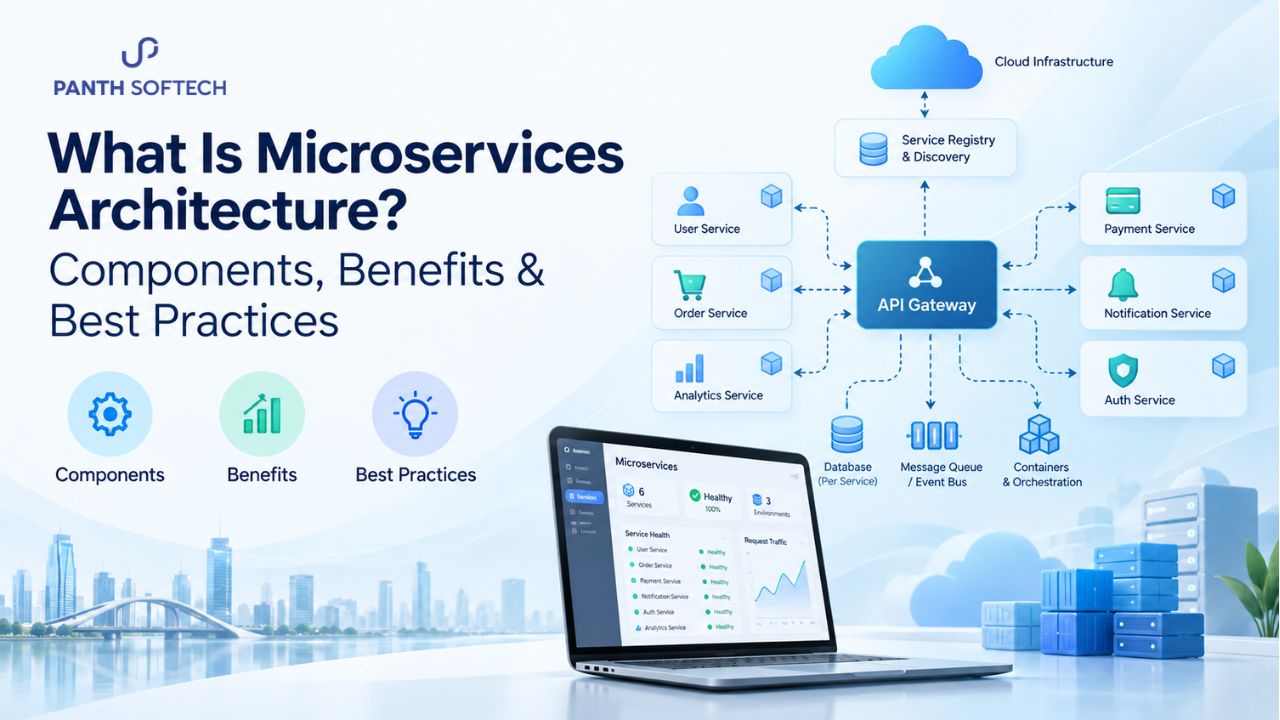
A working microservices system depends on several building blocks. These are the microservices architecture components you will see in most production setups.
1. Microservices
The core units of the system. Each one handles a specific business function and exposes its features through APIs.
2. API Gateway
The single entry point for all client requests. It routes traffic to the right service and handles authentication, rate limiting and request aggregation, so clients never need to know how many services exist behind it.
3. Service Registry and Discovery
Services are created, moved and destroyed constantly, especially in containers. A service registry keeps a live list of available services and their locations. Service discovery lets one service find another automatically.
4. Load Balancer
Distributes incoming traffic across multiple instances of a service, which improves performance and keeps the application available when an instance fails.
5. Message Broker
Tools like Apache Kafka and RabbitMQ let services communicate asynchronously through events. A service publishes an event, and other services react when they are ready. This keeps the system stable under heavy load.
6. Containers and Orchestration
Docker packages each service with everything it needs to run. Kubernetes then deploys, scales and heals those containers automatically.
7. Database per Service
Each service manages its own data store, chosen to fit its needs, such as SQL for transactions and NoSQL for flexible data. This prevents tight coupling through a shared database.
8. Monitoring, Logging and Tracing
With dozens of services running, you need visibility. Centralized logging, metrics and distributed tracing help teams find bottlenecks and errors quickly.
9. CI/CD Pipeline
Automated build, test and deployment pipelines let teams release small changes often and safely.
Benefits of Microservices Architecture
The benefits of microservices architecture are the main reason companies move away from monoliths.
Independent Scalability
You can scale only the services under heavy load. During a sale, an e-commerce store can scale its checkout and payment services without scaling the whole application, which uses infrastructure more efficiently and cuts cloud costs.
Faster Time to Market
Small teams can work on different services in parallel and release updates without waiting for a company-wide release cycle. New features reach users sooner.
Better Fault Isolation and Resilience
If one service fails, the rest of the application keeps working. A broken recommendation engine should not stop customers from checking out.
Technology Flexibility
Teams can pick the best language, framework or database for each service. That also makes it easier to adopt new technologies gradually instead of rewriting everything.
Easier Maintenance
Smaller codebases are easier to understand, test and debug. New developers get productive faster because they only need to learn one service at a time.
Stronger DevOps and CI/CD Alignment
Microservices fit naturally with automated testing, continuous integration and continuous delivery, which supports frequent and reliable releases.
Clear Team Ownership
Teams organized around business capabilities own their service end to end, which improves accountability and code quality.
Cloud-Native Microservices Architecture
Microservices and the cloud work well together. A cloud-native microservices architecture is built specifically to run in cloud environments such as AWS, Microsoft Azure and Google Cloud, using containers, orchestration and automation.
What makes it “cloud-native”:
- Containerized services that run the same way everywhere
- Dynamic orchestration with Kubernetes for automatic scaling and self-healing
- Stateless services that keep session data in external caches or databases, so instances can start and stop freely
- Managed cloud services for databases, messaging and monitoring
- Automated pipelines for building, testing and deploying
- Pay-as-you-go efficiency, where you scale resources up and down with demand
Many teams also combine microservices with serverless computing for event-driven tasks. This approach is the foundation of modern SaaS platforms, enterprise applications and AI-enabled products. If you are planning one, our cloud-native app development services can help you design and build it.
Common Challenges of Microservices Architecture
Microservices are powerful, but they are not a silver bullet. Plan for these challenges:
- Operational complexity: Managing many services needs solid DevOps, monitoring and orchestration.
- Data consistency: With separate databases, keeping data consistent across services needs patterns like event-driven design and saga transactions.
- Network latency: Services communicate over the network, so poorly designed, chatty calls slow the system down.
- Security surface: More services and APIs mean more entry points to secure.
- Testing complexity: Testing how services work together is harder than testing a single application.
- Higher initial cost: Infrastructure, tooling and skilled engineers can cost more at the start.
Most of these problems can be managed with good design, automation and observability.
Microservices Best Practices
Follow these microservices best practices to get the benefits without the pain.
- Design around business domains. Use domain-driven design (DDD) to set clear service boundaries based on business capabilities, not technical layers.
- Keep each service focused. One service should do one job well. A service that is too big becomes a mini-monolith, and one that is too small creates operational overhead.
- Give every service its own database. Do not share databases between services. Shared data creates tight coupling.
- Adopt an API-first approach. Define clear API contracts before writing code, so teams can work in parallel.
- Prefer asynchronous communication where possible. Event-driven messaging with Kafka or RabbitMQ reduces coupling and stops failures from cascading.
- Use an API gateway. Centralize authentication, routing and rate limiting.
- Containerize and orchestrate. Use Docker and Kubernetes for consistent deployments and automatic scaling.
- Automate with CI/CD. Every service should have its own automated build, test and deployment pipeline.
- Build for failure. Use patterns like circuit breakers, retries, timeouts and bulkheads so one failing service doesn’t drag down others.
- Invest in observability. Combine centralized logging, metrics and distributed tracing from day one.
- Secure every layer. Apply authentication, authorization, encryption and zero-trust principles to service-to-service traffic as well as user traffic.
- Version your APIs. Independent versioning prevents changes in one service from breaking others.
- Migrate gradually. If you are moving from a monolith, use the strangler pattern. Build new functionality as services and retire old code piece by piece rather than rewriting everything at once.
Popular Microservices Design Patterns
- API Gateway: a single entry point for clients
- Circuit Breaker: stops repeated calls to a failing service
- Saga: manages transactions that span multiple services
- Sidecar: attaches helper functions like logging to a service container
- Strangler Fig: migrates from a monolith step by step
- CQRS: separates read and write operations for better performance
Real-World Examples of Microservices Architecture
Many well-known companies rely on microservices:
- Netflix uses independent services for streaming, recommendations, search and billing, so it can scale each one to global demand.
- Amazon moved from a monolithic application to services owned by small teams, which made frequent deployments possible.
- Uber splits functions like trip matching, pricing, payments and notifications into separate services.
Common use cases include:
- E-commerce: catalog, cart, checkout, payments and orders as separate services
- Banking and fintech: account management, transactions and fraud detection
- Streaming and media: playback, recommendations and user profiles
- Logistics and supply chain: tracking, routing and inventory
- SaaS platforms: multi-tenant apps that need frequent updates and high availability
When Should You Use Microservices?
Microservices are a good fit when:
- Your application is large, complex or growing quickly
- You need to scale specific parts independently
- Multiple teams need to work and release in parallel
- You release updates frequently and need minimal downtime
- You have strong DevOps and cloud skills
A monolith may be better when:
- You are building an MVP or a simple product
- Your team is small
- Requirements are still changing rapidly
- You don’t yet have DevOps automation in place
A good rule of thumb is to start simple and move to microservices when your product and team make the extra complexity worthwhile.
How Panth Softech Can Help You Build Microservices
Choosing between a monolith and microservices, or moving from one to the other, is a big technical and business decision. At Panth Softech, we help businesses design, build and modernize scalable software with expertise in:
- Cloud application development
- Cloud-native app development
- Custom software development
- SaaS development
- Enterprise software solutions
Whether you are planning a new product or breaking down a legacy monolith, our team can guide you from architecture design to deployment. You can also hire dedicated developers to extend your team.
Conclusion
Microservices architecture breaks software into small, independent services that scale, deploy and fail on their own. Compared with monolithic architecture, it offers greater scalability, faster releases and better resilience, especially when paired with a cloud-native approach. It also brings complexity, so it works best with clear service boundaries, automation, strong observability and the best practices above.
If you are planning a scalable application or want to modernize a legacy system, contact Panth Softech for a free consultation.
Frequently Asked Questions (FAQs)
- What is microservices architecture in simple words?
It is a way of building an application as a set of small, independent services. Each service handles one business function and can be developed, deployed and scaled separately.
- What are the main components of microservices architecture?
The main components are the microservices themselves, an API gateway, service registry and discovery, a load balancer, a message broker, containers and orchestration, a database per service, monitoring and logging, and a CI/CD pipeline. - What is the difference between microservices and monolithic architecture?
A monolith is built and deployed as a single unit, while microservices split the application into independent services. Microservices scale and deploy more flexibly but need more operational expertise. - What are the benefits of microservices architecture?
The key benefits are independent scaling, faster releases, fault isolation, technology flexibility, easier maintenance and better alignment with DevOps and CI/CD. - What are the disadvantages of microservices?
They add operational complexity, make data consistency and testing harder, increase network overhead and security exposure, and can cost more at the start. - Is microservices architecture good for small businesses?
Not always. For an MVP or a simple product, a monolith is usually faster and cheaper. Microservices make more sense as the product and team grow. - Which technologies are used in microservices?
Common choices include Docker, Kubernetes, Apache Kafka, RabbitMQ, API gateways, service meshes like Istio, and cloud platforms such as AWS and Azure. Services can be built in Node.js, .NET Core, Java, Python and more. - How do microservices communicate with each other?
Through synchronous calls like REST or gRPC when an immediate response is needed, and through asynchronous messaging with brokers like Kafka or RabbitMQ when services should stay loosely coupled.