Panth Softech Team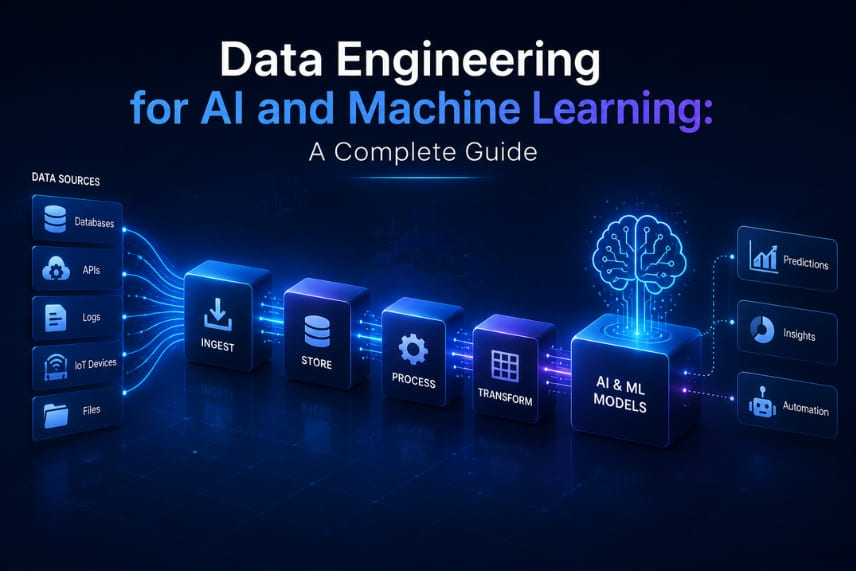
Artificial intelligence is only as powerful as the data behind it. No matter how advanced an AI model is, inaccurate, inconsistent, or poorly structured data will lead to unreliable predictions and poor business outcomes. This is why Data Engineering for AI and ML has become the foundation of successful AI initiatives, enabling organizations to collect, prepare, process, and deliver high-quality data for machine learning models.
As enterprises increasingly invest in AI-driven automation, predictive analytics, and intelligent applications, robust AI Data Engineering practices are essential for building scalable data pipelines, ensuring data quality, and accelerating model development. Whether you’re developing recommendation engines, computer vision systems, or generative AI applications, a modern data engineering strategy ensures your AI solutions are accurate, reliable, and production-ready.
In this guide, you’ll learn the role of data engineering in AI and machine learning, why it matters, the core components of AI-ready data pipelines, common implementation challenges, and the best practices organizations should follow to build scalable AI platforms.
Key Takeaways
- Data Engineering for AI and ML creates reliable, scalable data pipelines that power accurate machine learning models.
- High-quality data directly improves AI model performance, prediction accuracy, and business decision-making.
- Modern AI projects rely on automated data ingestion, transformation, feature engineering, and governance.
- Cloud-native data platforms enable organizations to build scalable and real-time AI data pipelines.
- Strong data engineering practices reduce AI implementation risks while accelerating enterprise AI adoption.
The Role of Data Engineering in AI and ML
Artificial intelligence and machine learning rely on vast amounts of structured and unstructured data to identify patterns, make predictions, and automate decision-making. However, raw business data is often fragmented across multiple systems, making it unsuitable for direct use in AI applications.
This is where Data Engineering for Machine Learning plays a critical role. Data engineering creates the infrastructure, pipelines, and processes required to collect, integrate, clean, transform, and deliver trusted datasets for AI model training and deployment.
A modern AI ecosystem depends on several data engineering capabilities, including:
- Data ingestion from multiple business systems
- Data integration and transformation
- Data quality validation
- Feature engineering
- Scalable data storage
- Real-time data processing
- Continuous pipeline monitoring
Without these capabilities, organizations struggle to build reliable AI solutions, resulting in inconsistent model performance and delayed business outcomes.
For enterprises building intelligent applications, investing in Data Engineering Services provides the foundation required to support scalable AI initiatives while ensuring long-term data reliability.
Why Data Engineering is Important in AI/ML
Successful AI projects begin with reliable, well-managed data rather than sophisticated algorithms alone. Modern Data Engineering in Artificial Intelligence ensures that AI models receive accurate, consistent, and timely data throughout their lifecycle, enabling organizations to develop intelligent systems that deliver measurable business value.
Improves Data Quality
AI models depend on clean, complete, and consistent datasets. Data engineering removes duplicate records, corrects inconsistencies, validates incoming data, and standardizes formats to improve model accuracy and reduce prediction errors.
Builds Scalable AI Data Pipelines
As organizations generate increasing volumes of data, manual processing quickly becomes unsustainable. AI Data Pipeline architecture automates data collection, transformation, and delivery, ensuring machine learning models always have access to fresh and reliable information.
Accelerates Machine Learning Model Development
Preparing data is often the most time-consuming stage of any AI initiative. Automated pipelines significantly reduce manual effort, allowing data scientists to focus on developing, training, and improving AI models rather than preparing datasets.
Supports Real-Time AI Applications
Modern AI applications such as fraud detection, recommendation engines, predictive maintenance, and intelligent automation require continuous access to real-time data. Data engineering enables low-latency data processing that supports fast and accurate AI-driven decisions.
Strengthens Data Governance
Enterprise AI requires trusted and compliant data. Data engineering establishes governance policies, metadata management, lineage tracking, and quality controls that improve transparency while supporting regulatory compliance.
Organizations often combine Data Integration & Orchestration with governance frameworks to ensure AI pipelines remain reliable across multiple enterprise systems.
Core Components of Data Engineering for AI and ML
Building AI-ready infrastructure requires more than storing large amounts of data. A successful Data Pipeline for AI consists of multiple interconnected components that work together to deliver accurate, scalable, and production-ready datasets.
Data Collection
The first step is gathering structured and unstructured data from business applications, IoT devices, APIs, cloud platforms, databases, and external sources. Reliable data collection ensures AI models are trained using comprehensive and representative datasets.
Data Integration
Business data is often distributed across multiple systems. Integrating information into a unified environment eliminates data silos and creates a consistent foundation for machine learning and analytics.
Data Cleaning & Transformation
Before data can be used for AI, it must be standardized, enriched, and validated. This stage removes errors, fills missing values, transforms formats, and prepares datasets for downstream AI processes.
Feature Engineering
Feature engineering identifies and creates meaningful variables that improve machine learning model performance. Well-designed features enable AI models to recognize patterns more accurately and generate better predictions.
Data Storage & Processing
Modern AI workloads require scalable storage solutions such as data lakes, cloud warehouses, and distributed processing platforms capable of handling high-volume datasets efficiently.
Organizations implementing enterprise-scale AI often leverage Cloud Data Engineering Services to build secure, cloud-native data platforms that support real-time analytics and machine learning workloads.
Pipeline Monitoring & Optimization
Continuous monitoring helps identify pipeline failures, data quality issues, and performance bottlenecks before they impact AI models. Automated monitoring ensures AI systems remain accurate, reliable, and continuously optimized.
Key Challenges in Data Engineering for AI and ML
While artificial intelligence promises smarter automation and faster decision-making, many AI initiatives fail because of weak data foundations rather than poor algorithms. Building Data Engineering for AI and ML requires organizations to overcome technical, operational, and governance challenges that directly impact AI model performance.
The following are some of the most common challenges enterprises face and practical approaches to address them.
| Challenge | Business Impact | Recommended Solution |
| Poor Data Quality | Inaccurate AI predictions and unreliable insights | Implement automated data validation, cleansing, and quality monitoring. |
| Data Silos | Disconnected business data limits model accuracy | Integrate enterprise systems into a unified data platform. |
| Scalability Issues | AI pipelines struggle with growing data volumes | Use distributed processing and cloud-native data architectures. |
| Real-Time Data Processing | Delayed predictions affect business decisions | Build streaming pipelines using event-driven architectures. |
| Data Governance & Compliance | Increased security and regulatory risks | Establish governance policies, lineage tracking, and access controls. |
| Feature Drift & Model Drift | Declining model accuracy over time | Continuously monitor pipelines and retrain models using updated datasets. |
1. Poor Data Quality
Challenge: AI models learn from the data they receive. Duplicate records, missing values, inconsistent formats, and inaccurate information can lead to biased predictions and poor model performance.
Solution: Implement automated data validation, cleansing, and quality monitoring throughout the data pipeline. Consistently maintaining clean and standardized datasets improves model accuracy and builds trust in AI-driven decisions.
2. Data Silos Across Enterprise Systems
Challenge: Business data is often scattered across ERP systems, CRMs, cloud applications, and legacy databases, making it difficult to create a unified view for machine learning.
Solution: Integrate data from multiple sources into a centralized platform using automated data integration and orchestration. This eliminates silos and ensures AI models are trained on complete, consistent, and reliable data.
3. Scaling AI Data Pipelines
Challenge: As organizations generate more data and deploy additional AI models, traditional data pipelines struggle to process increasing workloads efficiently.
Solution: Adopt cloud-native architectures and distributed processing frameworks that automatically scale with growing data volumes, ensuring high-performance AI pipelines without compromising reliability.
4. Processing Real-Time Data
Challenge: AI applications such as fraud detection, predictive maintenance, and recommendation engines require continuous access to real-time data, which batch processing cannot always provide.
Solution: Implement event-driven and streaming data pipelines that continuously ingest and process live data, enabling faster predictions and real-time business decisions.
5. Data Governance and Compliance
Challenge: AI initiatives rely on sensitive business and customer data, making governance, security, and regulatory compliance increasingly complex.
Solution: Establish clear governance policies, role-based access controls, metadata management, and data lineage tracking to improve transparency, maintain compliance, and protect critical information.
6. Feature Drift and Model Drift
Challenge: Business conditions and customer behavior change over time, causing machine learning models to become less accurate as the underlying data evolves.
Solution: Continuously monitor data quality and model performance, retrain models with updated datasets, and automate performance checks to ensure AI systems remain accurate and relevant.
7. Integrating Legacy Systems with Modern AI Platforms
Challenge: Many enterprises still depend on legacy applications that weren’t designed to support modern AI or advanced analytics, creating integration bottlenecks.
Solution: Modernize existing data infrastructure through APIs, cloud integration, and incremental migration strategies that connect legacy systems with scalable AI-ready data platforms.
8. Managing High Infrastructure Costs
Challenge: Processing and storing massive datasets for AI workloads can significantly increase infrastructure and operational costs if resources aren’t optimized.
Solution: Leverage cloud-native services, automated resource scaling, and cost-efficient data storage strategies to balance performance, scalability, and infrastructure expenses.
Top Platforms & Technologies for Data Engineering in AI and ML
Selecting the right technology stack is essential for building scalable, reliable, and AI-ready data platforms. Modern Data Engineering in Artificial Intelligence combines cloud infrastructure, distributed processing, data orchestration, and machine learning operations to support the complete AI lifecycle.
Below are some of the most widely adopted technologies used in enterprise AI data engineering projects.
Cloud Platforms
Cloud platforms provide the scalability, flexibility, and computing power required for modern AI workloads.
Common cloud platforms include:
- Amazon Web Services (AWS)
- Microsoft Azure
- Google Cloud Platform (GCP)
These platforms simplify data storage, distributed computing, and AI infrastructure management.
Data Processing Frameworks
Large-scale AI projects require powerful processing engines capable of handling massive datasets efficiently.
Popular technologies include:
- Apache Spark
- Databricks
- Apache Flink
These platforms accelerate data transformation, feature engineering, and machine learning preparation.
Data Integration & Streaming
Continuous data movement is essential for training and serving AI models.
Organizations commonly use:
- Apache Kafka
- Apache Airflow
- Azure Data Factory
- AWS Glue
These tools automate data ingestion, workflow orchestration, and real-time pipeline management.
Data Storage Platforms
AI models require scalable storage solutions capable of managing structured and unstructured datasets.
Common enterprise platforms include:
- Snowflake
- Google BigQuery
- Amazon Redshift
- Data Lakes
- Lakehouse Architectures
These environments enable efficient storage, querying, and analytics across large data volumes.
Machine Learning Operations (MLOps)
Managing AI models in production requires specialized tools for versioning, deployment, and monitoring.
Popular MLOps technologies include:
- MLflow
- Kubeflow
- TensorFlow Extended (TFX)
- SageMaker
These platforms simplify model lifecycle management while improving reproducibility and scalability.
Best Practices for Building AI-Ready Data Pipelines
A well-designed Data Pipeline for AI is essential for delivering reliable, scalable, and high-performing AI applications. Organizations that adopt proven engineering practices can reduce implementation risks while accelerating machine learning initiatives.
Design Scalable Data Pipelines
Build modular and distributed pipelines capable of handling growing data volumes, multiple data sources, and increasing AI workloads without compromising performance.
Prioritize Data Quality
Implement automated validation, cleansing, profiling, and monitoring throughout the pipeline to ensure AI models always receive accurate and trustworthy data.
Automate Data Integration
Reduce manual intervention by automating data ingestion, transformation, and orchestration across enterprise systems, cloud platforms, and third-party applications.
Implement Strong Data Governance
Establish governance policies that define ownership, lineage, metadata management, security, and compliance to improve transparency and reliability across AI projects.
Adopt Cloud-Native Architectures
Cloud-native data platforms improve scalability, resilience, and cost optimization while supporting distributed AI workloads and real-time analytics.
Continuously Monitor Pipeline Performance
Track pipeline health, processing latency, data freshness, and model performance to identify issues early and maintain consistent AI outcomes.
Integrate Data Engineering with MLOps
Connecting data engineering pipelines with machine learning operations enables continuous model training, deployment, monitoring, and optimization throughout the AI lifecycle.
Future Trends in Data Engineering for AI
As artificial intelligence continues to evolve, organizations need data engineering capabilities that go beyond traditional ETL pipelines. Modern Data Engineering for AI and ML is becoming more intelligent, automated, and scalable to support real-time analytics, generative AI, and enterprise-wide AI adoption.
Here are some key trends shaping the future of AI-ready data engineering.
Real-Time AI Data Pipelines
Businesses increasingly rely on real-time insights for applications such as fraud detection, predictive maintenance, recommendation engines, and customer personalization. Real-time data pipelines enable AI systems to process and analyze streaming data instantly, improving responsiveness and decision-making.
Lakehouse Architecture
Modern data platforms are moving toward lakehouse architectures that combine the scalability of data lakes with the performance and governance capabilities of data warehouses. This unified approach simplifies analytics, AI model training, and enterprise data management.
AI-Powered Data Engineering
Artificial intelligence is beginning to automate several data engineering tasks, including pipeline optimization, anomaly detection, schema mapping, and data quality monitoring. These capabilities reduce manual effort while improving pipeline reliability and operational efficiency.
Data Mesh and Domain-Oriented Architecture
Large enterprises are adopting Data Mesh principles to decentralize data ownership across business domains. This approach enables teams to build and manage scalable, reusable, and governed data products that support AI initiatives across multiple departments.
Vector Databases for Generative AI
With the rapid adoption of large language models (LLMs) and retrieval-augmented generation (RAG), vector databases have become a critical component of modern AI architectures. They enable semantic search, contextual retrieval, and faster access to unstructured information for generative AI applications.
Data Observability and Continuous Monitoring
As AI systems become more business-critical, organizations are investing in data observability to monitor data freshness, pipeline performance, schema changes, and data quality. Continuous monitoring helps identify issues before they impact machine learning models or business operations.
Partner with Panth Softech for AI-Ready Data Engineering Solutions
Transforming enterprise data into AI-driven business value requires the right combination of strategy, architecture, and engineering expertise. At Panth Softech, we help organizations design and implement scalable data platforms that support machine learning, predictive analytics, generative AI, and intelligent automation.
Our team specializes in building secure, cloud-native data ecosystems that improve data quality, streamline integration, and enable high-performance AI applications across industries.
Accelerate Your AI Journey with Enterprise Data Engineering
Artificial intelligence delivers results only when powered by trusted, high-quality data. Our experts help organizations build scalable data platforms that reduce implementation risks, improve model accuracy, and accelerate AI deployment.
Whether you’re implementing predictive analytics, Generative AI, or enterprise automation, Panth Softech can help you build a future-ready data ecosystem.
Frequently Asked Questions About Data Engineering for AI
What is Data Engineering for AI and ML?
Data Engineering for AI and ML is the process of collecting, integrating, transforming, and managing data to create reliable datasets for training, deploying, and monitoring machine learning models. It ensures AI systems receive accurate, high-quality, and scalable data.
Why is data engineering important for artificial intelligence?
Data engineering provides the infrastructure and data pipelines that AI models depend on. High-quality data improves prediction accuracy, reduces model errors, supports automation, and enables organizations to build reliable AI applications at scale.
What is the difference between data engineering and machine learning?
Data engineering focuses on preparing, integrating, and managing data, while machine learning focuses on developing algorithms that learn from that data. Data engineering builds the foundation, whereas machine learning creates intelligent models that generate predictions and insights.
What are the core components of an AI data pipeline?
An AI data pipeline typically includes data collection, data integration, data cleansing, transformation, feature engineering, scalable storage, pipeline automation, model-ready data delivery, and continuous monitoring to ensure reliable AI performance.
Which technologies are commonly used for Data Engineering in AI?
Organizations commonly use cloud platforms such as AWS, Microsoft Azure, and Google Cloud along with technologies like Apache Spark, Databricks, Apache Kafka, Snowflake, BigQuery, MLflow, and Kubeflow to build scalable AI-ready data platforms.
Which industries benefit most from Data Engineering for AI and ML?
Industries including manufacturing, healthcare, logistics, retail, FMCG, hospitality, finance, and agriculture use AI-ready data engineering to improve predictive analytics, automate operations, personalize customer experiences, and optimize business performance.
How can businesses build AI-ready data pipelines?
Businesses should begin by integrating data from multiple sources, implementing automated data quality checks, adopting scalable cloud-native architectures, establishing governance policies, and continuously monitoring pipeline performance to ensure reliable AI outcomes.