Panth Softech Team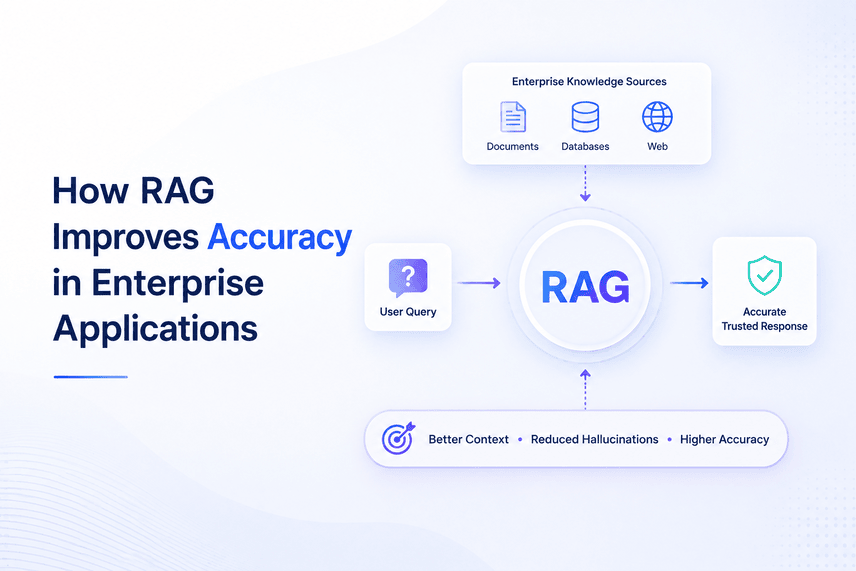
Enterprise applications are becoming more intelligent as businesses adopt artificial intelligence (AI), machine learning, and large language models (LLMs). From customer support and employee assistance to document analysis and business reporting, AI can automate tasks and make information easier to access.
However, enterprise AI systems can sometimes provide incorrect, outdated, or incomplete answers. This becomes a significant concern when applications rely on company policies, product information, technical documentation, customer data, or business records.
Retrieval-Augmented Generation (RAG) addresses this challenge by connecting an AI model with relevant external information. Instead of relying only on knowledge learned during model training, RAG retrieves information from trusted business sources and provides it to the model as context.
For organizations exploring RAG for enterprise AI, this approach can make AI responses more relevant, current, and grounded in business-specific information.
What Is Retrieval-Augmented Generation?
Retrieval-Augmented Generation (RAG) is an AI approach that combines information retrieval with text generation.
A traditional LLM generates responses based primarily on patterns and information learned during training. This means it may not know a company’s latest policies, internal documents, product specifications, or recently updated business information.
RAG adds a retrieval step before the model generates its response.
For example, an employee might ask:
“What is our current work-from-home policy?”
Instead of answering from general knowledge, a RAG-powered application can search the company’s internal HR documents, retrieve the latest policy, and provide the relevant information to the LLM.
A typical RAG workflow looks like this:
- The user submits a question.
- The system processes the query.
- Relevant information is retrieved from connected data sources.
- The retrieved information is provided to the LLM as context.
- The model generates a response using that context.
The result is an AI application that can work with information specific to an organization rather than relying entirely on general model knowledge.
Why AI Accuracy Matters in Enterprise Applications
Accuracy is critical when AI is used for business processes and decision support.
An incorrect answer from a customer service assistant can frustrate customers. An outdated response from an HR assistant can create confusion. Similarly, an AI system supporting business reporting can produce misleading results if it works with incomplete or incorrect information.
Enterprise applications often need access to information such as:
- Company policies
- Product catalogs
- Customer information
- Internal documentation
- Technical manuals
- Financial reports
- Knowledge bases
- Support tickets
- Sales information
- Business databases
Much of this information changes regularly. A general-purpose LLM may not have access to these sources or may contain outdated knowledge.
RAG helps bridge this gap by retrieving relevant information when the user asks a question.
How RAG Improves AI Accuracy
The main value of RAG comes from giving the AI model relevant context at the time a response is generated.
1. Provides Relevant Business Context
Enterprise users often need answers that are specific to their organization. RAG retrieves relevant company information and provides it to the LLM as context. For example, a customer service assistant can retrieve the latest return policy before answering a customer’s question.
This helps the model respond using business-specific information instead of relying only on generic knowledge.
2. Uses More Current Information
Business information changes frequently. Pricing, policies, product details, procedures, and documentation may be updated regularly. Retraining an entire AI model whenever this information changes is often impractical.
With RAG, organizations can update their connected knowledge sources. When a user submits a query, the application can retrieve information from those updated sources.
This makes RAG particularly useful for applications that depend on frequently changing enterprise information.
3. Grounds Responses in Trusted Sources
RAG can ground responses in specific documents or approved data sources.
For example, a technical support assistant can retrieve information from product manuals and troubleshoot documentation before generating a response.
Similarly, a document assistant can retrieve relevant sections from approved internal documents.
The model therefore has supporting context available when generating its response.
4. Reduces Irrelevant Responses
An AI model can sometimes provide a response that sounds reasonable but does not directly address the user’s question.
A well-designed retrieval process helps provide the model with information that is relevant to the query. Better retrieval can help the model focus on the specific information required to answer the question.
5. Makes Company Knowledge Easier to Access
Organizations often have valuable knowledge spread across documents, databases, knowledge bases, and business applications.
A RAG application can allow employees to access this information through natural-language questions instead of manually searching multiple systems.
For example:
- “How do I request annual leave?”
- “What is the process for approving an expense?”
- “Which product supports this feature?”
- “What are the latest onboarding steps?”
This can make enterprise knowledge more accessible while reducing the effort required to find information.
How RAG Reduces AI Hallucinations
AI hallucination occurs when a model generates information that is inaccurate, unsupported, or fabricated.
RAG does not eliminate hallucinations, but it can reduce the likelihood of unsupported responses by providing the model with relevant information from external sources.
For example, imagine an AI assistant answering questions about a company’s product specifications.
Without RAG, the model may generate an answer based on its general training patterns. With RAG, the application can retrieve the relevant product documentation and provide it as context.
The reliability of the final answer still depends on several factors, including:
- Quality of the source data
- Document processing
- Retrieval accuracy
- Relevance of retrieved content
- Model behavior
- Access controls
- Response validation
This is why implementing RAG is not simply a matter of connecting an LLM to a vector database. The complete retrieval and generation pipeline needs to be designed carefully.
RAG vs. Traditional LLMs
A traditional LLM and a RAG-based application can both generate natural-language responses, but they access information differently.
| Factor | Traditional LLM | RAG-Based Application |
| Enterprise data access | Limited unless integrated separately | Can retrieve connected enterprise data |
| Current information | May become outdated | Can retrieve updated information |
| Company-specific knowledge | Limited | Can use internal knowledge sources |
| External data retrieval | Not inherent | Core part of the architecture |
| Source grounding | Limited | Can use retrieved documents as context |
| Knowledge updates | May require model-related changes | Knowledge sources can be updated independently |
RAG is therefore particularly useful when an application needs access to information that is private, organization-specific, or frequently updated.
Understanding RAG Architecture
A typical RAG architecture includes several components that work together.
1. Data Sources
The process begins with enterprise information, which may come from:
- PDFs
- Websites
- Internal documents
- Databases
- CRM systems
- Knowledge bases
- Product catalogs
- Support platforms
- Cloud storage
2. Data Processing
Documents are cleaned, structured, and divided into smaller sections called chunks. Effective document processing is important because poorly structured content can make relevant information harder to retrieve.
3. Embeddings
Text can be converted into numerical representations called embeddings. Embeddings help the retrieval system identify content with similar semantic meaning, even when the exact words used in a query and document are different.
4. Vector Database
Embeddings can be stored in a vector database or another suitable retrieval system. When a user submits a query, the system searches for content that is semantically related to the request.
5. Retrieval
The system retrieves the most relevant information and prepares it as context for the language model. This stage is critical. If irrelevant or incorrect information is retrieved, the model may still generate an inaccurate response.
6. Language Model
The retrieved information is provided to the LLM along with the user’s question. The model then generates a response based on the available context.
7. Application Layer
Finally, the response is delivered through an enterprise application such as a chatbot, employee portal, customer support platform, document assistant, or analytics interface.
A production-grade implementation may also include metadata filtering, reranking, permissions, monitoring, and response validation.
How to Measure RAG Accuracy
Building a RAG system is only the first step. Organizations also need to evaluate whether the system is retrieving the right information and generating reliable answers. RAG accuracy can be evaluated across two major areas: retrieval quality and generation quality.
Retrieval Quality
Businesses can evaluate whether the system is finding the right information for a given query.
Important considerations include:
- Relevance of retrieved documents
- Retrieval precision
- Retrieval recall
- Ranking quality
- Metadata filtering
- Retrieval latency
Generation Quality
The generated response should accurately reflect the retrieved information and address the user’s question.
Businesses can evaluate:
- Answer relevance
- Factual accuracy
- Groundedness
- Citation accuracy
- Completeness
- Unsupported claims
Testing should include realistic business questions rather than only technical test cases.
Continuous evaluation can help identify retrieval failures, outdated information, and response-quality issues before they affect users.
RAG vs. Fine-Tuning: What’s the Difference?
When organizations customize AI applications, RAG vs. fine-tuning is a common consideration.
These approaches solve different problems.
- Fine-tuning involves further training a model on a specific dataset. It can be useful for adapting model behavior, style, formatting, or performance for particular tasks.
- RAG, on the other hand, gives the model access to external information when a query is submitted.
For example, if a business needs an AI assistant to answer questions about frequently changing company policies, RAG can be useful because the underlying knowledge source can be updated without retraining the language model.
Fine-tuning may be more appropriate when the goal is to change how a model performs a task rather than simply provide it with additional information.
In some enterprise applications, RAG and fine-tuning can also be used together.
Key Benefits of Retrieval-Augmented Generation
The benefits of Retrieval-Augmented Generation extend beyond individual AI responses.
Better Access to Enterprise Knowledge
Employees can interact with internal information using natural language rather than searching through multiple systems.
More Relevant Responses
The AI can use information that is specifically related to the user’s question and business context.
Easier Knowledge Updates
Organizations can update connected knowledge sources without necessarily retraining the underlying LLM.
Improved User Experience
AI assistants can provide more useful responses when they have access to relevant business information.
Greater Control
Businesses can control which information sources are connected and apply permissions to restrict access to authorized users.
Scalability
A well-designed RAG architecture can support growing amounts of enterprise information and multiple data sources.
Enterprise RAG Use Cases
Enterprise RAG can support a wide range of business applications.
Customer Support
RAG-powered assistants can retrieve information from product documentation, FAQs, policies, and support knowledge bases before responding to customers.
Employee Assistants
Employees can ask questions about HR policies, internal processes, benefits, IT procedures, and company guidelines.
Sales and Marketing
Sales teams can retrieve product information, pricing documents, case studies, and other approved sales content through an AI assistant.
Document Analysis
Businesses can use RAG applications to search, summarize, and interact with large collections of documents.
Technical Support
Technical teams can retrieve relevant information from manuals, troubleshooting guides, and internal documentation.
Business Intelligence
RAG can also work alongside business intelligence and data analytics platforms to make organizational information easier to access through natural-language interactions.
For example, an employee could ask:
“What were our highest-performing product categories last quarter?”
A properly integrated application could retrieve the relevant business information and provide a natural-language explanation.
This creates opportunities to combine RAG with data analytics services and machine learning technologies.
RAG Security and Data Privacy in Enterprise Applications
Enterprise RAG systems often connect AI applications to internal and potentially sensitive information. Security therefore needs to be considered as part of the architecture rather than added later.
Important areas include:
- Authentication
- Role-based access control
- Document-level permissions
- Data encryption
- Secure retrieval
- Data governance
- Audit logging
- Access monitoring
For example, if two employees have different permissions, the RAG system should not retrieve the same restricted documents for both users.
A secure implementation should ensure that retrieval follows the organization’s existing access policies.
RAG and Enterprise Software Development
RAG can become part of broader enterprise software solutions that connect AI with existing business systems.
For example, a company could build an AI assistant that integrates with its CRM, documentation platform, internal databases, and analytics tools.
The objective is not simply to add a chatbot. The application needs access to the right information while maintaining security, permissions, performance, and reliability.
A successful implementation should consider:
- Data quality
- Retrieval accuracy
- Security
- User permissions
- Data freshness
- Application performance
- Scalability
- Monitoring
- Integration requirements
Businesses planning an AI-powered application can benefit from working with an experienced software development company that understands both application architecture and AI technologies.
How RAG Works With Machine Learning and Data Analytics
RAG is part of a broader AI ecosystem and can work alongside machine learning solutions and analytics technologies.
Machine learning can identify patterns and make predictions, while RAG can help users access relevant organizational knowledge through natural-language interactions.
For example, an enterprise application could combine:
- Machine learning models for predictions
- RAG for knowledge retrieval
- Data analytics for performance analysis
- LLMs for natural-language responses
This combination can make business information easier to understand and access, including for employees who may not have technical knowledge of databases or analytics platforms.
When Should Businesses Use RAG?
RAG can be a strong option when an organization needs AI to work with information that is:
- Private or organization-specific
- Frequently updated
- Spread across multiple documents or systems
- Too large to manage through manual search
- Required for accurate, context-specific responses
RAG is particularly useful when the primary challenge is giving an AI model access to relevant knowledge.
However, RAG may not solve every AI customization requirement. If the primary objective is changing model behavior, tone, formatting, or task performance, fine-tuning or other approaches may be more appropriate.
The right architecture depends on the application’s objectives, data, security requirements, and expected user experience.
Challenges to Consider When Implementing RAG
RAG is not automatically accurate simply because a retrieval layer has been added.
Poor Data Quality
If source documents contain outdated or incorrect information, the AI may use that information when generating a response.
Incorrect Retrieval
The system may retrieve irrelevant information if the retrieval strategy, embeddings, chunking, or ranking process is not properly configured.
Data Security
Enterprise information may contain confidential or restricted content. Access controls need to ensure that users only retrieve information they are authorized to access.
Complex Data Sources
Organizations may have information distributed across databases, cloud platforms, documents, CRM systems, and other applications.
Ongoing Monitoring
RAG systems should be evaluated regularly to identify retrieval failures, outdated sources, and incorrect responses.
These challenges demonstrate why RAG implementation requires both AI expertise and strong software engineering practices.
Best Practices for Improving RAG Accuracy
Organizations can improve RAG performance by focusing on the complete pipeline.
Use Reliable Data
Build the knowledge base using trusted, maintained, and authoritative sources.
Improve Document Processing
Use appropriate chunking, metadata, and document structures to make relevant information easier to retrieve.
Optimize Retrieval
Test different retrieval strategies and evaluate whether the system consistently finds the right information.
Apply Access Controls
Ensure that users can retrieve only the information they are authorized to access.
Evaluate Responses
Test realistic business queries and monitor response quality, relevance, and groundedness.
Keep Knowledge Updated
Establish processes for adding, updating, and removing information from the knowledge base.
Monitor the Complete Pipeline
Track retrieval quality, response quality, latency, failures, and user feedback.
The goal should be continuous improvement rather than assuming that a RAG system will remain accurate without monitoring.
Why Businesses Are Adopting RAG for Enterprise AI
The value of RAG comes from connecting generative AI with the information businesses already use.
Instead of expecting an LLM to know everything, organizations can provide controlled access to relevant enterprise knowledge at the time a question is asked.
This makes RAG useful for applications where information changes frequently and business-specific accuracy matters.
From customer support and employee assistance to document search and business intelligence and data analytics, RAG can help organizations build AI applications that are more relevant and useful.
For businesses evaluating RAG, the next step is to identify the right data sources, retrieval architecture, security model, and application requirements rather than treating RAG as a one-size-fits-all technology.
Build More Reliable AI Applications With Panth Softech
Implementing RAG successfully requires more than connecting a language model to a database. Businesses need the right data architecture, retrieval strategy, application design, security controls, integrations, and monitoring processes.
Panth Softech helps businesses develop AI-powered and enterprise software solutions designed around real business requirements. Whether you are exploring an artificial intelligence service, developing machine learning solutions, or integrating RAG into an existing application, the right technical architecture can help you get more value from your enterprise data.
If your organization is planning an AI-powered application or looking to improve the accuracy and usability of an existing solution, contact Panth Softech to discuss your requirements and explore the right RAG and AI approach for your business.
Conclusion
Retrieval-Augmented Generation provides a practical way to make generative AI more useful for enterprise applications. By retrieving relevant information before generating a response, RAG can help AI systems provide answers that are more closely connected to current business knowledge.
Its effectiveness, however, depends on more than the language model. Data quality, retrieval accuracy, security, permissions, system architecture, and continuous evaluation all play important roles.
For businesses exploring RAG for enterprise AI, the right approach is to build an architecture that connects AI with reliable data and secure business systems.
Panth Softech can help organizations evaluate, design, and develop AI-powered enterprise applications using RAG, machine learning, data analytics, and modern software engineering practices. Contact Panth Softech to discuss your AI application requirements and identify an architecture that fits your business needs.
FAQs About RAG in Enterprise Applications
1. What is RAG in enterprise applications?
RAG in enterprise applications is an approach that connects an AI language model with external business information. It retrieves relevant data and provides it to the model as context before generating a response.
2. Does RAG eliminate AI hallucinations?
No. RAG cannot completely eliminate hallucinations. However, it can reduce unsupported responses by grounding AI outputs in relevant information from trusted sources.
3. Is RAG better than fine-tuning?
RAG and fine-tuning solve different problems. RAG is useful for providing models with current external knowledge, while fine-tuning is generally used to adapt model behavior or task performance. They can also be used together.
4. What data can be used with RAG?
RAG can work with documents, PDFs, databases, websites, knowledge bases, product information, support content, and other enterprise data sources.
5. Why is RAG useful for enterprise AI?
RAG allows enterprise AI applications to retrieve relevant company information when responding to users. This can improve relevance and provide access to current, business-specific knowledge.
6. Can RAG work with existing enterprise software?
Yes. RAG can be integrated with existing enterprise applications, databases, document management systems, CRM platforms, analytics tools, and other business systems, depending on the application’s architecture and security requirements.
7. How can businesses improve RAG accuracy?
Businesses can improve RAG accuracy by using reliable data, optimizing document processing and retrieval, applying access controls, evaluating responses, keeping knowledge sources updated, and continuously monitoring system performance.