Panth Softech Team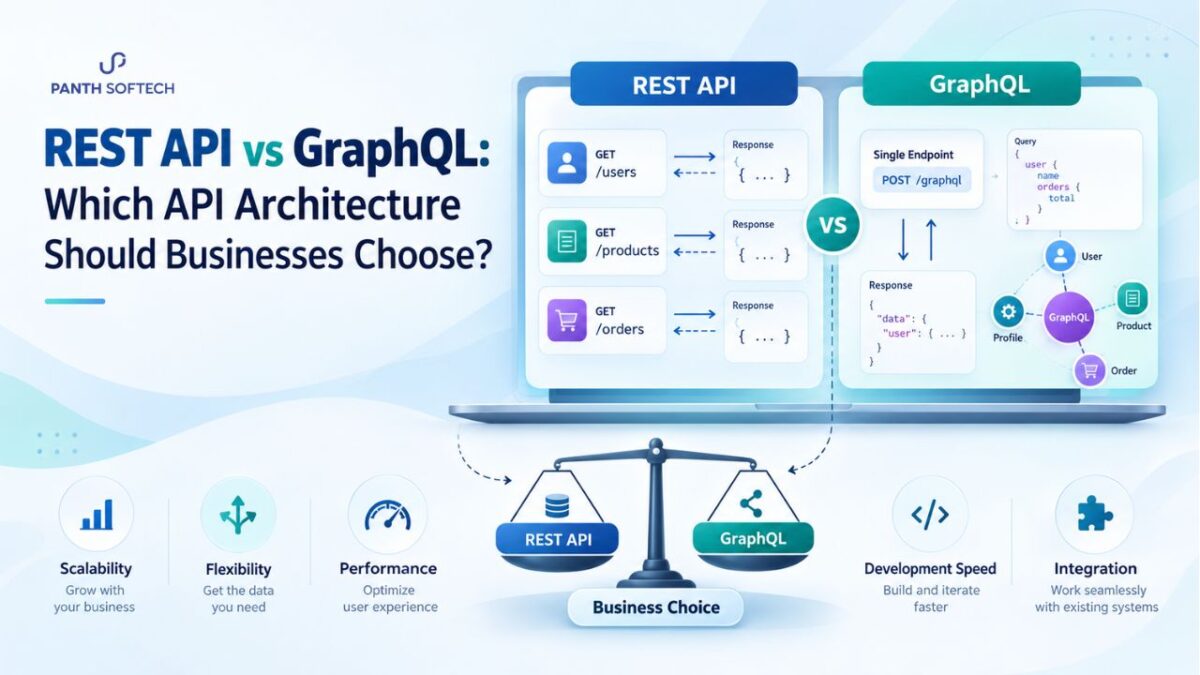
Every modern application — a mobile banking app, a SaaS dashboard, an e-commerce store, an internal enterprise tool — depends on APIs to move data between the front end and the back end. So when businesses plan a new digital product or modernize an existing one, one architectural decision comes up early and often: should we build with REST API or GraphQL?
Both are mature, production-tested technologies powering some of the world’s largest platforms. But they solve the data-exchange problem in very different ways, and choosing the wrong one for your use case can quietly cost you in performance, development speed, or long-term maintainability. This guide breaks down what REST and GraphQL actually are, how they compare, and how businesses can decide which architecture fits their project.
What Is a REST API?
REST (Representational State Transfer) is an architectural style for building web APIs where each piece of data is treated as a resource, accessed through its own URL using standard HTTP methods like GET, POST, PUT, and DELETE. It was defined by Roy Fielding in 2000 and has since become the most widely adopted standard for connecting applications over HTTP.
In a REST API, resources are organized into endpoints — for example:
- /customers
- /products
- /orders
- /payments
Because REST maps directly to everyday CRUD operations (Create, Read, Update, Delete) and builds on conventions the web already runs on, it’s intuitive for most developers and works with virtually any programming language or framework.
What Is GraphQL?
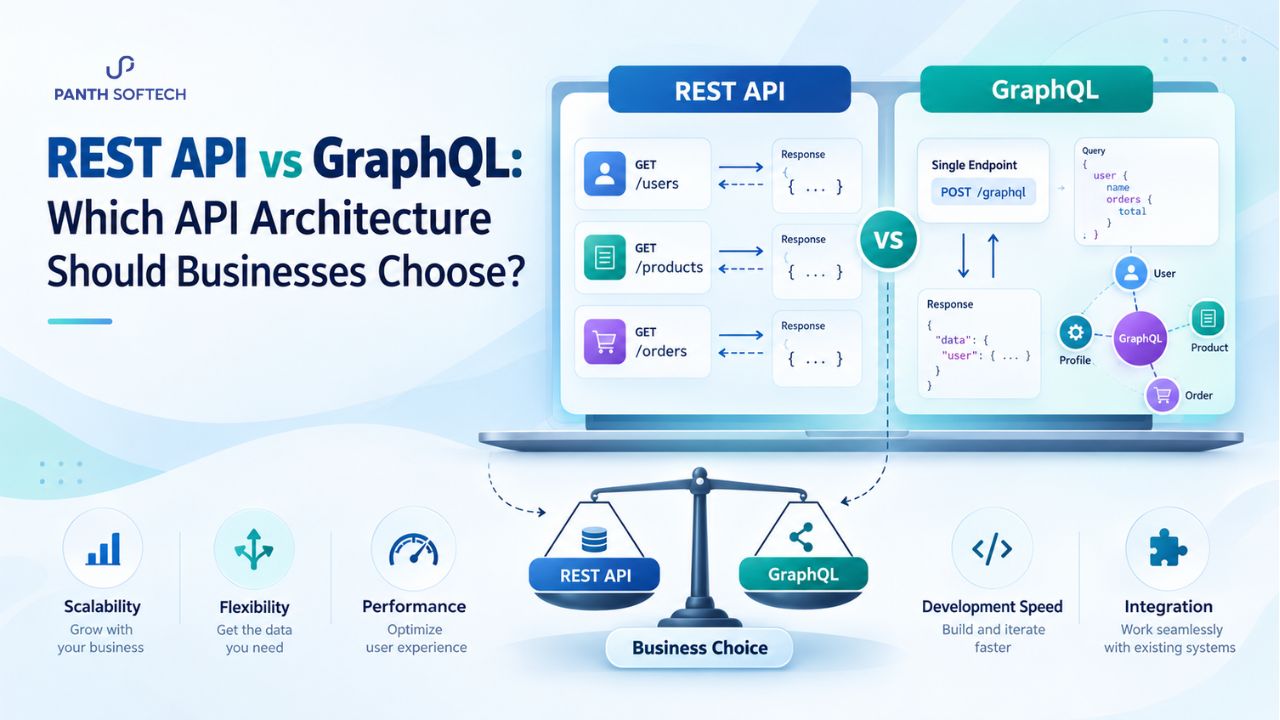
GraphQL is a query language and runtime for APIs that lets clients request exactly the data they need — and nothing more — through a single endpoint, instead of calling multiple fixed REST endpoints. It was originally built by Facebook to solve a real performance problem: mobile apps were making too many network calls and pulling back far more data than they actually needed.
Instead of exposing many endpoints, a GraphQL server exposes one endpoint. The client sends a query describing the exact fields it wants, and the server returns precisely that — in a single round trip.
Example GraphQL query:
{
customer(id: “101”) {
name
orders {
id
total
}
}
}
What REST and GraphQL Have in Common
Before comparing their differences, it’s worth noting that REST and GraphQL share the same foundation:
- Both are stateless — the server doesn’t retain memory of previous requests
- Both use a client-server model over HTTP
- Both organize data around resources with unique identifiers
- Both typically exchange data as JSON
- Both support caching, though implemented differently
- Both are language- and database-agnostic, working with any tech stack
They’re solving the same core problem — moving data between systems reliably — just with different philosophies about who controls the shape of that data: the server (REST) or the client (GraphQL).
REST API vs GraphQL: Comparison Table
| Feature | REST API | GraphQL |
| Structure | Multiple endpoints, one per resource | Single endpoint for all operations |
| Data fetching | Fixed response defined by the server | Client specifies exact fields needed |
| Over/under-fetching | Common issue | Largely eliminated |
| Request types | GET, POST, PUT, PATCH, DELETE | Query, Mutation, Subscription |
| Schema | Optional (e.g., OpenAPI) | Mandatory, strongly typed |
| Error handling | HTTP status codes (200, 404, 500) | Usually 200; errors detailed in payload |
| Caching | Native HTTP caching (easy) | Requires custom caching strategy |
| Versioning | Usually via /v1, /v2 in the URL | Schema evolves without breaking versions |
| Learning curve | Lower — familiar HTTP conventions | Higher — new query syntax and tooling |
| Tooling ecosystem | Mature, extensive | Rapidly growing, but newer |
| Best suited for | CRUD systems, public APIs, standard business apps | Data-rich apps, multiple client types, real-time features |
Key Differences Explained
1. How Data Is Requested
REST returns a fixed data structure set by the server, while GraphQL lets the client specify exactly which fields it needs in a single request. If you only need one field from a REST endpoint, you still get the full object back (over-fetching); if you need data spanning multiple resources, you may need several calls (under-fetching). GraphQL flips this — the client decides exactly what to pull, even across related resources, in one request.
2. Number of Endpoints
REST uses multiple endpoints — one per resource — while GraphQL uses a single endpoint for all operations. REST APIs grow by adding endpoints as an application expands: /products, /products/{id}/reviews, /products/{id}/inventory, and so on. GraphQL keeps one endpoint and instead grows its schema — adding or deprecating fields as the product evolves.
3. Schema and Typing
GraphQL requires a mandatory, strongly typed schema, while a schema in REST is optional. GraphQL’s schema, written in Schema Definition Language (SDL), explicitly defines every object, field, and operation available — making GraphQL APIs self-documenting and letting tools auto-generate validation and error messages. REST APIs are weakly typed by default; a schema (like OpenAPI/Swagger) can be added, but mismatched data types often aren’t caught automatically.
4. Caching
REST supports native HTTP caching, while GraphQL requires a custom caching strategy. Browsers, CDNs, and proxies already know how to cache REST’s GET requests out of the box. GraphQL, since most requests go through one endpoint via POST, needs an added approach — such as persisted queries or client libraries like Apollo Client and Relay.
5. Versioning and Long-Term Evolution
REST typically versions through the URL, while GraphQL evolves its schema without versioning. REST commonly uses paths like /v1/orders and /v2/orders, which can accumulate technical debt as old versions pile up. GraphQL avoids hard versioning entirely — new fields are added and old ones marked deprecated within the same schema, letting clients migrate gradually without breaking.
6. Error Handling
REST uses HTTP status codes to signal errors, while GraphQL returns errors inside the response body. REST relies on standard codes like 200, 400, 404, and 500. GraphQL almost always returns 200 OK, with error details embedded in the payload — which means client applications need a different pattern for catching and displaying errors.
7. Learning Curve and Team Readiness
REST has a lower learning curve than GraphQL because it builds on familiar HTTP conventions. Most engineers already know how to work with REST’s GET/POST/PUT/DELETE model. GraphQL requires learning schema design, resolvers, and query syntax — a bigger upfront investment that tends to pay off most on data-heavy, multi-client products.
Advantages of REST API
- Simple to design, build, and understand
- Huge ecosystem of frameworks, tools, and documentation standards
- Works with virtually every programming language and platform
- Native HTTP caching improves performance with minimal setup
- Predictable, stable, and proven at massive scale
- Easier to secure using mature standards like OAuth 2.0 and JWT
Advantages of GraphQL
- Clients fetch exactly the data they need — nothing more, nothing less
- Reduces network round-trips, especially valuable for mobile and low-bandwidth users
- One schema serves multiple front ends (web, iOS, Android) consistently
- Strongly typed schema improves reliability and enables self-documenting APIs
- Adding new fields doesn’t break existing client integrations
- Well suited to real-time features through subscriptions
- Ideal when aggregating data from multiple backend sources into one response
Limitations to Consider
REST limitations:
- Over-fetching and under-fetching on complex, data-rich screens
- Endpoint sprawl as the application and its features grow
- Versioning can become difficult to manage over the product’s lifetime
GraphQL limitations:
- Steeper learning curve for teams new to schema-driven development
- Caching requires deliberate engineering effort
- Poorly optimized queries can strain backend resources (the “N+1 query” problem)
- Needs safeguards like query depth limiting and disabling introspection in production
When Should a Business Choose REST API?
REST is generally the stronger choice when:
- Your data maps cleanly to resources and standard CRUD operations
- You want simple, effective caching out of the box
- You’re building a public-facing API that third parties will integrate with
- Your team is more comfortable with conventional, well-documented patterns
- The application — a typical CRM, ERP, e-commerce backend, or enterprise system — doesn’t need heavily customized data per client
This is why REST remains the default for most custom software development and enterprise software projects — it’s predictable, secure, and easy for teams of any size to maintain long term.
When Should a Business Choose GraphQL?
GraphQL tends to make more sense when:
- You’re supporting multiple front ends (web, mobile, IoT) with different data needs from the same backend
- Your UI is data-heavy, pulling nested or related information from many sources
- You want front-end teams to move fast without waiting on backend endpoint changes
- Bandwidth efficiency matters — for example, in mobile app development targeting users on unreliable networks
- You need real-time updates, such as live dashboards or notifications, via subscriptions
- You’re building complex SaaS platforms or analytics-heavy web applications that aggregate data from several services
Can Businesses Use REST and GraphQL Together?
Yes — and many do. A common pattern is exposing a REST API publicly for broad compatibility and easy third-party integration, while running GraphQL internally as an aggregation layer that pulls together multiple REST endpoints, microservices, or databases into a single response for the front end.
This hybrid approach is also a practical migration path: teams can layer a GraphQL server on top of existing REST services without a full rewrite, gradually shifting front-end teams to GraphQL where it adds the most value, while keeping REST endpoints intact for external partners and legacy integrations.
A Practical Decision Checklist
Before committing to an architecture, businesses should ask:
- How complex is your data model? Simple, resource-based → REST. Deeply nested and interrelated → GraphQL.
- Who are your clients? One type of client → REST is usually sufficient. Multiple client types (web + mobile + partner integrations) → GraphQL adds real value.
- What’s your team’s experience level? Familiar with REST conventions → lower risk with REST. Ready to invest in new tooling → GraphQL is workable.
- How important is caching? Need simple, robust caching → REST. Willing to build custom caching → GraphQL is fine.
- How fast does your product need to evolve? Frequent, potentially breaking changes → GraphQL’s schema evolution helps. Stable, slow-changing data → REST works well.
- What’s your budget and timeline? REST is generally faster and cheaper to build initially; GraphQL requires more upfront architecture but can reduce front-end rework later.
Final Verdict: Which Should Businesses Choose?
There’s no universal winner — the right architecture depends on your product, your data, your team, and your growth plans.
- Choose REST API if you value simplicity, predictability, mature tooling, and easy caching — especially for standard business applications, public APIs, and CRUD-heavy systems like CRMs, ERPs, and e-commerce platforms.
- Choose GraphQL if your application needs precise, flexible data fetching across multiple client types, and your team is ready to invest in the schema design and tooling it requires.
- Consider a hybrid approach if you want the stability of REST for external-facing services combined with the flexibility of GraphQL for internal, data-rich front ends.
The smartest move is to evaluate your specific use case — data complexity, client diversity, team skillset, and long-term roadmap — rather than choosing based on trend alone.
Building the Right API Architecture for Your Business
The right API architecture for your business depends on your data complexity, client types, and growth plans — not on following a trend, and an experienced development partner can help you decide with confidence.
At Panth Softech, our engineering teams design and build both REST and GraphQL APIs as part of our custom software development, web application development, and SaaS development services — choosing the architecture that fits your product rather than defaulting to one approach for every client. With 11+ years of experience and 500+ projects delivered across industries, we help businesses make this decision with confidence and build APIs that scale with them.
Not sure which architecture fits your project? Get in touch with our team for a free consultation.
Frequently Asked Questions
- Is GraphQL always better than REST?
No. GraphQL offers more flexibility, but REST offers simplicity, maturity, and easier caching. The right choice depends entirely on the project’s data complexity and team setup. - Is REST still relevant in 2026?
Yes. REST remains the most widely used API architecture for web apps, mobile apps, SaaS products, and enterprise integrations — and it isn’t going anywhere. - Which is better for mobile apps, REST or GraphQL?
Both can work well, depending on the app. REST suits many standard mobile apps, while GraphQL often improves efficiency for apps pulling data from multiple, related sources on limited bandwidth. - Can REST and GraphQL coexist in the same product?
Yes. Many organizations run REST for existing or public-facing services while introducing GraphQL for new features or data-heavy front ends. - Is GraphQL harder to learn than REST?
Yes, generally. REST builds on familiar HTTP conventions most developers already know, while GraphQL requires learning schema design, resolvers, and query syntax — a steeper but often worthwhile investment for complex products. - Does GraphQL replace REST completely?
No. GraphQL is not a replacement for REST — it’s an alternative approach best suited to specific use cases, like multi-client apps or data-heavy dashboards. REST remains the better fit for simpler, resource-based systems. - How do I know which API architecture is right for my business?
It depends on four factors: data complexity, number of client types, team expertise, and growth plans. A short technical discovery session with an experienced development partner can clarify this before you commit to either architecture.