Panth Softech Team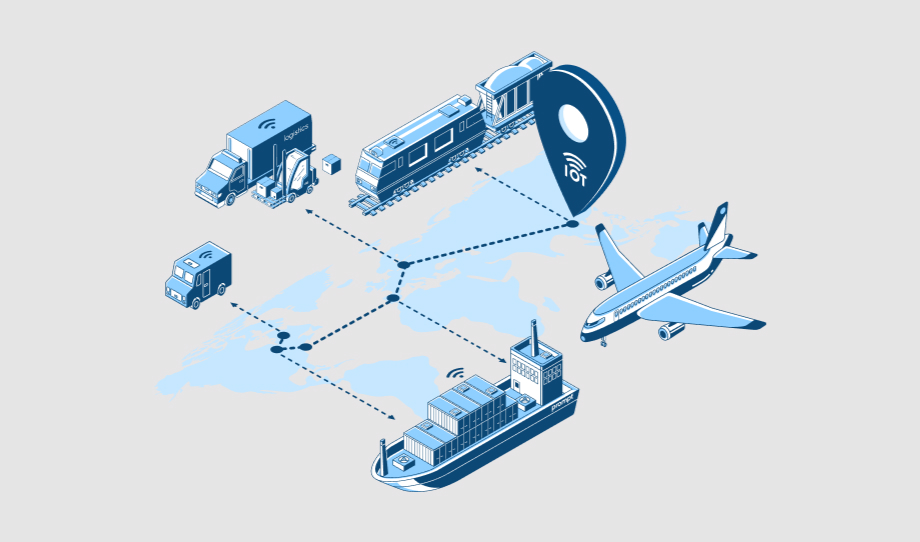
We all know that today, the logistics market is dynamic and has become competitive. In the last few decades, logistics has been redesigned not just because of rising competition and circumstances in the world but also because the Internet of Things (IoT) has dived deeper into the logistics niche.
As per KPMG reports, market challenges are compelling participants to find new development points for the business and recreate existing supply chains, like rail transit in the Asia-Europe direction. A high empty mileage decreases the efficiency of cargo transportation and causes congestion on the decided routes. Let’s look at modern IoT logistics solutions; and how they impact international logistics and transport.
What is IoT in logistics?
We can simply understand this technology through examples such as IoT, a modern smart refrigerator door that orders the delivery of your favorite pizza and drinks, or a smart kettle that brews your coffee in one click from a smartphone. There are smart sensors in agricultural fields and drones with high-pixel cameras that allows farmers to monitor the condition of the soil. The world will become an entire Internet of Things complex in a few more years.
However, when we mention the word Internet of Things, the first relation of this smart and emerging technology links with smart devices and tools that are physically available. Yet, IoT goes far beyond this and especially in global logistics.
IoT Logistics Examples
With the reduced cost of technology, the size of IoT devices also decreases. It is now quite apparent that devices and instruments are getting smaller with the growing market. Smaller sensors gather a more significant amount of data through creative and non-destructive placement.
Let’s assess what modern developments have been designed for us besides the sensors.
Warehouse & Inventory Management using IoT
IoT sensors track inventory and furnish data that can be utilized in trend analysis to presage inventory needs. Goods are automatically repositioned with stacker cranes’ assistance, production time and labor costs are cut down, and the human factor is balanced because the robot does not need leisure hours. This will bypass under-stock and over-stock situations.
Tracking Goods From Purchase To Delivery
Traditional monitoring depends on scanning an order between points of delivery. Special tags like RFID or Radio Frequency Identification simplify the search operation by connecting to the cloud and sending location data more frequently than scanning. This might get you back to the QR codes or Data Matrix times. Yes, they can also be used by analogy, but unlike FID, optical codes have to be scanned individually for each item, which takes time.
RFID tags reduce unnecessary expenditure. On average, the precision of inventory levels is approximately 65 percent. Employing RFID raises it to 95 percent. BigData monitoring under RFID will identify the most persuasive couriers and truckers, choose the most efficient delivery routes, and more. If delivery staff show unexpected results, they are sent for further revisions.
Drone Delivery
Drones are remotely controlled and unmanned aerial vehicles and droids that can improve the speed and efficiency of various logistics infrastructures. It is no more a trend or novelty as today’s developments are improving the accuracy and speed of their movement. As per the CompTIA poll, drones are employed by companies of different sectors and sizes. They enable the automation of business processes and allow smart inventory tracking, fast product transportation, and prompt delivery from stores.
Future Insights of IoT in Logistics
The proliferation of the Internet of Things in the international logistics market generated $34,504.8 million in 2019. Prescient Strategic intelligence shows a steady CAGR of 13.2 percent by the end of 2030. Nowadays, crucial assignments of logistics companies are the following:
- Assure just-in-time delivery.
- Offer transparency in the supply chain.
- Ensure the transparency of the transport cycle and grade of services.
The success of any logistics company depends on effective stock and warehousing management, automation of internal business processes, prompt delivery, and assuring the safe storage of goods. Data becomes helpful when it passes through this cycle. Wireless networks like Bluetooth, GSM, Wi-Fi, etc., offer information exchange in logistics processes.
IoT has now become part of all the sectors where transport is involved. That is, its impact and usage are just not limited to logistics and transport. Instead, it is used in manufacturing and retail trade, including e-commerce, hospitals, construction, and many other sectors. This enables transparency of processes in the supply chain, better and more stable work of transport and employees, and saves company resources.
The logistics business is attaining a new height after embracing IoT, as it provides efficacious solutions aimed at working with Big Data, speeding logistics supply chains, and many other things. This is supported by other advanced trends like the proliferation of the 5G Internet, the fast growth of mobile applications, and cloud services.
FAQ About the Impact of IoT on Global Logistics Development
- What is the impact of IoT on global logistics development?
The Internet of Things (IoT) improves global logistics by connecting vehicles, warehouses, cargo, and tracking devices through the internet. It enables real-time monitoring, automated operations, and data-driven decisions. This helps logistics companies reduce delays, lower costs, improve delivery accuracy, and increase supply chain visibility across international markets.
- What are the main benefits of using IoT in logistics?
IoT helps businesses track shipments in real time, optimize delivery routes, monitor vehicle health, reduce fuel consumption, and improve warehouse efficiency. It also minimizes human errors and provides valuable insights through data analytics, allowing logistics companies to make faster and more informed business decisions.
- How does IoT improve supply chain visibility?
IoT devices such as GPS trackers, RFID tags, and smart sensors continuously collect and share shipment data. Businesses can monitor the exact location, condition, and movement of goods throughout the supply chain. This improves transparency, reduces the risk of lost shipments, and enables proactive responses to disruptions.
- What industries benefit the most from IoT-enabled logistics?
Industries such as retail, eCommerce, manufacturing, healthcare, automotive, food and beverage, pharmaceuticals, and third-party logistics (3PL) benefit significantly from IoT. These sectors rely on accurate inventory management, real-time tracking, and timely deliveries to maintain operational efficiency and customer satisfaction.
- Is IoT in logistics secure and reliable for global operations?
Yes, when implemented correctly with strong cybersecurity measures, IoT solutions are highly secure and reliable. Features like encrypted communication, secure cloud platforms, device authentication, and continuous monitoring protect sensitive logistics data while ensuring uninterrupted global supply chain operations.
- How can Panth Softech help businesses implement IoT solutions for logistics?
Panth Softech develops custom IoT-enabled logistics solutions tailored to business needs. From fleet tracking and warehouse automation to predictive maintenance and cloud-based analytics, the company helps organizations improve operational efficiency, reduce costs, and build scalable digital supply chains using modern technologies.
- Why should businesses choose Panth Softech for IoT logistics development?
Panth Softech combines expertise in IoT, AI, cloud computing, and enterprise software development to deliver end-to-end logistics solutions. The team focuses on secure architecture, scalable systems, seamless integration with existing platforms, and ongoing support, helping businesses accelerate digital transformation with confidence.
- Is investing in IoT for logistics worth it for growing businesses?
Yes. IoT provides long-term value by reducing operational costs, improving asset utilization, increasing delivery accuracy, and enhancing customer experience. Even small and medium-sized businesses can achieve measurable returns through better inventory control, automated processes, and real-time operational insights.