Panth Softech Team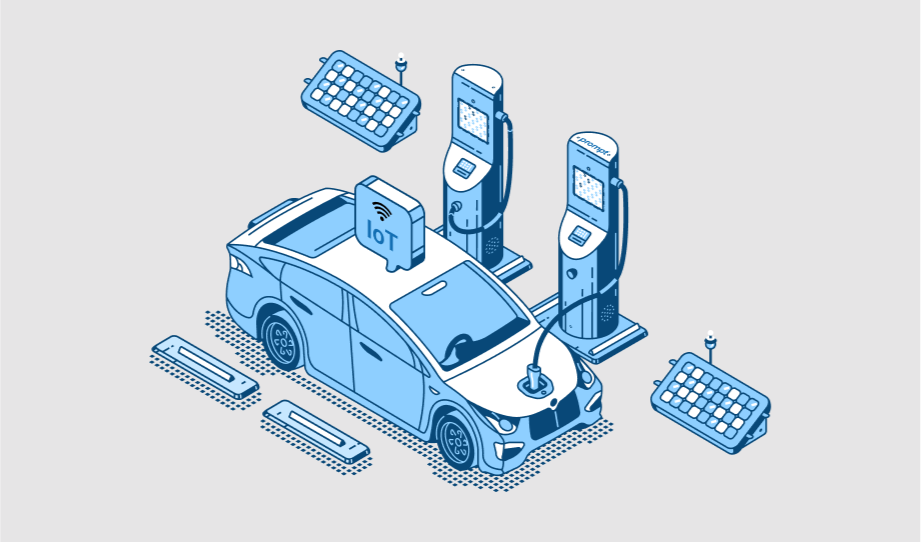
Today we are witnessing the temperature rise, and one of the major reasons behind this is air pollution. The emission of global house gases is worsening the situation, and its continuity might leave the earth unfit for humans in the coming years.
Vehicles are one of the major contributors to air pollution; therefore, it has become a major issue to look after. Today, people and the government are looking for ways to handle this issue. One of the best ways to control air pollution is by replacing fuel-based vehicles with electronic vehicles. Electric vehicles (EVs) are a new and environment-friendly innovation in this direction.
Electronic vehicles are hi-tech machines that collect an immense amount of data to deliver optimum performance. The performance parameters incorporate monitoring speed, mileage, acceleration, battery management, fault alert, charging, and predictive maintenance systems. Therefore IoT plays a crucial role in the monitoring of electric vehicles.
What is the role of IoT in Electric Vehicle Management?
Let’s know each aspect of an IoT integrated Electric vehicle management system and how they help obtain the optimal performance of electric vehicles.
Battery Management System:
The primary function of the Battery Management System is to watch and control the battery’s functioning. This implies monitoring the charging and discharging cycle to ensure battery health and minimize the risk of battery damage by assuring that optimized energy is provided to run the vehicle.
The monitoring circuit in Battery Management System (BMS) monitors the key parameters of the battery, that is, current, voltage, and temperature during charging and discharging conditions. It assesses parameters like power, State of Health (SoH), and State of Charge (SoC) and assures good health based on the calculation. Internet of Things exhibits a vital role in monitoring and controlling as it allows remote data logging facility for battery parameters, conditions, etc. Most EV manufacturers use high-quality Li-ion battery packs as they have a longer life and exceptionally high energy density.
However, there are some drawbacks as well. In situations when battery malfunction happens, the onboard sensor data acquired using IoT can aid in managing the issues. Then, these can operate through AI-based models for performance estimation. Tests can be executed on some Li-ions to evaluate the patterns of partial and full charging and discharging. Models are marked using the data gathered from each step and are integrated with Artificial Intelligence before deploying on a server. The EV sends important sensor data to the server, delivering insights on the next course of action and performance. We can conclude that the server checks the condition of the Electronic Vehicle.
Safety and Smart Driving:
The adoption of Iot also allows real-time monitoring of the vehicles and their parts. It helps in preventive maintenance provided by the technology, which is found to be more reliable by the users. IoT devices attached to EVs can offer the following features to the users.
- It can measure the exact parameters of the driver like speed, acceleration, and many other things to offer real-time tips to ensure optimal performance.
- It can prevent theft by real-time tracking, geo-fencing, and immobilization. This ensures better safety and security to diminish the dependence on insurance.
- It also checks the performance data of the vehicle, based on which EV and battery OEMs can enhance thee products. Here parameters are the range of each charge, use of a vehicle, performance difference based on geography, age, weather conditions, and adjustment in range for each charge over a certain period.
Fault Alert and Preventive Maintenance System:
Electronic vehicles also face technical glitches as other machines do. IoT-enabled fault alert systems can help alert vehicle drivers about the EV faults, providing them time to act and address them before it’s too late. Though EVs are well designed to prohibit errors, sometimes parts might fail or stop.
To anticipate this, AI algorithms and remote IoT data play a vital role. They help alert the EV users and provide them time to resolve the issues before they actually happen. This enhances customer experience as they can rely on it for optimal performance. In addition, it is necessary to know the overall temperature and moisture conditions in various geographies, and keeping a check on remote performance is essential. These factors will help resolve the issue promptly and promises comfort and security to the user.
Telematics Data:
By using IoT-based telematics technology, data is gathered when linked to the vehicle sensors, shown through widgets, instant notifications, and produce automatic reports.
Let’s look at the useful factors of employing telematics for monitoring distant electric vehicles.
- Battery Usage Data: Electric vehicles with telematics allow users to track real-time battery usage data. It lets users check important parameters like current, voltage, and temperature to skip battery breakdowns. Battery usage of EVs can be recorded and shared to a remote server that empowers to customize the battery configuration and enhance the best charging practices.
- Charging Report: The addition of telematics in electric vehicles allows to yield reports on the vehicles’ entire charging sessions, i.e., the entire lifespan. The charging report shows the time duration, location of the charger station, and percentage of charge received by the vehicles.
- Nearby Charging Stations Alert: Electric vehicle users encounter challenges like knowing state-of-charge(SOC) to schedule when and where to charge. Electric vehicles keep a tap on solutions with telematics and alert the user concerning the vehicles’ low battery level and the informs about the available nearby charging station.
- Driver Behavior Data: Electric vehicle remote monitoring system with telematics ensures safety by monitoring and analyzing the electric vehicle performance data and also checks the behavioral data of the driver. Telematic provides quick feedback on driver’s behavior changes to fleet managers/owners through IoT enabled smartphone app. This ensures safety and improvement for better output.
Challenges of IoT in Electric Vehicle Management
Let us know some possible challenges of IoT for monitoring electric vehicles.
Cybersecurity:
The generation of the high amount of data and its transit over a network makes this data vulnerable to cyber-attacks and data leakage. Therefore, it is essential to strengthening the IoT networks used in the EV system to ensure no data leakage.
High Cost:
IoT systems in EVs are expensive. They are highly advanced and have high installation and operating costs. Thus, this technology requires more R&D, and the future might provide better and more cost-friendly IoT solutions.
Weighing the Benefits & Challenges:
We can conclude that IoT plays a crucial role in monitoring electric vehicles. The performance parameters enclose monitoring speed, mileage, acceleration, battery management, fault alert, charging, and predictive maintenance systems.
Overall, IoT holds an important place in the success of electric vehicles. However, challenges like cybersecurity should be considered seriously. EVs are innovative steps toward the environment, and their success will promise a better and green future.
FAQ About the Role of IoT in Electric Vehicle Monitoring & Management
- What is the role of IoT in electric vehicle monitoring and management?
IoT (Internet of Things) enables electric vehicles to collect, transmit, and analyze real-time data through connected sensors and cloud platforms. It helps monitor battery health, vehicle performance, charging status, location, and maintenance needs. This improves fleet efficiency, reduces downtime, and enhances the overall EV ownership experience.
- What are the main benefits of using IoT in electric vehicle management?
IoT improves vehicle visibility by providing real-time insights into battery condition, energy consumption, driver behavior, and predictive maintenance. Businesses can optimize charging schedules, reduce operating costs, improve fleet utilization, and prevent unexpected failures. These benefits lead to better performance and increased return on investment.
- How does IoT help improve battery performance in electric vehicles?
IoT continuously tracks battery temperature, charging cycles, voltage, and overall health. It detects abnormal conditions early and alerts operators before issues become serious. This helps extend battery lifespan, improves safety, reduces replacement costs, and ensures vehicles maintain reliable performance throughout their lifecycle.
- Can IoT improve electric vehicle fleet management?
Yes. IoT allows fleet managers to monitor vehicle locations, charging status, route efficiency, maintenance schedules, and driver performance from a centralized dashboard. Real-time data helps optimize fleet operations, reduce idle time, lower maintenance expenses, and improve service reliability for commercial EV fleets.
- How does IoT compare with traditional vehicle monitoring systems?
Traditional monitoring often relies on manual inspections or basic diagnostics, while IoT provides continuous real-time monitoring and automated alerts. IoT solutions deliver predictive insights, remote diagnostics, and cloud-based analytics, helping businesses make faster decisions and reduce maintenance costs before problems become critical.
- How does Panth Softech develop IoT solutions for electric vehicle monitoring?
Panth Softech designs custom IoT solutions that integrate connected sensors, cloud platforms, AI-powered analytics, and real-time dashboards for EV monitoring. The company focuses on scalable, secure, and reliable systems that help manufacturers, fleet operators, and mobility businesses improve operational efficiency and vehicle performance.
- Why choose Panth Softech for IoT-based EV management solutions?
Panth Softech combines expertise in IoT, AI, cloud technologies, and enterprise software development to build customized EV management platforms. The team prioritizes secure data handling, seamless device integration, scalable architecture, and ongoing technical support, helping businesses deploy reliable connected mobility solutions with confidence.
- Is IoT secure enough for electric vehicle monitoring systems?
Modern IoT platforms use encryption, secure communication protocols, user authentication, and cloud security practices to protect vehicle data. When implemented correctly by experienced technology partners, IoT systems provide secure remote monitoring while maintaining data integrity, regulatory compliance, and reliable system performance.