Panth Softech Team
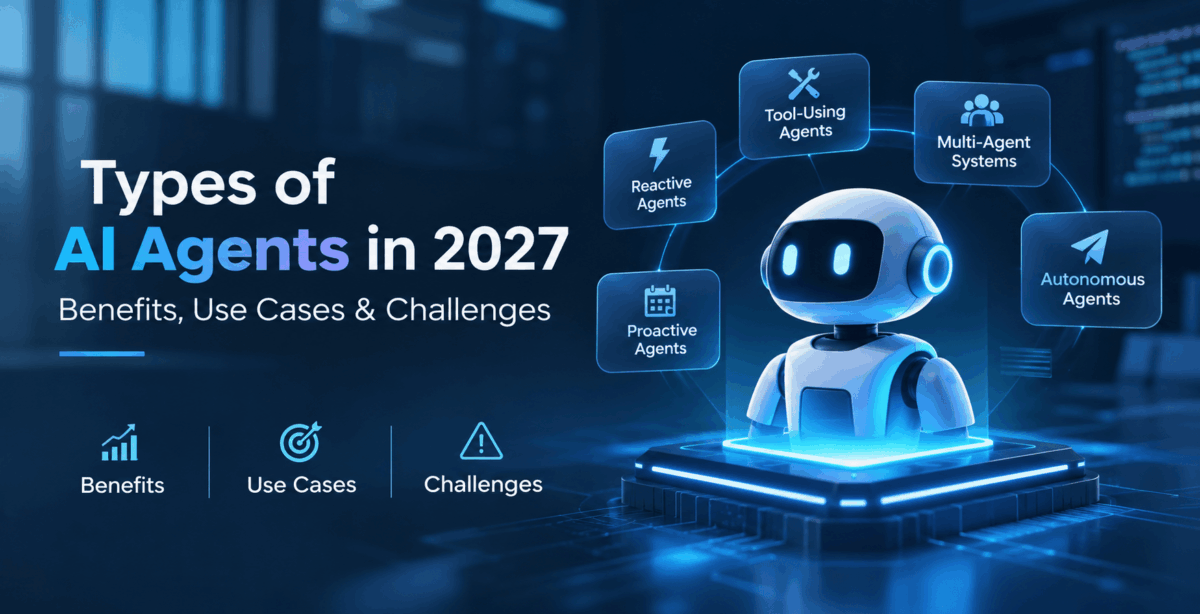
The five commonly taught types of agents in AI are simple reflex, model-based reflex, goal-based, utility-based, and learning agents. Each handles decisions differently. Some react to a condition, others track what has already happened, and others plan toward a goal or compare the trade-offs between possible actions.
For businesses planning automation in 2027, the practical question is how much judgment a workflow needs. A help desk can route an urgent ticket with a fixed rule. Resolving a delivery exception may require checking shipment history, coordinating with a carrier, and weighing the cost of a replacement. Those workflows call for different designs and levels of oversight.
What is an agent in AI?
An agent in AI observes information about its environment, selects an action, and carries it out within defined limits. The environment could be a support queue, a warehouse management system, or a set of business applications. Depending on its design, the agent may use rules, track state, plan actions, evaluate options, or learn from feedback.
A language model can help an agent interpret a request or work with tools. The workflow still needs clear rules about what the agent can read, change, and escalate.
Five types of agents in AI at a glance
| Agent type | How it decides | Example use case | Main benefit | Main challenge |
| Simple reflex | Matches the current input to a rule | Routes urgent support tickets | Consistent, easy-to-audit actions | Misses context outside the current input |
| Model-based reflex | Applies rules using a stored state | Tracks open delivery exceptions | Uses earlier events when deciding what to do | Can act on stale or incomplete state |
| Goal-based | Plans actions that can reach a goal | Finds and books an eligible meeting slot | Can try another path when a step fails | Needs clear completion and stopping rules |
| Utility-based | Scores feasible options against criteria | Selects a fulfillment option | Makes trade-offs explicit | Depends on accurate scores and weights |
| Learning | Improves a decision policy using feedback | Ranks support articles for staff | Can adapt to changing query patterns | Needs reliable feedback and evaluation |
How each type of AI agent works
1. Simple reflex agents
A simple reflex agent matches a current observation to an if-then rule. It uses the information supplied at that moment. This makes it suitable for repeatable decisions when the input is reliable and exceptions are easy to define.
- How it works — Read the current ticket fields, check the priority flag, and apply the matching routing rule.
- Use case — Send tickets tagged as service outages to the incident queue and leave routine requests in standard support.
- Benefit — Staff can trace each routing decision to a rule.
- Challenge — A missing or incorrect priority flag can send an urgent ticket to the wrong queue.
2. Model-based reflex agents
A model-based reflex agent maintains an internal view of the environment. It updates that state as new observations arrive and applies rules to the updated picture. This is useful when the latest event alone gives an incomplete view.
- How it works — Read the latest carrier scan, update the order status, and check when the customer last received a notice.
- Use case — Flag a delayed shipment for follow-up and suppress duplicate messages while the issue remains open.
- Benefit — The agent can distinguish a new exception from one the support team is already handling.
- Challenge — Late carrier updates can leave the stored status out of sync. Flag stale records for review.
3. Goal-based agents
A goal-based agent chooses actions based on a defined outcome. It can evaluate possible steps and revise its plan when a dependency changes. The goal should specify what completion looks like and when the agent must stop or escalate.
- How it works — Read scheduling constraints, find viable slots, recheck availability, and book an eligible slot after the required confirmation.
- Use case — Schedule a customer onboarding call across time zones, with a fallback if a participant becomes unavailable.
- Benefit — The agent can find another route to completion when the initial plan fails.
- Challenge — Unclear completion rules can lead to unnecessary retries, so set a retry limit and a handoff condition.
4. Utility-based agents
A utility-based agent evaluates options using a score that represents business preferences. It first checks which actions meet hard requirements, then compares the eligible choices. Teams can inspect the scoring criteria to understand why one option ranked higher.
- How it works — Filter carriers by delivery deadline and package requirements, then score eligible services by cost, expected arrival, and reliability.
- Use case — Select a shipping service for an order that could be fulfilled through several carriers.
- Benefit — Operations teams can adjust how the agent weighs cost against delivery performance.
- Challenge — Stale rates or poorly calibrated weights can distort the ranking. Review choices against actual fulfillment outcomes.
5. Learning agents
A learning agent improves some part of its decision process using feedback. It can use historical outcomes to update a ranking model or policy. Learning can be done offline, with changes evaluated and approved before deployment.
- How it works — Record which suggested support articles helped resolve tickets, update the ranker, and evaluate it on separate cases before rollout.
- Use case — Suggest knowledge-base articles to support staff as product issues and customer questions change.
- Benefit — Recommendations can improve as the team collects relevant feedback.
- Challenge — Clicks can reward prominent articles even when they solve few cases. Include resolution outcomes in the evaluation.
What are the benefits of AI agents for businesses?
The benefits of AI agents depend on the work they take on and how teams measure the results. For routing, compare time to assignment and misrouting rates. For scheduling, measure successful bookings and manual interventions. For fulfillment, track delivery performance alongside cost so savings do not hide missed commitments.
- Faster handling of repeatable tasks through rules that apply consistently across a queue.
- Better use of operational context when decisions depend on prior events or actions.
- Clearer trade-offs when teams can review how competing options were evaluated.
- More relevant recommendations when feedback captures whether the task was resolved.
Deployment challenges to plan for in 2027
| Challenge | What to do |
| Incomplete or stale data | Check data freshness and route uncertain cases to a person. |
| Actions that exceed business permissions | Limit tool access by role and require approval for actions that affect customers, spending, or records. |
| Unreliable tool responses | Validate outputs, cap retries, and check whether an action already succeeded before attempting it again. |
| Weak evaluation | Test common cases, edge cases, and failures. Compare results with the current workflow before expanding scope. |
| Rising cost or latency | Track time and cost per resolved task, including tool calls and retries. |
How to choose the right agent for your workflow
Start by describing one use case of AI agents in business terms. Write down what triggers the work, what counts as success, which systems hold the information, and which actions require approval. Then match the workflow to the simplest decision pattern that meets those requirements.
The types of agents in AI describe how decisions are made. A separate design choice is whether one agent or several agents share the work. An onboarding workflow could use one goal-based agent. A larger process might split document checks and scheduling across agents with different permissions. Use the single agent vs multi agent comparison to evaluate that choice.
If you are planning a pilot, bring one workflow, an example of a failed handoff, and the outcome you want to improve. Explore Panth Softech’s AI agent development services to discuss where an agent fits and which decisions should stay with your team.
Frequently asked questions
1. What are the main types of agents in AI?
The five commonly taught types are simple reflex, model-based reflex, goal-based, utility-based, and learning agents. They differ in how they choose actions, from applying rules to tracking state, planning toward an outcome, scoring trade-offs, or improving from feedback.
2. What is a practical use case of AI agents in customer support?
An agent can read a ticket, check its priority and existing case history, then route it to the right team. It can ask for missing details or escalate uncertain cases. Track routing accuracy and time to assignment to see whether the workflow improves.
3. Can AI agents combine multiple decision patterns?
Yes. A fulfillment agent can follow hard rules to exclude ineligible carriers, then use a utility score to rank the remaining options. A separate feedback process can help refine future rankings. Each part should have its own tests and approval rules where needed.