Panth Softech Team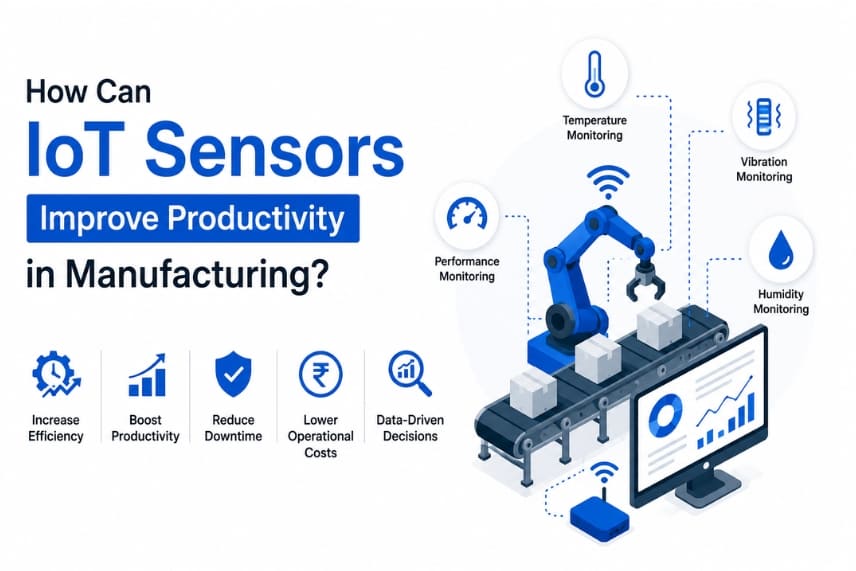
Manufacturing is becoming increasingly connected as businesses look for better ways to improve production efficiency, reduce downtime, and make faster operational decisions. IoT Sensors for Manufacturing play a critical role in this transformation by continuously collecting data from machines, production lines, equipment, and industrial environments. In fact, factories are expected to represent around 26% of the potential economic value created by IoT by 2030, highlighting the growing importance of connected technologies in manufacturing.
By turning machine and process information into real-time, actionable data, IoT Sensors in Manufacturing can help businesses monitor equipment performance, identify production bottlenecks, detect abnormal conditions, and improve maintenance planning. Instead of relying solely on manual inspections or delayed reports, manufacturers can gain continuous visibility into what is happening across their operations.
The real productivity gains come when sensor data is connected with IoT production monitoring, analytics, predictive maintenance, and manufacturing intelligence systems. This enables manufacturers to move from reactive operations toward more proactive and data-driven processes—helping reduce unplanned downtime, improve equipment utilization, optimize production, and make better decisions across the factory floor.
Key Takeaways
- IoT Sensors for Manufacturing provide continuous visibility into machines, processes, and production environments.
- Real-time sensor data helps manufacturers identify equipment problems before they result in costly downtime.
- IoT Production Monitoring improves visibility into machine performance, production output, OEE, and operational bottlenecks.
- Sensor data supports predictive maintenance, quality monitoring, energy optimization, and production efficiency.
- IoT Integration in Manufacturing connects machines and sensor data with ERP, MES, cloud, and analytics platforms.
- Combining IoT with AI, machine learning, and predictive analytics enables manufacturers to move from reactive to proactive decision-making.
- A phased implementation approach can help manufacturers scale connected factory initiatives while controlling costs and complexity.
What Are IoT Sensors for Manufacturing?
IoT Sensors for Manufacturing are connected sensing devices that collect operational information from machines, equipment, production lines, and industrial environments and transmit that data to an IoT platform or connected software system.
Unlike traditional sensors that may simply display or record a measurement, IoT-enabled sensors can transmit data through connected networks for centralized monitoring, analysis, and automation.
For example, a vibration sensor installed on an industrial motor can continuously monitor vibration patterns. If the vibration increases beyond an expected threshold, the system can alert maintenance teams or trigger a predictive analytics model to identify a potential equipment failure.
This creates a continuous data flow that can support:
- Equipment performance monitoring
- Production monitoring
- Predictive maintenance
- Quality control
- Energy management
- OEE monitoring
- Manufacturing data analytics
- Process optimization
How IoT Sensors Work in a Manufacturing Environment
A typical connected manufacturing environment follows this flow:
Machine → IoT Sensor → Gateway/Network → IoT Platform → Data Processing → Analytics/Dashboard → Business Action
Sensors collect operational data, gateways or networks transmit it, and analytics platforms convert the information into actionable insights.
This architecture enables manufacturers to move beyond simply collecting data toward using sensor data analytics to improve production performance.
Types of IoT Sensors Used in Manufacturing
Different manufacturing processes require different types of sensors. The appropriate sensor depends on the machine, production environment, operational objective, and type of information required.
Temperature Sensors
Temperature sensors monitor motors, machinery, furnaces, production environments, and other assets where temperature changes can indicate abnormal conditions.
They can help identify overheating and other conditions that may eventually cause equipment failure.
Vibration Sensors
Vibration sensors are widely used for machine condition monitoring. Changes in vibration patterns can indicate problems such as bearing wear, imbalance, misalignment, or mechanical deterioration.
This makes vibration monitoring particularly useful for predictive maintenance.
Pressure Sensors
Pressure sensors monitor hydraulic, pneumatic, and process systems. Abnormal pressure levels can indicate leaks, blockages, equipment problems, or process deviations.
Proximity & Position Sensors
These sensors detect the presence, position, or movement of components and machinery. They are particularly useful for automated production lines and manufacturing processes.
Current & Energy Sensors
Current and energy sensors measure electricity consumption and equipment power usage. Manufacturers can use this information to identify inefficient machines, abnormal energy consumption, and opportunities for optimization.
Humidity & Environmental Sensors
Humidity and environmental sensors are useful in manufacturing environments where temperature, humidity, air quality, or other environmental conditions can affect equipment performance or product quality.
Together, these Smart Factory Sensors create a connected environment where manufacturers can continuously monitor physical operations and convert them into measurable digital data.
How IoT Sensors Digitize Manufacturing Operations
The adoption of Industrial IoT is transforming traditional manufacturing environments by connecting physical equipment with digital platforms and analytics systems.
From Manual Data Collection to Automated Data Capture
Instead of depending on employees to manually record machine readings, connected sensors automatically capture operational information at defined intervals or in real time.
This reduces manual effort while improving data availability and consistency.
From Periodic Reporting to Real-Time Monitoring
Traditional production reports may only show what happened several hours ago or at the end of a shift. Real-Time Manufacturing Monitoring provides continuous visibility into machine conditions, production output, downtime, and operational performance.
From Reactive to Predictive Maintenance
Traditional maintenance often responds after equipment fails. IoT-enabled monitoring allows manufacturers to analyze equipment behavior and identify early warning signals before a failure occurs.
This supports a transition from:
Reactive Maintenance → Condition Monitoring → Predictive Maintenance
From Isolated Machines to a Connected Factory
IoT connects machines, production systems, sensors, software, and business platforms into a unified digital environment.
This creates a Connected Factory where operational data can move across production, maintenance, quality, supply chain, and management functions.
How IoT Sensors Improve Manufacturing Productivity
The primary value of IoT sensors comes from what manufacturers do with the data they generate. When sensor information is connected to analytics, dashboards, alerts, and intelligent systems, businesses can identify inefficiencies and take action faster.
1. Reduce Machine Downtime
Continuous equipment monitoring helps manufacturers identify abnormal operating conditions before they result in major equipment failures.
Monitoring vibration, temperature, pressure, current, and other parameters can provide early indicators of machine problems.
This supports Machine Downtime Reduction by allowing maintenance teams to intervene before failures stop production.
2. Enable Predictive Maintenance
IoT sensor data provides the foundation for predictive maintenance. Historical and real-time equipment information can be analyzed to identify patterns associated with potential failures.
Instead of maintaining every machine on a fixed schedule, manufacturers can prioritize maintenance based on actual equipment condition.
Benefits include:
- Reduced unplanned downtime
- Lower maintenance costs
- Improved equipment reliability
- Longer asset lifespan
- Better maintenance scheduling
3. Improve Production Monitoring
IoT Production Monitoring gives production managers real-time visibility into machine status, production cycles, output, downtime, and operational performance.
Instead of waiting for manual reports, teams can identify production issues as they happen and respond more quickly.
Manufacturers can monitor:
- Machine status
- Production output
- Cycle time
- Downtime
- Throughput
- OEE
- Production targets
4. Improve Overall Equipment Effectiveness
Overall Equipment Effectiveness measures three major components:
Availability + Performance + Quality
IoT sensors can continuously provide the machine and process data required for OEE Monitoring.
Manufacturers can identify whether production losses are caused by machine availability, reduced performance, quality problems, or other operational factors.
5. Identify Production Bottlenecks
Manufacturing bottlenecks can reduce throughput and cause machines or workers to remain idle.
Connected sensors help organizations understand how equipment and processes perform throughout the production line. By analyzing production data, manufacturers can identify where delays occur and optimize workflows accordingly.
6. Improve Product Quality
IoT-enabled manufacturing can continuously monitor production conditions and identify deviations that could affect product quality.
For example, temperature, pressure, vibration, humidity, or machine settings can be monitored to detect abnormal conditions before they result in large volumes of defective products.
This can reduce:
- Scrap
- Rework
- Production defects
- Quality-related downtime
7. Optimize Energy Consumption
Connected energy sensors provide visibility into machine-level power consumption.
Manufacturers can identify equipment that consumes excessive energy, compare consumption across production lines, and detect abnormal usage patterns.
This supports both Production Efficiency and sustainability initiatives by helping organizations optimize energy-intensive operations.
8. Support Faster Data-Driven Decisions
Sensor data becomes significantly more valuable when combined with manufacturing dashboards, analytics, AI, and machine learning.
Production managers can move from assumptions and delayed reports toward real-time, evidence-based decisions.
This creates a progression from:
Data Collection → Monitoring → Analytics → Prediction → Optimization
IoT Integration in Manufacturing: From Sensors to Business Insights
Sensors are only one part of a connected manufacturing ecosystem. To generate meaningful business value, sensor data must be integrated with other operational and enterprise systems.
IoT Integration in Manufacturing enables organizations to connect physical assets with applications such as MES, ERP, cloud platforms, data warehouses, analytics tools, and Business Intelligence systems.
Integrating IoT Sensors with Existing Machines
Many manufacturers operate a combination of modern and legacy equipment. IoT solutions can use appropriate sensors, gateways, and connectivity technologies to collect data from machines that were not originally designed for connected operations.
This allows manufacturers to modernize existing infrastructure without necessarily replacing every machine.
Connecting IoT Data with ERP and MES
Integration with ERP and MES systems creates a more complete view of manufacturing operations.
For example, machine data can be combined with:
- Production orders
- Inventory information
- Maintenance schedules
- Quality records
- Workforce information
- Production targets
This enables organizations to connect shop-floor performance with broader business processes.
Connecting Sensor Data with Cloud Analytics
Cloud platforms can provide scalable infrastructure for storing, processing, and analyzing large volumes of sensor data.
Manufacturers can use cloud analytics to monitor operations across multiple production facilities while creating centralized reporting and analytics environments.
Using Sensor Data for Manufacturing Intelligence
When sensor information is combined with operational and business data, manufacturers can create Manufacturing Intelligence systems that provide deeper insights into production performance.
This is where IoT moves beyond simple monitoring and becomes a strategic data source for operational optimization.
Benefits of IoT Sensors in Manufacturing
The Benefits of IoT Sensors in Manufacturing extend across production, maintenance, quality, energy management, and decision-making.
Reduced Downtime
Continuous equipment monitoring helps identify potential problems earlier and enables proactive maintenance.
Higher Production Efficiency
Real-time visibility into machine and process performance helps manufacturers identify inefficiencies and improve throughput.
Predictive Maintenance
Sensor data enables manufacturers to move from fixed maintenance schedules toward condition-based and predictive maintenance.
Improved Quality
Monitoring production conditions can help detect abnormalities earlier, reducing defects, scrap, and rework.
Real-Time Operational Visibility
Production teams can monitor equipment and production KPIs continuously instead of relying on delayed manual reports.
Better Resource Utilization
Manufacturers can optimize machine utilization, energy consumption, materials, and workforce resources using real-time operational insights.
Faster Decision-Making
Connected data provides managers with timely information required to respond quickly to production issues and changing conditions.
Real-World Applications of IoT Sensors in Manufacturing
IoT sensors can support multiple manufacturing processes and operational objectives.
Predictive Maintenance
Monitor vibration, temperature, pressure, current, and other machine conditions to identify potential equipment failures.
Production Line Monitoring
Track machine status, production output, cycle times, downtime, and throughput across production lines.
Quality Monitoring
Monitor process conditions to identify deviations that could affect product quality.
Asset Tracking
Use connected sensors and devices to improve visibility into equipment, materials, tools, and assets across manufacturing facilities.
Energy Monitoring
Track machine-level energy consumption and identify opportunities to improve energy efficiency.
Inventory & Material Tracking
Connected technologies can improve the visibility and movement of materials throughout manufacturing and warehouse environments.
Worker & Environmental Safety
Environmental sensors can monitor conditions such as temperature, humidity, air quality, and other parameters relevant to workplace safety and operational compliance.
Challenges of Implementing IoT Sensors in Manufacturing
Although IoT can deliver significant benefits, successful implementation requires careful planning.
Legacy Equipment Integration
Older machines may not provide modern connectivity interfaces. Manufacturers may need gateways, retrofit sensors, or other integration approaches to connect legacy equipment.
Sensor Selection & Placement
Incorrect sensor selection or placement can produce unreliable data. Sensors should be selected based on the equipment, operating environment, measurement requirements, and business objective.
Connectivity & Network Reliability
Manufacturing environments may require reliable connectivity across large facilities, remote equipment, or areas with challenging industrial conditions.
Data Volume & Management
Thousands of connected sensors can generate significant volumes of operational data. Organizations need scalable data pipelines, storage, processing, and analytics infrastructure.
Cybersecurity
Connected machines and devices increase the potential attack surface. Manufacturers should implement appropriate authentication, access controls, network security, monitoring, and data protection practices.
Scalability
A successful pilot involving a small number of machines does not automatically guarantee enterprise-wide scalability. Manufacturers should consider architecture, connectivity, data management, security, and operational requirements before expanding IoT deployments.
Data Quality
Poorly calibrated sensors, missing information, inconsistent formats, and unreliable connectivity can affect the quality of analytics and predictive models.
How to Get Started with IoT Sensors in Manufacturing
Manufacturers don’t need to connect every machine simultaneously. A phased approach can reduce implementation risk and demonstrate measurable business value.
Step 1: Identify Productivity Problems
Start by identifying the operational problems you want to solve.
Examples include:
- High machine downtime
- Poor equipment utilization
- Quality problems
- Excessive energy consumption
- Production bottlenecks
- Inefficient maintenance
Step 2: Identify Machines & Processes to Monitor
Prioritize high-value machines, production lines, or processes where improved visibility can generate measurable business benefits.
Step 3: Select Appropriate Sensors
Choose sensors based on the equipment and specific operational objective. Temperature, vibration, pressure, current, proximity, humidity, and environmental sensors may be appropriate for different applications.
Step 4: Establish IoT Connectivity
Determine how sensor data will reach your IoT platform using suitable gateways, industrial networks, wireless technologies, or other connectivity solutions.
Step 5: Integrate Sensor Data
Connect sensor data with relevant IoT platforms, MES, ERP, cloud systems, data platforms, and analytics applications.
Step 6: Build Monitoring & Analytics
Create dashboards and KPIs that enable production and maintenance teams to monitor operational performance in real time.
Step 7: Add Predictive Analytics
Once sufficient data is available, organizations can introduce machine learning and predictive analytics to identify potential failures, forecast production outcomes, and optimize operations.
The maturity journey can therefore progress from:
Monitoring → Diagnosis → Prediction → Optimization
The Future of IoT Sensors in Manufacturing
The future of Industrial IoT (IIoT) will increasingly involve combining connected sensors with AI, machine learning, edge computing, and advanced analytics.
AI-Powered IoT
AI can analyze large volumes of sensor data to identify patterns, anomalies, and potential operational problems.
Edge AI
Processing data closer to machines can enable faster responses for applications requiring real-time decision-making.
Digital Twins
Digital twins can combine sensor data with virtual representations of physical assets and processes to support simulation, monitoring, and optimization.
Predictive Analytics
Manufacturers can use historical and real-time sensor data to forecast equipment failures, demand, production performance, and other operational outcomes.
Smart Factory Automation
Connected sensors, robotics, AI, and automated systems can work together to create increasingly autonomous and intelligent production environments.
The long-term direction is clear: manufacturers are moving from simply collecting machine data toward creating intelligent systems that can sense, analyze, predict, and optimize operations.
Partner with Panth Softech for IoT-Enabled Manufacturing Solutions
Connected manufacturing starts with more than installing sensors. To generate measurable productivity improvements, manufacturers need the right combination of IoT architecture, connectivity, data engineering, analytics, cloud infrastructure, and intelligent automation.
At Panth Softech, we help businesses design and implement connected manufacturing ecosystems that turn machine and production data into actionable insights. From IoT strategy and sensor integration to real-time analytics, predictive maintenance, and intelligent manufacturing solutions, we help organizations build scalable Industry 4.0 capabilities.
Ready to Turn Manufacturing Sensor Data into Productivity Gains?
Talk to Panth Softech about building an IoT-enabled manufacturing environment that combines real-time monitoring, connected equipment, data analytics, and predictive intelligence to improve productivity and reduce operational inefficiencies.
Explore IoT Solutions for Smarter Manufacturing
Frequently Asked Questions
How does IoT increase productivity in manufacturing?
IoT increases manufacturing productivity by continuously monitoring machines and processes, identifying inefficiencies, reducing downtime, supporting predictive maintenance, improving OEE, and providing real-time data for faster operational decisions.
How is IoT used in manufacturing?
IoT is used for production monitoring, predictive maintenance, equipment performance tracking, quality monitoring, energy management, asset tracking, inventory visibility, and real-time manufacturing analytics.
What types of IoT sensors are used in manufacturing?
Common manufacturing IoT sensors include temperature, vibration, pressure, proximity, position, current, energy, humidity, and environmental sensors. The appropriate sensor depends on the machine, process, and monitoring objective.
How do IoT sensors help reduce manufacturing downtime?
IoT sensors continuously monitor equipment conditions and can identify abnormal temperature, vibration, pressure, or energy patterns. These insights allow maintenance teams to intervene earlier and reduce the likelihood and duration of unexpected equipment failures.
Can IoT sensors support predictive maintenance?
Yes. IoT sensors provide continuous equipment condition data that can be analyzed using machine learning and predictive analytics to identify patterns associated with potential equipment failures.
How are IoT sensors integrated with existing manufacturing systems?
IoT sensors can connect through gateways and industrial networks to IoT platforms, which can then integrate with ERP, MES, cloud platforms, data warehouses, and Business Intelligence systems.
What should manufacturers look for in manufacturing intelligence software with IoT sensor support?
Manufacturers should evaluate real-time data processing, sensor connectivity, ERP/MES integration, dashboard capabilities, scalability, security, alerting, historical analytics, and predictive analytics capabilities when selecting manufacturing intelligence software.
Are IoT sensors suitable for legacy manufacturing equipment?
Yes. Retrofit sensors and IoT gateways can often connect legacy machines that lack modern digital interfaces, allowing manufacturers to improve monitoring and data visibility without replacing entire production systems.