Panth Softech Team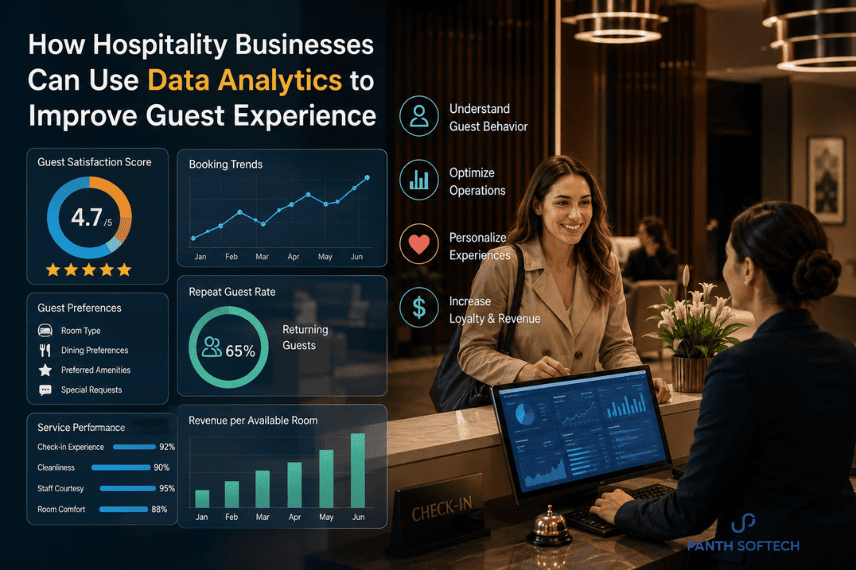
The hospitality industry has evolved beyond offering comfortable accommodations and quality service. Today’s guests expect personalized recommendations, seamless digital experiences, faster responses, and consistent service across every interaction. Meeting these expectations requires more than intuition—it requires intelligent use of data.
Data Analytics for Hospitality enables hotels, resorts, restaurants, and travel businesses to transform operational and customer data into actionable insights. By analyzing booking trends, guest preferences, purchasing behavior, online reviews, and operational performance, hospitality businesses can deliver personalized experiences while improving efficiency and profitability.
Modern Hospitality Data Analytics empowers decision-makers to understand guest expectations, anticipate future demand, optimize pricing strategies, and continuously improve service quality. Combined with modern Data Analytics & Business Intelligence capabilities, organizations can make faster, evidence-based decisions that enhance guest satisfaction and strengthen long-term customer loyalty.
Whether you’re operating a boutique hotel, luxury resort, hospitality chain, or vacation rental business, leveraging analytics has become a competitive necessity rather than a technology advantage.
In this article, we’ll explore how hospitality businesses can use data analytics to improve guest experiences, increase operational efficiency, and build long-lasting customer relationships.
Key Takeaways:
- Data Analytics for Hospitality helps businesses understand guest preferences, optimize operations, and deliver personalized experiences.
- Hospitality Data Analytics transforms booking, operational, and customer data into actionable business insights.
- Guest Experience Analytics enables hotels to improve customer satisfaction, loyalty, and service quality.
- Technologies like Predictive Analytics, Customer Behavior Analytics, and Real-Time Dashboards support smarter operational decisions.
- A strong data strategy helps hospitality businesses increase revenue while creating memorable guest experiences.
What Is Data Analytics in the Hospitality Industry?
Data Analytics for Hospitality is the process of collecting, integrating, analyzing, and interpreting data from multiple hospitality touchpoints to improve guest experiences, operational performance, and business decision-making.
Every guest interaction generates valuable information—from online bookings and mobile check-ins to dining preferences, loyalty programs, website visits, customer reviews, and payment transactions. Hospitality businesses that analyze this information can better understand customer expectations, identify operational trends, and make informed decisions that improve overall service quality.
Unlike traditional reporting, modern Hospitality Data Analytics focuses on transforming raw data into meaningful insights that support personalized guest experiences, revenue optimization, workforce planning, and operational excellence.
By combining data from reservation systems, property management systems (PMS), Hospitality CRM platforms, point-of-sale systems, and digital marketing channels, businesses gain a unified view of the customer journey. This enables hotel managers and hospitality leaders to proactively identify opportunities, resolve service issues faster, and deliver consistent guest experiences across every touchpoint.
As customer expectations continue to evolve, data analytics has become a strategic capability that helps hospitality organizations remain competitive in an increasingly digital marketplace.
Why Data Analytics Matters for Hospitality Businesses
Guest expectations have changed dramatically over the last decade. Travelers no longer compare their experience with just another hotel—they compare it with every personalized digital experience they receive from leading brands across industries.
To meet these expectations, hospitality businesses need more than historical reports. They need real-time visibility into guest behavior, operational performance, and market trends.
This is where Hospitality Business Intelligence becomes a competitive advantage.
Instead of relying on assumptions, hospitality leaders can use data to understand what guests value most, identify operational bottlenecks, and improve every stage of the customer journey.
Deliver Personalized Guest Experiences
Every guest has different preferences, travel habits, and service expectations. By leveraging Customer Behavior Analytics, hospitality businesses can understand booking patterns, preferred room types, dining preferences, seasonal travel trends, and spending behavior.
These insights enable hotels to personalize offers, recommend relevant services, and create memorable guest experiences that increase satisfaction and repeat bookings.
Improve Operational Efficiency
Managing room availability, housekeeping schedules, staffing, inventory, and maintenance becomes significantly easier when supported by reliable analytics.
With Real-Time Dashboards, hospitality managers can monitor occupancy, service requests, operational KPIs, and resource utilization, enabling faster responses and better day-to-day decision-making.
Optimize Revenue Management
Pricing plays a critical role in hospitality profitability.
Using Hotel Data Analytics, organizations can analyze historical bookings, seasonal demand, competitor pricing, cancellation trends, and occupancy forecasts to optimize room rates and maximize revenue without compromising guest satisfaction.
Anticipate Guest Needs
Rather than reacting to customer requests, hospitality businesses can proactively improve experiences using Predictive Analytics.
By identifying booking trends, guest preferences, and behavioral patterns, organizations can anticipate demand, recommend personalized services, forecast occupancy levels, and improve resource planning before issues arise.
Enable Smarter Business Decisions
Successful hospitality organizations rely on Data-Driven Decision Making rather than assumptions or intuition.
From evaluating marketing campaign performance to optimizing staffing levels and expanding service offerings, analytics helps leaders make strategic decisions based on measurable business insights.
Build Long-Term Customer Loyalty
Guest satisfaction doesn’t end at check-out.
Analyzing feedback, loyalty program engagement, review platforms, and repeat booking behavior helps hospitality businesses continuously refine their services and strengthen long-term customer relationships.
Organizations that combine customer insights with scalable Data Engineering Services can create reliable, connected data ecosystems that support personalization, reporting, and future AI initiatives across every guest interaction.
Why Hospitality Businesses Should Invest in Data Analytics Today
The hospitality industry is becoming increasingly competitive, with guests expecting personalized service, digital convenience, and consistent experiences across every interaction.
Businesses that invest in modern Data Analytics for Hospitality gain a significant competitive advantage by understanding customer expectations, improving operational efficiency, increasing profitability, and delivering experiences that encourage guests to return.
Rather than simply collecting data, leading hospitality organizations use analytics to create smarter operations, stronger customer relationships, and sustainable long-term growth.
Types of Hospitality Data Businesses Should Analyze
Every guest interaction generates valuable information that can improve operational efficiency and customer satisfaction. However, the real value lies not in collecting data but in analyzing the right data to uncover actionable insights.
Successful Data Analytics for Hospitality begins with identifying high-value data sources that influence guest experience, operational performance, and business growth.
Booking & Reservation Data
Reservation data provides valuable insights into customer demand, booking channels, travel patterns, seasonal trends, occupancy rates, cancellation behavior, and average booking values.
By analyzing this information, hospitality businesses can:
- Forecast occupancy accurately
- Optimize room pricing
- Identify high-performing booking channels
- Reduce cancellations
- Improve revenue management
This data also supports long-term capacity planning and business forecasting.
Guest Preference & Profile Data
Understanding guest preferences enables businesses to deliver highly personalized experiences.
Important guest information includes:
- Room preferences
- Food and beverage choices
- Preferred amenities
- Travel purpose
- Special requests
- Stay history
- Loyalty status
Personalized experiences based on guest preferences significantly improve satisfaction and increase repeat bookings.
Customer Feedback & Review Data
Guest reviews provide direct insight into service quality and operational performance.
Hospitality businesses should continuously analyze:
- Online reviews
- Customer surveys
- Ratings
- Social media feedback
- Complaint history
- Net Promoter Score (NPS)
Analyzing customer sentiment helps identify recurring service issues, measure guest satisfaction, and prioritize operational improvements.
Website & Digital Engagement Data
A hospitality website is often the first interaction with potential guests.
Monitoring digital engagement metrics such as:
- Website traffic
- Booking conversion rates
- User behavior
- Landing page performance
- Session duration
- Cart abandonment
- Search behavior
helps businesses optimize the online booking experience and improve marketing performance.
Operational Performance Data
Operational data provides visibility into day-to-day business performance.
Examples include:
- Room occupancy
- Housekeeping status
- Maintenance requests
- Staff productivity
- Check-in and check-out times
- Inventory utilization
- Service response times
When monitored consistently, operational metrics help reduce inefficiencies while improving guest satisfaction.
Loyalty & Marketing Data
Customer retention is just as important as acquiring new guests.
Hospitality businesses should analyze:
- Loyalty program participation
- Repeat bookings
- Campaign performance
- Email engagement
- Promotional offers
- Customer lifetime value
These insights help improve customer retention strategies while maximizing marketing ROI.
How Hospitality Businesses Can Use Data Analytics to Improve Guest Experience
Collecting hospitality data is only the first step. The real competitive advantage comes from transforming that information into meaningful actions that improve every stage of the guest journey.
From booking to post-stay engagement, Data Analytics for Hospitality enables businesses to understand guest expectations, personalize experiences, and continuously improve service quality.
Deliver Personalized Guest Experiences
Modern travelers expect personalized experiences rather than one-size-fits-all services.
Using guest booking history, spending patterns, preferred amenities, and loyalty data, businesses can recommend relevant room upgrades, dining experiences, spa packages, and promotional offers tailored to individual guests.
Personalization increases guest satisfaction while encouraging repeat visits.
Optimize Revenue Management
Pricing decisions directly impact profitability.
Using Hotel Data Analytics, hospitality businesses can analyze occupancy trends, competitor pricing, seasonal demand, booking windows, and cancellation patterns to implement dynamic pricing strategies that maximize revenue throughout the year.
Instead of relying on fixed pricing models, businesses can respond to market demand in real time.
Improve Guest Communication
Effective communication plays a vital role throughout the guest journey.
Analytics helps identify:
- Preferred communication channels
- Booking reminders
- Pre-arrival messaging
- Personalized promotions
- Check-in notifications
- Post-stay follow-ups
Delivering timely and relevant communication improves customer engagement while strengthening brand loyalty.
Reduce Service Delays
Long wait times negatively affect guest experiences.
By analyzing operational performance and staffing trends through Real-Time Dashboards, hospitality managers can identify service bottlenecks, optimize workforce allocation, and respond quickly to maintenance requests, housekeeping schedules, and customer inquiries.
This leads to faster service delivery and improved operational efficiency.
Forecast Demand More Accurately
Demand fluctuates due to holidays, events, weather conditions, and seasonal travel.
Using Predictive Analytics, hospitality businesses can forecast occupancy, staffing requirements, inventory demand, and pricing strategies with greater accuracy.
Accurate forecasting reduces operational costs while improving resource utilization.
Improve Marketing Performance
Marketing becomes significantly more effective when supported by analytics.
By understanding customer demographics, booking behavior, campaign performance, and guest preferences, businesses can create targeted campaigns that attract the right audience while increasing booking conversions.
This also helps reduce marketing spend on low-performing channels.
Strengthen Customer Loyalty
Retaining existing guests is often more cost-effective than acquiring new ones.
Analytics enables hospitality businesses to identify:
- Frequent visitors
- High-value customers
- Loyalty program engagement
- Guest satisfaction trends
- Repeat booking opportunities
Using these insights, businesses can design personalized loyalty programs that improve long-term customer retention.
Support Smarter Business Decisions
Hospitality leaders manage hundreds of operational decisions every day.
By combining reservation systems, financial data, marketing insights, operational metrics, and guest feedback through Data-Driven Decision Making, executives gain a complete view of business performance.
This enables faster decisions, better planning, and continuous service improvements across every department.
Hospitality Data Analytics Use Cases
Modern hospitality businesses are leveraging analytics far beyond traditional reporting. From luxury hotels to restaurant chains and vacation rentals, data-driven insights are helping organizations deliver exceptional guest experiences while improving operational efficiency.
Hotels & Resorts
Hotels use analytics to optimize occupancy, personalize guest services, forecast demand, automate pricing strategies, and improve customer satisfaction through continuous performance monitoring.
Restaurants & Food Services
Restaurant businesses analyze customer ordering patterns, peak dining hours, menu preferences, inventory consumption, and customer feedback to improve service quality while reducing food waste.
Vacation Rentals
Property managers use analytics to monitor booking performance, pricing trends, occupancy rates, maintenance schedules, and guest reviews to maximize rental profitability.
Event & Convention Centers
Event venues analyze attendee registrations, event participation, resource utilization, catering demand, and customer feedback to improve event planning and operational efficiency.
Travel & Tourism Companies
Travel agencies and tourism operators leverage analytics to understand traveler behavior, personalize travel packages, optimize marketing campaigns, and improve customer engagement throughout the travel lifecycle.
Multi-Property Hospitality Groups
Hospitality chains consolidate operational and guest data across multiple locations to monitor performance, standardize service quality, optimize staffing, and support enterprise-wide reporting.
Organizations managing data across multiple properties often rely on Cloud Data Engineering Services and Data Integration & Orchestration to unify operational data, automate workflows, and create centralized analytics platforms capable of supporting enterprise-scale hospitality operations.
Benefits of Data Analytics in the Hospitality Industry
Hospitality businesses generate vast amounts of operational and customer data every day. When analyzed effectively, this data becomes a strategic asset that improves guest experiences, streamlines operations, and supports sustainable business growth.
Here are the key benefits of implementing Data Analytics for Hospitality.
Deliver Highly Personalized Guest Experiences
Modern travelers expect personalized recommendations, seamless services, and memorable experiences. By analyzing guest preferences, booking history, spending habits, and engagement patterns, hospitality businesses can tailor services, promotions, and experiences that increase customer satisfaction and loyalty.
Improve Operational Efficiency
Analytics provides visibility into occupancy trends, staffing requirements, housekeeping schedules, inventory management, and maintenance activities. This enables hospitality managers to allocate resources more effectively, reduce operational bottlenecks, and improve overall service delivery.
Optimize Revenue & Profitability
Using historical and real-time business data, organizations can optimize room pricing, promotional campaigns, occupancy management, and resource utilization. Better forecasting helps maximize revenue while reducing unnecessary operational costs.
Enable Faster Business Decisions
Hospitality leaders no longer need to rely on assumptions. Analytics provides accurate, real-time business insights that help managers respond quickly to operational issues, customer expectations, and changing market conditions.
Increase Customer Retention
Understanding guest behavior allows businesses to create personalized loyalty programs, targeted marketing campaigns, and proactive customer engagement strategies that encourage repeat bookings and strengthen long-term customer relationships.
Prepare for Future Growth
As hospitality businesses expand, analytics provides the visibility needed to identify new business opportunities, improve operational scalability, and support strategic planning through reliable business insights.
Challenges of Implementing Hospitality Data Analytics
Although analytics provides significant business value, implementing a successful hospitality analytics strategy comes with several operational and technical challenges.
Data Silos Across Multiple Systems
Hotels often manage separate systems for reservations, CRM, billing, housekeeping, POS, and marketing. When these systems operate independently, obtaining a unified view of guest data becomes difficult.
Poor Data Quality
Duplicate records, missing customer information, inconsistent formats, and outdated data reduce reporting accuracy and negatively impact decision-making. Maintaining clean and standardized data is essential for reliable analytics.
Legacy Technology Infrastructure
Many hospitality organizations still rely on legacy software that lacks integration capabilities. Modernizing these systems requires careful planning to avoid operational disruptions.
Data Privacy & Security
Hospitality businesses handle sensitive guest information, including personal details and payment data. Strong security policies, encryption, access controls, and regulatory compliance are essential to protect customer information.
Limited Analytics Expertise
Collecting data alone does not create business value. Organizations often struggle to convert raw data into meaningful insights without the right analytics strategy, skilled resources, and modern technology platforms.
Change Management
Adopting data-driven processes often requires cultural and operational changes. Training employees, establishing governance, and encouraging data-driven decision-making are critical for long-term success.
Future Trends in Hospitality Data Analytics
Hospitality technology continues to evolve rapidly, with analytics becoming a central component of digital transformation initiatives.
Several emerging trends are shaping the future of Hospitality Data Analytics.
Artificial Intelligence-Powered Personalization
AI is enabling hospitality businesses to deliver personalized recommendations, automate customer interactions, predict guest preferences, and improve service quality through intelligent decision-making.
Predictive Guest Experience Management
Organizations are increasingly using predictive models to forecast guest behavior, anticipate service requests, identify potential issues, and optimize operational planning before challenges occur.
Real-Time Operational Intelligence
Access to live operational data allows hotel managers to monitor occupancy, housekeeping, maintenance, staffing, and customer service metrics instantly, enabling faster responses and improved guest satisfaction.
Smart Hospitality Ecosystems
Connected devices, IoT sensors, and cloud platforms are creating intelligent hospitality environments capable of automating room controls, maintenance alerts, energy management, and personalized guest experiences.
Unified Enterprise Data Platforms
Hospitality businesses are moving away from isolated systems toward centralized data platforms that integrate operational, financial, marketing, and customer information into a single source of truth for enterprise-wide analytics.
How Panth Softech Helps Hospitality Businesses Become Data-Driven
Delivering exceptional guest experiences requires more than collecting data—it requires transforming that data into actionable business intelligence.
At Panth Softech, we help hospitality organizations build intelligent, scalable, and secure analytics platforms that connect data from reservation systems, CRM platforms, property management systems, marketing channels, and operational applications into a unified ecosystem.
Our experts design modern analytics solutions that enable hospitality businesses to understand guest behavior, improve operational efficiency, optimize revenue, and make faster business decisions with confidence.
Whether you’re modernizing legacy infrastructure, building enterprise dashboards, implementing predictive analytics, or preparing for AI-driven hospitality operations, our team delivers technology solutions aligned with your long-term business goals.
Organizations looking to accelerate innovation can also leverage our Artificial Intelligence Services to build intelligent automation, predictive models, and personalized guest experiences powered by enterprise data.
Frequently Asked Questions
1. What is Data Analytics in the hospitality industry?
Data Analytics for Hospitality involves collecting, analyzing, and interpreting guest, operational, and business data to improve customer experiences, optimize operations, increase revenue, and support data-driven decision-making across hospitality businesses.
2. How does Data Analytics improve guest experience?
Data analytics helps hospitality businesses understand guest preferences, personalize services, optimize communication, improve response times, and anticipate customer needs using historical and real-time business insights.
3. What types of data are analyzed in the hospitality industry?
Hospitality businesses analyze booking data, guest preferences, CRM records, operational metrics, customer feedback, loyalty program data, website analytics, financial information, and marketing performance to improve decision-making.
4. Why is Predictive Analytics important for hospitality businesses?
Predictive Analytics enables hospitality organizations to forecast occupancy, anticipate guest demand, optimize pricing strategies, improve staffing decisions, and deliver personalized experiences before customer needs arise.
5. What are the biggest challenges in Hospitality Data Analytics?
Common challenges include fragmented data sources, poor data quality, legacy systems, data privacy concerns, integration complexity, limited analytics expertise, and ensuring consistent data governance across multiple business applications.
6. How can hospitality businesses get started with Data Analytics?
Organizations should begin by identifying business objectives, integrating critical data sources, improving data quality, implementing analytics dashboards, and establishing a scalable analytics strategy that supports long-term business growth.
Final Thoughts
The hospitality industry is becoming increasingly customer-centric, and data has become one of its most valuable business assets. Organizations that leverage Data Analytics for Hospitality can better understand guest expectations, optimize daily operations, improve profitability, and create personalized experiences that drive long-term loyalty.
Rather than relying on intuition, modern hospitality businesses are embracing analytics to make faster, smarter, and more informed decisions across every stage of the guest journey. As technologies such as AI, predictive analytics, and cloud platforms continue to evolve, organizations with a strong data foundation will be better positioned to adapt, innovate, and remain competitive.
Ready to Transform Guest Experience with Data Analytics?
Whether you’re looking to unify hospitality data, improve operational visibility, implement predictive analytics, or build enterprise reporting solutions, Panth Softech helps hospitality businesses unlock the full value of their data.
Talk to Our Data Analytics Experts Today